
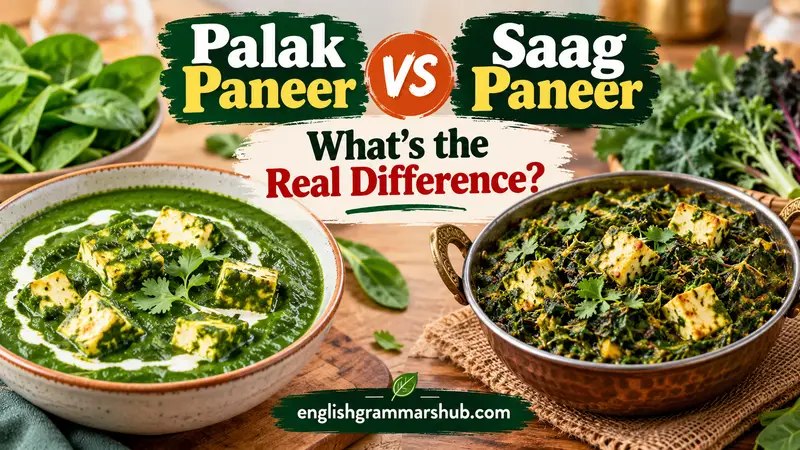
Palak paneer vs saag paneer is a common food comparison because both Indian dishes feature soft cheese cubes in a flavorful green sauce. They look similar, share many spices, and often appear on the same restaurant menus. However, the greens used to prepare them create an important difference.
Palak paneer is made primarily with spinach, while saag paneer can contain different leafy greens, including spinach, mustard greens, and fenugreek leaves.
This distinction affects their flavor, appearance, and sometimes their texture. Palak paneer generally tastes mild and has a smooth consistency. Saag paneer can offer a stronger, earthier flavor, especially when mustard greens are included.
Understanding these differences can help you choose the right dish at an Indian restaurant or prepare a version that matches your taste at home.
Quick Answer
The main difference between palak paneer and saag paneer is the type of leafy greens used. Palak paneer features spinach as its main green ingredient, creating a mild, often smooth curry. Saag paneer uses a broader range of greens, sometimes combining spinach with mustard greens or fenugreek leaves for a stronger flavor.
Both dishes contain paneer, a fresh Indian cheese that holds its shape during cooking. Their seasonings and cooking methods can be similar, and some restaurant recipes use the names interchangeably.
Palak Paneer vs Saag Paneer: Key Differences at a Glance
The following table shows how these two popular Indian dishes typically compare.
| Feature | Palak Paneer | Saag Paneer |
| Main greens | Spinach | Spinach, mustard greens, or other leafy greens |
| Flavor | Mild, slightly sweet, earthy | Often stronger, peppery, or mildly bitter |
| Texture | Usually smooth and creamy | Smooth or slightly coarse |
| Color | Often bright green | May be darker or olive green |
| Main protein | Paneer cheese | Paneer cheese |
| Common spices | Cumin, coriander, garam masala | Cumin, coriander, garam masala |
| Cooking approach | Spinach is often blended | Greens may be blended or mashed |
| Creaminess | Often creamy | Varies by recipe |
| Best for | People who prefer mild spinach flavors | People who enjoy richer leafy-green flavors |
| Bread pairing | Naan, roti, or paratha | Roti, naan, or paratha |
These differences are common patterns rather than strict rules. The final taste and texture depend on which greens, spices, and dairy ingredients a cook chooses.
What Is Palak Paneer?
Palak paneer is a North Indian vegetarian dish featuring paneer cubes in a spinach-based gravy. The Hindi word palak means spinach, making the main vegetable clear from the name.
The dish typically combines cooked spinach with aromatic ingredients such as ginger, garlic, onions, and spices. The greens are often blended to create a smooth sauce before the paneer is added.
Some recipes include tomatoes, cream, or butter for additional flavor. Others use fewer ingredients to keep the natural spinach taste noticeable.
Main Ingredients in Palak Paneer
Common ingredients include:
- Fresh or frozen spinach
- Paneer cheese
- Onion and garlic
- Fresh ginger
- Green chilies
- Cumin and coriander
- Garam masala
- Oil, butter, or ghee
- Optional cream or yogurt
Spinach remains the defining ingredient. Adding a small amount of fenugreek for seasoning does not necessarily turn the dish into a mixed-greens saag.
What Does Palak Paneer Taste Like?
Palak paneer usually has a mild, earthy flavor with a creamy finish.
Spinach provides a gentle vegetable taste, while spices add warmth and depth. The paneer itself is mild, so it absorbs some flavor from the surrounding sauce.
The result is often comforting rather than intensely spicy.
Restaurants may offer versions with more chili, stronger garlic, or additional cream. Therefore, two servings of palak paneer can taste noticeably different even though both use spinach.
What Is Saag Paneer?
Saag paneer is a dish made with paneer and a leafy-green gravy. Unlike palak, which specifically means spinach, saag is a broader term for cooked leafy greens.
Depending on the recipe, saag paneer may contain several vegetables or only one kind of green.
Common choices include mustard greens, spinach, fenugreek leaves, and other locally available greens.
Mustard greens are especially important in Punjabi cooking, where sarson ka saag is a well-known dish. However, traditional sarson ka saag does not necessarily contain paneer.
Main Ingredients in Saag Paneer
A typical mixed-greens version may contain:
- Mustard greens
- Spinach
- Fenugreek leaves
- Paneer cheese
- Onion and garlic
- Ginger
- Green chilies
- Cumin and coriander
- Garam masala
- Ghee or vegetable oil
Some recipes also include tomatoes, butter, cream, or cashews.
There is no single required combination of greens for every dish called saag paneer.
What Does Saag Paneer Taste Like?
Saag paneer can have a more complex flavor than spinach-only palak paneer.
Mustard greens introduce peppery notes, while fenugreek leaves may add a slightly bitter and aromatic quality. Spinach can balance these stronger flavors.
When prepared with a combination of greens, the finished dish may taste heartier and more intensely earthy.
However, a saag paneer recipe made mainly with spinach can taste very similar to palak paneer.
The Biggest Difference: Spinach vs Mixed Greens
The most reliable way to understand palak paneer vs saag paneer is to examine the main vegetables.
Palak Means Spinach
In Hindi, palak refers specifically to spinach.
Therefore, spinach must play the central role in palak paneer. Other ingredients may contribute flavor, but they do not replace spinach as its defining vegetable.
Fresh spinach often produces a lively green sauce when carefully cooked. Frozen spinach works as well, although its moisture content and processing can influence the result.
Saag Refers to Leafy Greens
The term saag covers a wider group of edible leafy vegetables and dishes prepared from them.
Depending on the region and recipe, cooks may use:
- Mustard greens: Peppery, somewhat bitter leaves.
- Spinach: Mild greens that blend easily.
- Fenugreek leaves: Aromatic leaves with a slightly bitter taste.
- Bathua: A traditional leafy vegetable used in parts of South Asia.
- Radish greens: Edible leaves with a more pronounced flavor.
Kale, collard greens, and Swiss chard can also serve as practical substitutes in American kitchens.
The key distinction is that palak specifies spinach, while saag allows a wider choice of greens.
Flavor Differences Between Palak Paneer and Saag Paneer
Flavor often becomes the deciding factor when choosing between these dishes.
Palak Paneer Has a Gentler Flavor
Palak paneer commonly tastes mild because spinach has a relatively soft flavor when cooked.
Cream or butter can make the dish richer, while onions and garlic provide savory depth.
A lightly spiced version is often a good choice for someone trying Indian spinach dishes for the first time.
Still, palak paneer is not automatically mild in terms of chili heat. A cook can make it as spicy as desired.
Saag Paneer Can Taste More Robust
Saag paneer develops its flavor from whichever greens are included.
A recipe containing mustard greens may taste sharper and more peppery. Fenugreek can add a distinctive herbal bitterness.
These ingredients create a layered vegetable flavor that differs from a simple spinach puree.
For example, replacing half the spinach in a palak paneer recipe with mustard greens will usually make the gravy taste stronger.
However, cream, butter, and seasonings can soften those differences.
Texture and Appearance: How Can You Tell Them Apart?
Palak paneer often has a smooth appearance, while mixed-greens saag paneer may have a thicker or more rustic texture.
The difference comes from both the vegetables and the cooking method.
Palak Paneer Texture
Many palak paneer recipes use a blender or food processor to puree cooked spinach.
This produces a consistent sauce that coats the paneer cubes evenly.
The sauce may be thick or pourable depending on how much liquid and dairy the cook adds.
Saag Paneer Texture
Saag paneer sometimes contains more visible pieces of leafy greens.
Some recipes mash or roughly blend the greens instead of making a completely smooth puree.
Mustard greens and other sturdy leaves may also require longer cooking than tender spinach.
Nevertheless, saag paneer can be blended until smooth, and palak paneer can be left slightly coarse.
Does Color Reveal the Difference?
Color provides a clue, but it cannot identify either dish with certainty.
Palak paneer frequently appears bright green, particularly when spinach is cooked briefly and blended.
Saag paneer may appear darker when mustard greens and other leaves are included.
Cooking time, spices, tomato, cream, and the age of the greens all influence color. A darker green curry is not necessarily saag paneer.
Are Palak Paneer and Saag Paneer From the Same Region?
Both dishes are connected to North Indian food traditions, but their names and regional associations are not identical.
Palak paneer is especially familiar in North Indian cooking and is widely served in restaurants both inside and outside India.
Cooked leafy-green dishes are also part of several regional food traditions throughout South Asia.
Punjabi cuisine is particularly associated with mustard-green preparations such as sarson ka saag.
Why Is Saag Paneer Common on American Menus?
Many Indian restaurants in the United States use the term saag paneer for dishes featuring paneer in green vegetable gravy.
Some restaurants prepare it with mixed greens. Others use spinach as the main or only leafy vegetable.
As a result, the names saag paneer and palak paneer sometimes overlap on American menus.
This does not mean that spinach and saag are identical words.
Rather, restaurant naming conventions may be broader than the ingredient-based distinction.
If you want a particular green, asking about the ingredients is more dependable than relying on the menu description.
Cooking Methods: Are They Prepared Differently?
Palak paneer and saag paneer share many cooking techniques.
Both commonly begin with a flavorful base of onions, ginger, garlic, and spices. Cooked greens are then combined with that mixture before paneer is added.
The main difference is how the leafy vegetables are prepared.
How Palak Paneer Is Usually Made
A typical preparation follows these steps:
- Wash the spinach thoroughly.
- Briefly blanch or wilt the leaves.
- Cool the spinach and blend it into a puree.
- Cook onions, ginger, garlic, and spices in oil or ghee.
- Add the spinach puree and adjust the consistency.
- Gently add paneer cubes and heat until warmed through.
- Finish with cream or butter if desired.
Some recipes cook spinach directly with the aromatics instead of blanching it separately.
The goal is to make a flavorful spinach sauce without cooking away all its fresh character.
How Saag Paneer Is Usually Made
A mixed-greens version involves a similar process but may require more cooking time.
First, tougher leaves such as mustard greens are cleaned and chopped.
Next, the greens are cooked until tender. Spinach may be included to balance the stronger flavors.
The cooked leaves are then mashed or blended and combined with spices.
Finally, paneer is added and warmed in the sauce.
A rustic texture is common, but it is not mandatory.
Which Dish Is Healthier: Palak Paneer or Saag Paneer?
Neither dish is automatically healthier. Their nutritional value depends on the vegetables, paneer quantity, cooking fat, cream, and serving size.
Both can contribute leafy vegetables, protein, and important nutrients to a meal.
Nutritional Benefits of Palak Paneer
Spinach provides nutrients such as:
- Vitamin K
- Folate
- Vitamin A precursors
- Iron
- Magnesium
Paneer adds protein and calcium, although the amount varies by product.
Together, spinach and paneer can form a filling vegetarian dish.
However, a restaurant version prepared with generous amounts of cream, butter, or ghee may also contain substantial saturated fat and calories.
Nutritional Benefits of Saag Paneer
Saag paneer can include a wider variety of leafy vegetables.
Mustard greens and spinach provide different combinations of vitamins and minerals.
Using several greens may increase dietary variety, but it does not guarantee that saag paneer contains more nutrients than palak paneer.
The exact nutritional profile depends on the recipe.
Which Has More Calories?
Neither dish has a fixed calorie advantage.
A creamy palak paneer recipe could have more calories than a lightly prepared saag paneer. The opposite is also possible.
For a lighter version of either dish, cooks can use moderate amounts of oil and cream while keeping plenty of vegetables in the recipe.
The healthier choice is usually determined by the complete preparation, not simply by whether the dish is called palak or saag.
Palak Paneer vs Saag Paneer: Which Is Better for Weight Management?
Both dishes can fit into a balanced eating plan when portions and ingredients are appropriate.
Leafy greens add volume and nutrients, while paneer contributes protein.
However, paneer also contains fat, and restaurant preparations may include rich sauces.
For someone managing calorie intake, cooking either dish at home provides greater control over portions and added fats.
A practical approach is to use plenty of greens, a measured amount of paneer, and a moderate quantity of cooking oil.
Pairing the dish with an appropriate portion of rice or bread can help create a satisfying meal.
Neither option should be considered a weight-loss food simply because its sauce contains green vegetables.
Can You Substitute Palak Paneer for Saag Paneer?
Yes. Palak paneer and saag paneer can often replace each other in a meal because they share similar ingredients, textures, and serving styles.
The main difference will usually be the flavor of the greens.
If a recipe calls for saag paneer but you only have spinach, you can make a spinach-based version.
Similarly, adding mustard greens or another leafy vegetable to a palak paneer-style recipe creates a mixed-greens variation.
Easy Substitutions for American Home Cooks
Several vegetables available in US grocery stores can work in a saag-style dish.
| Ingredient | Flavor Contribution | Cooking Tip |
| Spinach | Mild and earthy | Cooks quickly |
| Mustard greens | Peppery and slightly bitter | Cook until tender |
| Kale | Stronger vegetable flavor | Remove tough stems |
| Collard greens | Hearty and slightly earthy | Chop finely and cook longer |
| Swiss chard | Mild to earthy | Separate thick stems from leaves |
For a balanced mixed-greens sauce, try combining spinach with a smaller amount of a stronger-tasting green.
This allows you to explore new flavors without making the dish overly bitter.
Which Dish Is Better for Beginners?
Palak paneer is often the easier starting point for people who are unfamiliar with Indian leafy-green curries.
Its spinach-based sauce usually offers a familiar taste, especially for anyone who already enjoys cooked spinach.
The texture is also frequently smooth and creamy.
Saag paneer may appeal more to people who enjoy mustard greens, collard greens, kale, or other vegetables with stronger flavors.
However, personal preference matters more than the name.
A mild mixed-greens saag paneer can be just as approachable as a spinach-based curry.
Choose Palak Paneer If You Prefer
A dish centered on spinach, with a gentle vegetable flavor and often a smooth consistency.
Choose Saag Paneer If You Prefer
A curry that may include several leafy greens, with a deeper, more peppery or earthy flavor.
For restaurant orders, the most useful question is whether the saag contains spinach alone or a combination of vegetables.
What Should You Serve With Palak Paneer or Saag Paneer?
Both dishes pair well with Indian breads and rice.
Their savory sauces work especially well with foods that can absorb or scoop up the gravy.
Naan
Naan is a soft, often fluffy flatbread that pairs nicely with creamy spinach and mixed-greens sauces.
Garlic naan can add another layer of flavor.
Roti
Roti is a simple flatbread often made with whole wheat flour.
Its mild flavor allows the greens and spices to remain the focus of the meal.
Paratha
Paratha is a layered or pan-cooked flatbread that can be richer than plain roti.
It makes a satisfying accompaniment to either paneer dish.
Basmati Rice
Basmati rice provides a neutral base for the sauce.
It is especially useful when the curry is strongly seasoned or contains plenty of gravy.
Other Side Dishes
Plain yogurt, cucumber raita, or a simple vegetable salad can provide a refreshing contrast.
These sides work with both dishes, so there is no need to create a completely different meal for each one.
Common Misunderstandings About Palak Paneer and Saag Paneer
Several assumptions can cause confusion when comparing these dishes.
Mistake: Saag Paneer Always Contains Mustard Greens
Mustard greens are common in many saag preparations, but they are not required in every recipe called saag paneer.
Some versions use spinach, fenugreek, or other leafy vegetables.
Mistake: Palak Paneer and Saag Paneer Are Always Identical
They can be very similar, especially on restaurant menus.
However, palak refers specifically to spinach, while saag is a broader term.
A saag paneer made with mustard greens will usually taste different from a spinach-only palak paneer.
Mistake: Saag Paneer Is Always Spicier
Saag paneer may have a stronger vegetable flavor, but that does not necessarily mean it contains more chili.
Spice heat depends on the recipe and the amount of chili used.
A hot palak paneer can be much spicier than a mild saag paneer.
Mistake: Both Dishes Must Contain Cream
Neither dish requires heavy cream.
Some cooks use cream, butter, yogurt, or cashews to add richness. Others rely on the blended vegetables for a thick sauce.
Creaminess can come from several ingredients and preparation methods.
How to Remember the Difference Easily
The easiest memory trick is to focus on the names.
Palak = Spinach. Saag = Leafy greens. Paneer = Fresh Indian cheese.
Think of palak as a specific ingredient and saag as a broader category.
For example, imagine reading two descriptions on a restaurant menu.
One says, “Paneer cubes in a smooth spinach gravy.”
The other says, “Paneer cubes cooked with mustard greens and spinach.”
The first clearly describes palak paneer. The second describes a mixed-greens saag paneer.
This simple distinction helps even when the sauces look nearly identical.
FAQs
Is Palak Paneer the Same as Saag Paneer?
Not necessarily. Palak paneer uses spinach as its defining green, while saag paneer may contain spinach, mustard greens, fenugreek leaves, or other leafy vegetables.
Some American restaurants use the names for similar spinach-based dishes. However, a mixed-greens saag paneer can have a different flavor and texture from traditional spinach-based palak paneer.
Which Is Tastier, Palak Paneer or Saag Paneer?
Taste depends on personal preference. Palak paneer usually has a gentler spinach flavor, making it appealing to people who enjoy mild vegetable dishes.
Saag paneer can offer a stronger, more layered taste when prepared with mustard greens or fenugreek leaves. Neither dish is universally better.
Does Saag Paneer Always Have Spinach?
No. Saag refers to leafy greens broadly, so a saag dish does not always require spinach.
However, spinach is commonly included because it has a mild flavor and blends well with stronger greens. Some restaurant versions of saag paneer use spinach as the main ingredient.
Is Palak Paneer Healthier Than Saag Paneer?
Not automatically. Both dishes provide leafy vegetables and paneer, but their nutritional values depend on the complete recipe.
Saag paneer may offer greater vegetable variety, while palak paneer provides spinach-based nutrients. Cream, butter, ghee, paneer quantity, and portion size can influence their calorie and fat content.
Is Saag Paneer a Traditional Indian Dish?
Cooked saag and paneer dishes have strong connections to Indian cuisine, particularly North Indian food traditions.
However, the combined menu name saag paneer is especially familiar in restaurants outside India. In many Indian households, palak paneer and traditional saag preparations are treated as separate dishes.
Can I Make Saag Paneer With Frozen Spinach?
Yes. Frozen spinach can be used in saag-style preparations and is convenient for home cooking.
If spinach is the only green ingredient, the finished dish is more specifically described as palak paneer. Adding other greens, such as kale or mustard greens, creates a mixed-greens version.
Which Is Better With Naan: Palak Paneer or Saag Paneer?
Both work well with naan. Palak paneer’s smooth spinach gravy pairs nicely with soft bread, while saag paneer’s heartier green sauce can provide a stronger vegetable flavor.
Choose the dish according to your preferred taste rather than the bread. Roti, paratha, and basmati rice also complement both preparations.
Conclusion
The main difference between palak paneer and saag paneer comes down to their leafy greens.
Palak paneer is specifically spinach-based, while saag paneer can use a broader selection of greens. This difference can influence flavor, texture, and appearance, although individual recipes often overlap.
Choose palak paneer if you prefer a mild spinach curry with a typically smooth sauce. Try saag paneer if you enjoy stronger vegetable flavors or want to explore combinations of leafy greens.
When ordering from a restaurant, check which greens are used. That simple question is the most reliable way to know what will arrive at your table