
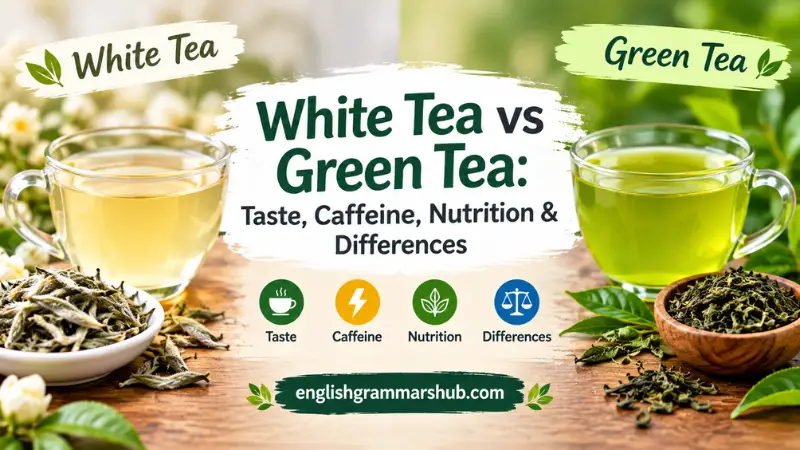
White tea and green tea come from the same plant, Camellia sinensis, but they are made differently. White tea is generally made from young buds and leaves with minimal processing, while green tea is processed to limit oxidation. That difference affects their flavor, appearance, caffeine content, and chemical composition.
White tea tends to have a lighter, softer, more delicate taste. Green tea usually has a stronger vegetal, grassy, or slightly bitter flavor. Both provide caffeine, polyphenols, catechins, and L-theanine, but the exact amounts can vary substantially by tea type, harvest, processing, and brewing method.
So, which should you choose? The answer depends on what matters most to you: taste, caffeine, brewing style, or the type of tea compounds you want.
Quick Answer
White tea vs green tea: White tea is generally less processed and often has a delicate, subtle flavor, while green tea usually has a stronger vegetal taste and a more pronounced character. Both are made from Camellia sinensis and contain caffeine and beneficial plant compounds. Neither has a universal nutritional advantage because composition varies widely among individual teas and brewing methods.
White Tea vs Green Tea at a Glance
| Feature | White Tea | Green Tea |
| Plant | Camellia sinensis | Camellia sinensis |
| Processing | Minimal processing | Heated to limit oxidation |
| Typical color | Pale yellow to light gold | Pale green to yellow-green |
| Taste | Delicate, floral, mild, sometimes sweet | Grassy, vegetal, fresh, sometimes bitter |
| Caffeine | Contains caffeine; amount varies | Contains caffeine; amount varies |
| Catechins | Contains catechins | Rich in catechins |
| L-theanine | Contains L-theanine | Contains L-theanine |
| Typical brewing style | Lower temperature, gentle steeping | Moderate temperature, controlled steeping |
| Best for | People who prefer subtle flavors | People who prefer a stronger tea flavor |
The table describes typical characteristics rather than absolute rules. Tea composition can differ considerably between cultivars, harvests, products, and brewing conditions.
What Is White Tea?
White tea is a type of tea made from the Camellia sinensis plant. It is commonly produced from young buds and leaves and undergoes relatively little processing.
Some famous varieties include Silver Needle and White Peony (Bai Mudan).
The name “white tea” is associated with the fine, pale hairs found on young tea buds. These hairs can give unopened buds a silvery or whitish appearance.
How white tea is made
Although production varies by style, white tea generally involves:
- Harvesting young buds or leaves.
- Withering them.
- Drying them.
- Avoiding the extensive oxidation used for black tea.
Because white tea receives relatively little processing, its flavor can be delicate and its appearance relatively light.
What does white tea taste like?
White tea is often described as:
- Light
- Floral
- Fresh
- Delicate
- Mildly sweet
- Soft
- Slightly fruity
However, not every white tea tastes the same.
A high-quality Silver Needle, for example, can taste quite different from a White Peony or another white-tea style.
What Is Green Tea?
Green tea is also made from Camellia sinensis. Unlike white tea, green tea leaves are generally heated soon after harvesting to limit enzymatic oxidation.
Common green teas include:
- Sencha
- Matcha
- Dragon Well (Longjing)
- Gunpowder
- Gyokuro
Production methods vary by region and tea style.
How green tea is made
A simplified process may involve:
- Harvesting tea leaves.
- Heating the leaves to reduce oxidation.
- Shaping or rolling the leaves.
- Drying them.
The heating step helps preserve many of the compounds associated with fresh tea leaves and gives green tea its characteristic flavor and color.
What does green tea taste like?
Green tea can be:
- Grassy
- Vegetal
- Fresh
- Slightly sweet
- Astringent
- Nutty
- Umami-rich
- Bitter, especially when overbrewed
The exact flavor depends on the variety, growing conditions, processing method, water temperature, and steeping time.
White Tea vs Green Tea: What Is the Main Difference?
The biggest difference is processing.
White tea is generally minimally processed, while green tea undergoes heating that limits oxidation.
This affects the final tea’s flavor, aroma, appearance, and chemical profile.
It is tempting to assume that “less processed” automatically means “healthier,” but that conclusion is too simple. Studies comparing white and green teas have found substantial variation in catechins, caffeine, phenolic compounds, and antioxidant activity among individual samples.
In other words, processing matters, but it is not the only factor that determines what is in your cup.
White Tea vs Green Tea: Taste Difference
If flavor is your main concern, the difference can be easy to notice.
White tea
White tea usually has a softer flavor profile. It may have floral, honey-like, fruity, or delicate notes.
It can be a good choice if you dislike strongly vegetal or bitter teas.
Green tea
Green tea generally has a more recognizable “tea” character. Depending on the variety, it may taste grassy, vegetal, nutty, roasted, or savory.
Some green teas have significant bitterness or astringency, particularly when brewed too hot or for too long.
Which tastes better?
There is no objective winner.
If you prefer light and subtle flavors, white tea may suit you better.
If you prefer fresh, grassy, vegetal, or savory flavors, green tea may be more appealing.
White Tea vs Green Tea: Caffeine
Both white tea and green tea naturally contain caffeine.
However, you should not assume that white tea always has less caffeine.
Caffeine levels can vary substantially depending on:
- Tea variety
- Plant material
- Buds versus mature leaves
- Growing conditions
- Harvest
- Processing
- Amount of tea used
- Water temperature
- Steeping time
- Serving size
Research on commercial teas has found considerable variation in caffeine content, and studies do not consistently show one category always containing less caffeine than the other.
For example, one analysis of brewed commercial teas found white, green, and black teas could all fall within a broad caffeine range. More recent experimental work also demonstrates that brewing time and temperature can substantially affect caffeine extraction.
Does white tea have less caffeine than green tea?
Sometimes, but not reliably.
The common idea that white tea is automatically the lowest-caffeine true tea is misleading.
If caffeine matters to you, check the specific product when possible and pay attention to how you brew it.
White Tea vs Green Tea: Antioxidants
Both white and green tea contain polyphenols, including catechins.
One of the best-known tea catechins is EGCG (epigallocatechin gallate).
Green tea has been particularly well studied for its catechin content. White tea also contains catechins and other phenolic compounds.
However, saying that one tea always contains “more antioxidants” is too broad.
Studies comparing actual tea samples have found substantial differences between products. Some analyses have found higher levels of particular compounds in green tea, while other samples of white tea have shown strong antioxidant activity.
The important point
Tea type alone does not tell you exactly how many antioxidants are in your cup.
Cultivar, harvest, processing, storage, and brewing can all influence the final composition.
White Tea vs Green Tea: Nutrition
Plain white tea and plain green tea are both very low in calories when consumed without added sugar, honey, cream, or milk.
Their main nutritional interest comes from naturally occurring compounds rather than macronutrients.
Both can provide:
- Polyphenols
- Catechins
- Caffeine
- L-theanine
- Other plant compounds
- Small amounts of minerals
The exact amounts vary considerably.
Adding sugar or sweetened flavorings can change the nutritional profile of the drink substantially.
Which is more nutritious?
There is no simple answer.
White tea is not automatically more nutritious simply because it is less processed, and green tea is not automatically superior because it has been studied more extensively.
For everyday drinking, both can fit into a healthy diet when consumed in a suitable form and without excessive added sugar.
White Tea vs Green Tea: Potential Health Benefits
Research has investigated both teas because they contain polyphenols and other bioactive compounds.
Studies have explored possible relationships between tea consumption and areas such as:
- Cardiovascular health
- Metabolic health
- Oxidative stress
- Inflammation
- Brain health
- Weight management
However, laboratory findings and observational studies should not be interpreted as proof that drinking a particular tea prevents or treats a disease.
Human research is also complicated by differences in tea products, amounts consumed, diets, lifestyles, and study designs.
What can you reasonably say?
A practical conclusion is that both white and green tea can provide polyphenols and other naturally occurring compounds as part of a varied diet.
It is better to avoid claims such as “white tea burns fat” or “green tea prevents disease” as guaranteed outcomes.
Which Has More EGCG: White Tea or Green Tea?
Green tea is generally associated with substantial amounts of EGCG, but the exact amount depends on the product.
White tea also contains EGCG and other catechins.
Individual studies have produced different results because researchers may analyze different cultivars, harvests, processing methods, and preparation techniques.
Therefore, it is more accurate to say:
Green tea is a well-known dietary source of EGCG, while white tea also provides catechins, including EGCG. The amount varies by tea.
White Tea vs Green Tea for Weight Loss
Neither tea should be treated as a magic weight-loss drink.
Green tea has been extensively researched in relation to body weight and metabolism, and some studies suggest modest effects under certain conditions. White tea has also been investigated, but the human evidence is less extensive.
Even when an effect is observed, it does not mean drinking tea alone will produce significant weight loss.
For weight management, factors such as overall calorie intake, diet quality, physical activity, sleep, and long-term habits are much more important than choosing between white and green tea.
White Tea vs Green Tea: Which Is Better for Morning?
Either can work in the morning because both contain caffeine.
Choose based on your preferred flavor and caffeine response.
Choose white tea if you want:
- A lighter taste
- A delicate aroma
- A less assertive tea
- A gentle alternative to stronger-tasting teas
Choose green tea if you want:
- A stronger vegetal flavor
- A more distinctive tea character
- A wide variety of styles
- Options such as matcha or sencha
If you are sensitive to caffeine, remember that brewing conditions can change the amount you consume.
White Tea vs Green Tea: Which Is Better for Evening?
If caffeine affects your sleep, neither regular white nor green tea is automatically a caffeine-free evening drink.
Both naturally contain caffeine.
Instead, consider:
- A decaffeinated tea
- A naturally caffeine-free herbal infusion
- A shorter or lighter brew, while recognizing that it may still contain caffeine
Do not assume that white tea is caffeine-free simply because its flavor is mild.
How Brewing Changes White and Green Tea
Brewing can have a major effect on the final cup.
Temperature
Water that is too hot can make some teas taste bitter or astringent.
Steeping time
Longer steeping generally extracts more compounds, including caffeine.
Amount of tea
Using more leaves or tea bags can increase the concentration of compounds in the finished drink.
Water quality
Mineral content and water chemistry can affect flavor and extraction.
This means two cups made from the same tea can taste noticeably different if brewed under different conditions.
Common Mistakes When Comparing White and Green Tea
Mistake 1: “White tea has no caffeine.”
Incorrect. White tea naturally contains caffeine.
Mistake 2: “Less processed means automatically healthier.”
Not necessarily. Processing is only one factor affecting the tea’s chemical composition.
Mistake 3: “Green tea always has more caffeine.”
Not necessarily. Caffeine varies considerably among products and brewing methods.
Mistake 4: “All white tea tastes sweet.”
White tea is often delicate, but flavor varies by variety and preparation.
Mistake 5: “Green tea should always taste bitter.”
A well-brewed green tea can be smooth, sweet, vegetal, nutty, or umami-rich. Excessive bitterness can result from brewing conditions.
Mistake 6: “Antioxidant content determines which tea is best.”
That oversimplifies the choice. Taste, caffeine tolerance, preparation, and personal preference also matter.
White Tea vs Green Tea: Which Should You Choose?
Use this simple decision guide:
Choose white tea if you prefer:
- Delicate flavors
- Floral or subtle aromas
- A lighter-tasting cup
- Minimal processing as a tea-making characteristic
Choose green tea if you prefer:
- Grassy or vegetal flavors
- More variety in tea styles
- Stronger flavor
- Well-known green-tea varieties such as sencha or matcha
If caffeine is your priority: don’t choose based on the tea’s name alone. Check the product and brewing method because caffeine levels can vary widely.
If health is your priority: both provide plant compounds such as catechins and polyphenols. Neither needs to be declared a universal winner.
FAQs
Is white tea healthier than green tea?
Not necessarily. Both contain polyphenols and catechins, and research has investigated their potential health effects. The chemical composition varies among individual teas, so “healthier” is too broad a label to apply universally.
Does white tea have more caffeine than green tea?
It can, but it is not consistently higher or lower. Caffeine depends on the tea variety, plant material, serving size, and brewing conditions. Some studies have found substantial variation even among teas in the same category.
Which tea has more antioxidants?
There is no universal answer. Green and white teas both contain antioxidant compounds, but amounts vary significantly between samples. Green tea is especially well known for its catechin content, including EGCG.
Can I drink white tea instead of green tea?
Yes. Both are teas made from Camellia sinensis. Your choice can depend on flavor, caffeine preference, availability, and how you like to prepare your tea.
Which tastes milder, white tea or green tea?
White tea is generally milder and more delicate. Green tea often has a stronger vegetal or grassy flavor. However, individual varieties can differ considerably.
Is white tea naturally caffeine-free?
No. White tea naturally contains caffeine. If you need to avoid caffeine, look for a caffeine-free beverage or a specifically decaffeinated product.
Which is better for weight loss, white tea or green tea?
Neither should be considered a stand-alone weight-loss solution. Green tea has been studied more extensively for body-weight-related effects, but any potential effects should be considered modest and within the context of an overall diet and lifestyle.
Conclusion
White tea vs green tea is mainly a difference in processing, flavor, and tea style—not a simple question of which one is healthier. White tea is generally delicate and minimally processed, while green tea is typically more vegetal and undergoes heating to limit oxidation.
Both contain caffeine, catechins, polyphenols, and L-theanine, but their amounts can vary substantially from one tea to another.
If you want a light, subtle cup, try white tea. If you prefer a fresh, grassy, or more robust tea flavor, green tea may be a better fit. For caffeine or nutrition, look beyond the tea category and consider the specific product and brewing method.


