
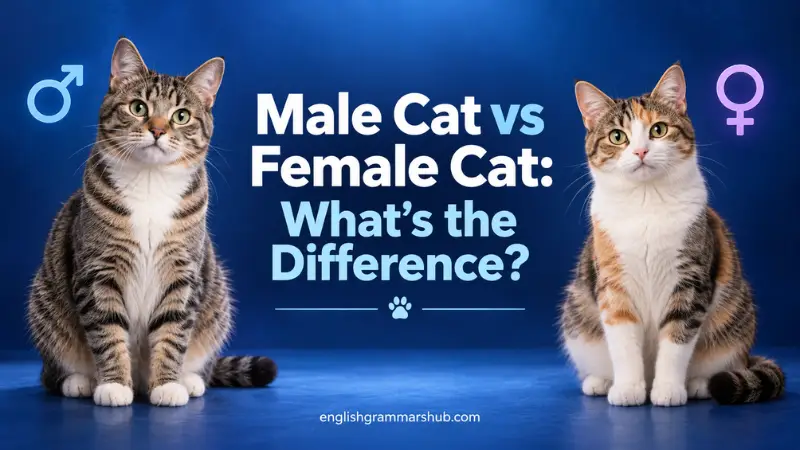
Choosing between a male cat and a female cat can seem like a simple decision, but sex is only one part of a cat’s personality and care needs. Male cats are often somewhat larger, while intact males are more likely to roam, spray, and fight. Female cats can become vocal and restless when they are in heat. After spaying or neutering, many of these hormone-driven differences become much less noticeable.
So, is a male cat or female cat better? There is no universal answer. Personality, early socialization, breed, age, health, environment, and whether the cat is altered can matter more than sex alone.
Quick Answer
Male cats and female cats can both make affectionate, playful, and excellent pets. Male cats tend to be a little larger, while unneutered males are more likely to roam, mark territory, and fight. Unspayed females experience heat cycles that can cause vocalization and restlessness. Spaying or neutering greatly reduces many sex-related behaviors.
Male Cat vs Female Cat: Key Differences
| Feature | Male Cat | Female Cat |
|---|---|---|
| Typical size | Often somewhat larger | Often somewhat smaller |
| Affection | Can be very affectionate | Can be very affectionate |
| Playfulness | Can be highly playful | Can be highly playful |
| Territorial behavior | More noticeable in intact males | Can occur, but hormone-driven territorial behavior is generally less prominent |
| Urine spraying | More common in intact males | Less common, but females can spray too |
| Roaming | More likely when intact | Can roam, especially when seeking a mate |
| Heat cycles | No heat cycle | Unspayed females experience heat cycles |
| Fighting | More common among intact males | Can occur |
| After neutering/spaying | Many hormone-driven behaviors decrease | Heat-related behaviors stop |
The biggest mistake is treating these tendencies as personality rules. Being male does not automatically make a cat aggressive or being female does not automatically make a cat calm. Veterinary sources emphasize that personality is strongly influenced by genetics, early experiences, health, environment, and socialization.
Male Cats Are Often Larger
One physical difference you may notice is size.
Male domestic cats tend to be somewhat larger than females, although individual variation is considerable. Breed, genetics, nutrition, age, and overall health can all affect a cat’s size.
For example, a healthy female from a large breed may easily be bigger than a small male from another breed.
So, sex can provide a general tendency, but it is not a reliable way to predict an individual cat’s adult size.
Male Cat Behavior
The most noticeable behavioral differences usually involve intact males—male cats that have not been neutered.
An intact male may be more likely to:
- Roam in search of females
- Mark territory with urine
- Fight with other males
- Show sexually motivated behaviors
- Develop a larger roaming territory
These behaviors are influenced by male reproductive hormones. Neutering generally reduces behaviors such as spraying, roaming, and some types of aggression.
Example
An unneutered male that suddenly begins spending more time outside, fighting with neighborhood cats, or spraying vertical surfaces may be responding to reproductive and territorial drives.
However, neutering does not magically change every aspect of a cat’s personality. Behaviors that are not primarily hormone-driven, such as anxiety or general hyperactivity, may remain.
Female Cat Behavior
Unspayed female cats have a different hormone-related behavior pattern.
When a female enters heat, she may become:
- More vocal
- Restless
- More interested in finding a mate
- More likely to display mating-related behaviors
Spaying eliminates the heat cycle and prevents pregnancy.
A spayed female, therefore, may show few obvious behavioral differences from a neutered male simply because many reproductive behaviors have been removed.
Are Male Cats More Affectionate?
Not necessarily.
The idea that male cats are always more affectionate is a popular generalization, but sex alone does not determine whether a cat will enjoy cuddling, sitting on your lap, or following you around.
VCA specifically notes that male cats can be just as affectionate as females, while females can be just as playful as males.
A cat’s personality can be influenced by:
- Genetics
- Early socialization
- Experiences with people
- Home environment
- Breed
- Age
- Individual temperament
Example
A friendly, well-socialized female may be a constant lap cat, while a male from the same litter may prefer sitting nearby rather than being held.
The opposite can also happen.
Male Cat vs Female Cat for Spraying
This is one area where the difference can be significant.
Urine spraying is particularly associated with intact male cats. Spraying is a form of scent marking in which a cat deposits a small amount of urine, often on a vertical surface.
Neutering substantially reduces this behavior in many male cats. However, spraying is not exclusively a male behavior. Females can spray too, including some spayed females.
So the more useful distinction is:
Intact male → highest likelihood of hormone-related spraying
rather than:
Male → sprays / Female → never sprays
That second statement is inaccurate.
Do Male Cats Fight More?
Intact males are more likely to engage in fights with other males, particularly because of territorial and mating competition. Cornell notes that male cats can show aggression toward other males as they approach social maturity.
Outdoor access can increase the risks because cats may encounter unfamiliar animals and compete over territory.
Neutering can reduce sexually motivated fighting, roaming, and territorial behaviors, although it does not eliminate every possible cause of aggression.
If a neutered cat suddenly becomes aggressive, don’t assume the behavior is simply a “male cat trait.” Pain, fear, environmental stress, territorial conflict, or another problem can contribute.
Health Differences Between Male and Female Cats
Male and female cats share most basic healthcare needs, including:
- Vaccinations
- Parasite prevention
- Dental care
- Healthy nutrition
- Regular veterinary examinations
- Weight management
- Mental and physical enrichment
However, their reproductive anatomy creates some different health considerations.
Male cats
Male cats have a greater risk of urethral obstruction because their urethra is longer and narrower than a female cat’s. A urinary blockage is a medical emergency.
A male cat that repeatedly strains to urinate, produces little or no urine, cries while attempting to urinate, or appears severely distressed needs immediate veterinary attention.
Female cats
Spaying prevents pregnancy and eliminates the risk of pyometra, a potentially serious infection of the uterus. It also reduces the risk of mammary cancer, particularly when performed early.
For both sexes, preventive veterinary care is more important than assuming that one sex is generally “healthier.”
Spaying and Neutering Change the Comparison
One of the most important points in a male cat vs female cat comparison is whether the cats are altered.
Neutering refers to sterilizing a male cat, generally by removing the testicles.
Spaying refers to sterilizing a female cat by surgically removing the reproductive organs, typically including the ovaries and uterus.
These procedures prevent reproduction and reduce many hormone-driven behaviors.
For example:
- An intact male may roam and spray.
- A neutered male is generally less likely to show these behaviors.
- An unspayed female can enter heat.
- A spayed female no longer experiences heat cycles.
This is why comparing an intact male with an intact female can produce much larger behavioral differences than comparing a neutered male with a spayed female.
Which Is Better for an Indoor Home?
Both can be excellent indoor pets.
If you’re choosing a cat primarily for companionship, don’t make the decision based only on sex.
Instead, consider:
- Personality — Is the cat friendly, confident, shy, energetic, or relaxed?
- Age — Kittens require more supervision and play.
- Socialization — Cats with positive early experiences may adapt more easily to people and environments.
- Health — Look at the individual cat’s medical history.
- Energy level — Match the cat’s activity level to your household.
- Compatibility — Consider existing pets and family members.
- Spay/neuter status — This can substantially affect reproductive behaviors.
A calm, friendly male may be a better match for one household, while a confident female may be a better match for another.
Male Cat vs Female Cat: Personality Myths
Several common beliefs are too broad to be reliable.
Myth: Male cats are always friendlier.
Not true. Individual temperament varies considerably. Male cats can be highly affectionate, but so can females.
Myth: Female cats are always independent.
Not true. Some females are independent, while others are extremely social and affectionate.
Myth: Every male cat sprays.
Not true. Spraying is particularly associated with intact males, but many male cats never develop the behavior, and neutering can greatly reduce it.
Myth: Female cats never spray.
Not true. Female cats can also urine-mark.
Myth: Sex determines a cat’s personality.
Not reliably. Genetics, early experiences, environment, and individual temperament all matter.
What About Two Cats Together?
If you’re adopting two cats, sex is only one factor in compatibility.
Two cats of the same sex can live together successfully, and a male and female can also have conflicts.
Pay attention to:
- Individual temperament
- Previous social experience
- Age
- Energy level
- Whether the cats are spayed or neutered
- How introductions are handled
- Available food, litter boxes, resting spaces, and hiding areas
Two well-matched cats can form a strong relationship regardless of whether they are both male, both female, or one of each.
Male Cat vs Female Cat: Which Should You Choose?
There is no universal winner between male and female cats.
For most prospective owners, the individual cat’s personality and circumstances are more useful selection factors than sex alone.
A male cat may be a good fit if:
- You find a male with the personality you want.
- You are prepared for routine veterinary care and neutering.
- His energy level matches your household.
- You like his temperament and social behavior.
A female cat may be a good fit if:
- You find a female with the personality you want.
- You are prepared for routine veterinary care and spaying.
- Her energy level matches your household.
- You like her temperament and social behavior.
The most useful rule is simple:
Choose the individual cat, not just the sex.
Male Cat vs Female Cat: The Bottom Line
Male cats and female cats can both be loving, playful, social, and rewarding companions. Males are often somewhat larger, while intact males are more prone to roaming, territorial marking, and fighting. Unspayed females experience heat cycles that can cause vocalization and restlessness. Spaying and neutering reduce many of these hormone-driven differences.
If you’re choosing a pet, look beyond sex. Temperament, socialization, health, age, lifestyle, and compatibility with your household are usually more useful factors.
FAQs
Are male cats more affectionate than female cats?
Not necessarily. Male cats can be extremely affectionate, but female cats can be just as loving. Individual personality, genetics, early socialization, and environment all influence how a cat interacts with people.
Are female cats calmer than male cats?
There is no reliable rule that females are always calmer. Intact males may show more hormone-driven roaming, marking, and fighting, but those behaviors do not represent the personality of every male cat.
Do male cats spray more than female cats?
Yes, urine spraying is particularly common among intact male cats. However, females can spray too, and neutering can greatly reduce spraying in males.
Are male cats bigger than female cats?
Generally, male cats tend to be somewhat larger, but this is only a general tendency. Breed, genetics, nutrition, age, and individual variation can make a particular female larger than a particular male.
Do female cats go into heat?
Yes. Unspayed female cats experience heat cycles and may become more vocal and restless while seeking a mate. Spaying prevents these heat cycles.
Which is easier to care for, a male cat or female cat?
Neither sex is automatically easier. For a household pet, whether the cat is spayed or neutered, its personality, health, age, and environment can matter more than sex.
Is a male or female cat better for a family?
Either can be a good family pet. Instead of choosing solely by sex, look for an individual cat whose temperament and energy level fit the family, especially if children or other pets are involved.
Conclusion
The male cat vs female cat difference is real in some physical and reproductive traits, but it is often exaggerated when people talk about personality. Male cats tend to be somewhat larger, while intact males are more likely to roam, spray, and fight. Unspayed females experience heat cycles that can cause vocalization and restlessness. Spaying and neutering reduce many of these reproductive behaviors.
For most homes, the best approach is to choose based on the individual cat’s temperament, health, age, socialization, and compatibility with your lifestyle rather than assuming one sex is universally better.


