
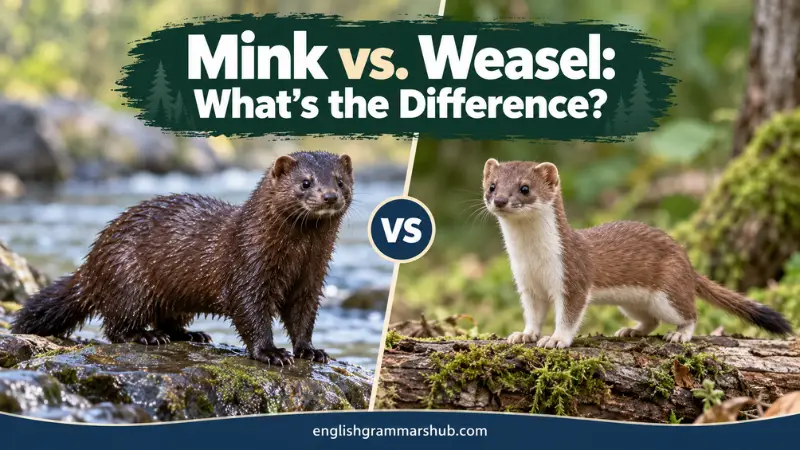
Mink and weasels look alike because both are long, slender members of the weasel family. However, a mink is usually larger, darker, and much more closely tied to water. A weasel is generally smaller, has a brown back with a pale belly, and is more often found in fields, woods, and brushy areas.
Quick Answer
The biggest difference between a mink and a weasel is their build and habitat. Mink are larger, dark brown, and semi-aquatic, so they often live near streams, marshes, ponds, and shorelines. Weasels are smaller, usually brown and white, and more land-based. Both are quick predators with long bodies and short legs.
Mink vs. Weasel at a Glance
| Feature | Mink | Weasel |
|---|---|---|
| Family | Weasel family (Mustelidae) | Weasel family (Mustelidae) |
| Typical size | Larger and heavier | Smaller and lighter |
| Fur color | Usually dark brown, sometimes nearly black | Brown upper body with a pale or white underside |
| Habitat | Streams, ponds, marshes, lakeshores, and wetlands | Fields, woods, farms, grasslands, and brush |
| Relationship with water | Strong swimmer; semi-aquatic | Can swim, but usually lives and hunts on land |
| Tail | Thick and furry, usually one solid color | Slimmer; some species have a black tail tip |
| Winter coat | Usually stays dark | Some species turn partly or fully white in snowy areas |
| Common prey | Fish, frogs, crayfish, rodents, birds, and eggs | Mice, voles, rabbits, insects, birds, and eggs |
Are Mink and Weasels the Same Animal?
No. A mink is not simply a large weasel, although the animals are close relatives.
Both belong to the family Mustelidae, which also includes otters, badgers, ferrets, martens, and wolverines. Their shared family traits explain their similar look: long bodies, short legs, rounded ears, sharp teeth, and fast movements.
In everyday speech, people may use “weasel” loosely for several small mustelids. In wildlife identification, though, a mink and a weasel are different animals.
In the United States, the animal most people mean by “mink” is the American mink. Common weasel species include the least weasel, long-tailed weasel, and short-tailed weasel, also called an ermine in its white winter coat.
Size: Mink Are Usually Bigger
Size is one of the easiest clues.
A mink has a thicker body, stronger neck, and fuller tail. It may look somewhat like a small, dark otter from a distance. A weasel looks thinner, lighter, and more delicate, even though it can be an extremely determined hunter.
A long-tailed weasel can be large enough to confuse with a small mink. Still, the mink usually has a more solid, muscular appearance.
A useful rule is this:
- Small, narrow, quick animal in dry grass or a field: more likely a weasel
- Larger, dark animal near a creek or pond: more likely a mink
Fur Color and Markings
Mink usually have rich dark-brown fur. Some appear nearly black, especially in shade or when wet. Many have a small white patch on the chin or throat, but the rest of the coat is often fairly uniform in color.
Weasels usually show a clearer color contrast. Their backs tend to be brown, while their bellies are cream, yellowish white, or white. A long-tailed weasel often has a noticeable black tip at the end of its tail.
Winter Color Changes
Many people mistake a white winter weasel for a different animal. In colder, snowier parts of North America, some weasels change to white fur in winter. This camouflage helps them blend into snow.
Mink do not normally make that dramatic white winter change. Their coat remains dark.
Habitat: Water Is the Best Clue
Habitat often gives a better answer than color alone.
Mink are semi-aquatic. They commonly live beside permanent water, including:
- Creeks and rivers
- Marshes and wetlands
- Pond edges
- Lake shores
- Coastal areas
- Beaver ponds and drainage channels
They are strong swimmers and may hunt along muddy banks, under logs, or in shallow water.
Weasels are more flexible on land. You may find them in:
- Fields and meadows
- Woodlands
- Brush piles
- Barns and farm areas
- Stone walls
- Rodent burrows
A weasel may visit water and can swim when needed. Still, it does not rely on aquatic habitat in the same way a mink does.
Their Diets Overlap, but Mink Eat More Aquatic Prey
Both animals are carnivores. They hunt smaller animals and often enter tight spaces that larger predators cannot reach.
A weasel’s narrow body helps it chase mice, voles, and other small mammals through tunnels and burrows. It may also eat birds, eggs, insects, and young rabbits.
Mink eat rodents and birds too, but their waterside lifestyle adds more prey choices. Their diet can include fish, frogs, crayfish, aquatic insects, and waterbirds.
That difference matters when identifying tracks or signs. If an animal is regularly hunting around a pond, streambank, or marsh, a mink is more likely.
Tail Shape Can Help You Identify Them
Look at the tail if you get a clear view.
A mink usually has a long, bushy-looking tail that matches the dark body color. It can look thick compared with a weasel’s tail.
A weasel’s tail is usually slimmer. Long-tailed and short-tailed weasels may have a black tail tip, which stands out especially when the rest of the animal is pale or white in winter.
However, tail markings are not enough by themselves. Lighting, mud, wet fur, and distance can make colors hard to judge.
Behavior: Both Are Fast, Curious Hunters
Mink and weasels move in a similar bounding or hopping style. They may pause, raise their heads, and look around before darting into cover. Both can be active during the day or night, although they are often hard to spot because they move quickly and stay close to cover.
A mink often travels along a water’s edge, swims across a narrow channel, or searches beneath rocks and logs near shore.
A weasel is more likely to slip into a hole, race through grass, or hunt near a brush pile. Its small size allows it to follow prey into spaces that many animals cannot enter.
Neither animal should be handled. They are wild predators and may bite if cornered or frightened.
Why People Confuse Mink and Weasels
The confusion is understandable. Both animals have:
- Long, tube-shaped bodies
- Short legs
- Small rounded ears
- Pointed faces
- Thick fur
- Fast, bouncing movements
The simplest way to separate them is to combine several clues instead of depending on one.
Dark, bigger, and near water usually means mink.
Smaller, brown-and-white, and in dry cover usually means weasel.
Mink vs. Weasel vs. Otter
An otter can also be mistaken for a mink, especially when seen swimming.
Otters are much larger than mink, with broader heads, thicker bodies, and noticeably webbed feet. Their tails are long and powerful, tapering to a point. Mink are smaller and slimmer, though they are also excellent swimmers.
If the animal looks about the size of a house cat or larger and moves smoothly through water, it may be an otter rather than a mink.
Common Misconceptions
“All dark weasel-like animals are mink.”
Not necessarily. Lighting can make brown fur look darker, and some animals may be muddy or wet. Habitat, body size, and tail shape give a more reliable answer.
“A mink is a type of weasel.”
This is partly true in a broad family sense. A mink belongs to the weasel family, but it is not the same animal as the species commonly called weasels.
“Weasels always turn white in winter.”
No. Winter whitening depends on the species and location. Weasels in areas with little snow may stay brown or become only partly pale.
“Mink live only in water.”
No. Mink spend time on land and may travel far along shorelines. They need nearby water, but they do not live entirely in it.
FAQs
Is a mink more aggressive than a weasel?
Neither animal is a safe pet or an animal to approach. Both are alert predators that may defend themselves if trapped or handled. Their behavior varies by situation, so it is better to give either animal space than to label one as harmless.
Is a mink larger than a weasel?
Usually, yes. American mink are generally larger and heavier than the weasels most people see in the United States. A large long-tailed weasel can look similar, but a mink typically has a thicker, more powerful build.
Can mink and weasels swim?
Yes, both can swim. The key difference is that mink are much more closely connected to water. They regularly hunt near and in streams, ponds, marshes, and shorelines, while weasels usually spend more of their time on land.
How can I tell a mink from a weasel in winter?
Look for color, size, and location. A mink usually remains dark brown and stays near water. A weasel in a snowy northern area may be white or partly white, often with a black tail tip. A dark animal beside a stream is more likely a mink.
Are mink dangerous to pets or chickens?
Mink and weasels are predators, so they can pose a risk to small poultry, eggs, rabbits, and very small pets if they gain access to an enclosure. Secure coop openings, cover gaps with sturdy hardware cloth, and avoid trying to trap or handle wildlife without local guidance.
Conclusion
When comparing mink vs. weasel, remember the main pattern: mink are larger, darker, and strongly connected to water, while weasels are smaller, lighter underneath, and more often seen in fields or wooded cover. Look at the animal’s size, coat, tail, and location together for the most accurate identification.


