
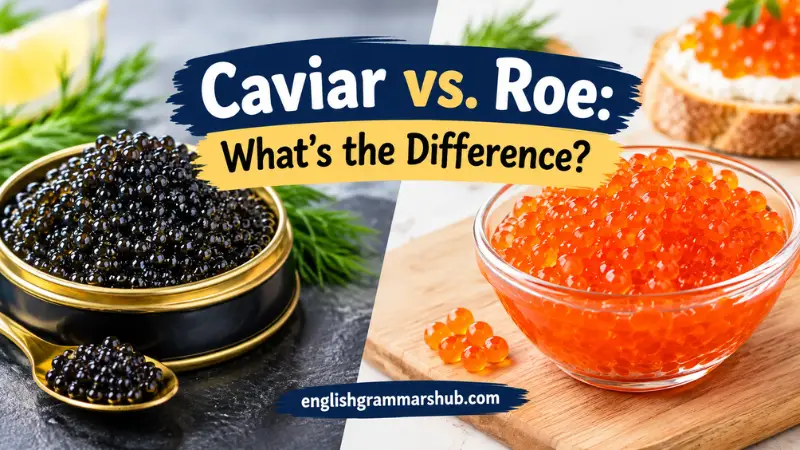
If you’re wondering about caviar vs. roe, the simplest distinction is this: roe is the broader term for fish eggs used as food, while caviar traditionally refers to salted, cured roe from sturgeon. However, English-language food labeling and everyday usage can sometimes use caviar more broadly, especially when the fish species is named.
That means all traditional caviar is roe, but not all roe is traditional caviar. Salmon roe, trout roe, cod roe, and other fish eggs are examples of roe that are not traditionally considered true sturgeon caviar.
Quick Answer
Roe means fish eggs—or, in some definitions, the egg or reproductive material of certain aquatic animals—used as food. Caviar is a particular type of prepared roe, traditionally made from sturgeon and preserved with salt. Codex describes caviar specifically as sturgeon roe, while dictionaries also record broader culinary uses of caviar for the roe of other fish.
Easy rule:
Roe is the category; traditional caviar is a specific type of roe.
Caviar vs. Roe at a Glance
| Feature | Caviar | Roe |
| Basic meaning | A delicacy made from fish eggs | Fish eggs used as food |
| Traditional source | Sturgeon | Many types of fish |
| Preparation | Usually salted or cured | May be fresh, salted, cured, cooked, smoked, or otherwise prepared |
| Common examples | Sturgeon caviar | Salmon roe, trout roe, cod roe, tobiko |
| Scope | Narrower | Broader |
| Relationship | A type of roe | The larger category |
Codex food standards distinguish sturgeon caviar from other fish-roe products, including salmon roe, cod roe, and lumpfish products.
What Is Roe?
Roe is a general culinary term for fish eggs used as food. The word can refer to eggs from many different fish species.
For example:
- Salmon roe — eggs from salmon
- Trout roe — eggs from trout
- Cod roe — eggs from cod
- Herring roe — eggs from herring
- Flying-fish roe — commonly associated with tobiko
- Sturgeon roe — the traditional source of caviar
Roe does not have to be black, expensive, or served as a luxury food. It can range from small, pale eggs to large, brightly colored eggs.
Collins defines roe as the eggs or sperm of a fish eaten as food, while the U.S. National Agricultural Library classifies fish roe as fish eggs eaten as food.
Examples of “roe” in a sentence
- We ordered salmon roe with the sushi.
- The chef served trout roe on top of the appetizer.
- The recipe calls for cod roe.
- The market sells several kinds of fish roe.
What Is Caviar?
Caviar is a prepared fish-egg delicacy traditionally made from sturgeon roe, usually by separating the eggs and salting them.
Sturgeon belong to the family Acipenseridae. International food standards use the term caviar specifically for roe from sturgeon species.
Traditional caviar is associated with varieties such as:
- Beluga
- Ossetra
- Sevruga
Caviar is generally treated as a specialty food rather than simply fresh fish eggs.
Example sentences
- The restaurant served sturgeon caviar with blinis.
- She bought a small tin of caviar for the dinner party.
- The chef used caviar as a garnish.
Why Are Caviar and Roe Confused?
The confusion comes from the fact that caviar is made from roe.
Think about the relationship this way:
Fish eggs → roe → sturgeon roe → traditional caviar
The terms are therefore related, but they are not interchangeable in every context.
For example:
Salmon roe is roe.
But:
Traditional sturgeon caviar is also roe.
So saying “caviar is roe” is generally accurate, but saying “all roe is caviar” is too broad.
Is All Caviar Made From Sturgeon?
Traditionally and under the Codex definition, caviar refers to sturgeon roe. However, English dictionaries and food markets sometimes use caviar more broadly for salted roe from other fish, particularly when the fish is identified.
This creates an important distinction between traditional/technical terminology and broader commercial or everyday usage.
For example:
- Sturgeon caviar — traditional caviar
- Salmon roe — clearly roe
- Salmon caviar — a broader culinary/commercial expression that identifies the fish
The safest wording in a general article is to call sturgeon roe caviar and identify other products by their fish species, such as salmon roe or trout roe.
Caviar vs. Salmon Roe
One of the most common comparisons is caviar vs. salmon roe.
| Feature | Sturgeon Caviar | Salmon Roe |
| Fish | Sturgeon | Salmon |
| Category | Roe | Roe |
| Traditional term | Caviar | Salmon roe |
| Appearance | Often small, dark or grayish eggs | Usually larger orange or red eggs |
| Typical use | Luxury appetizer or garnish | Sushi, appetizers, and other dishes |
| Traditional caviar? | Yes | No |
The important difference is the fish species and terminology, not simply the color.
Calling something “caviar” because it consists of salted fish eggs can be acceptable in some culinary contexts, but traditional food standards distinguish sturgeon caviar from roe of other species.
Is Roe Always Raw?
No. Roe describes the product or eggs, not one single cooking method.
Depending on the species and food product, roe may be:
- Fresh
- Salted
- Cured
- Pasteurized
- Smoked
- Cooked
- Frozen
- Otherwise preserved
Codex categorizes different roe products according to their preparation and preservation methods.
So roe does not automatically mean raw fish eggs.
Is Caviar Always Salted?
Traditional caviar is generally salted or salt-cured.
The salting process helps preserve the product and also contributes to its characteristic flavor. Food-industry references describe caviar production as involving the separation of the eggs followed by treatment with food-grade salt.
This is one reason fresh sturgeon eggs and finished caviar are not necessarily the same thing.
Caviar vs. Roe: Which Word Should You Use?
Use roe when you mean fish eggs generally.
Use caviar when you mean traditional sturgeon caviar or when a food product is specifically marketed and identified as caviar.
Use “roe” in sentences like:
- “The sushi contains salmon roe.”
- “The chef bought fresh trout roe.”
- “This recipe uses cod roe.”
Use “caviar” in sentences like:
- “The restaurant serves sturgeon caviar.”
- “We tasted Beluga caviar.”
- “The appetizer was topped with caviar.”
A useful writing tip
When there could be confusion, be specific:
Better: The dish is topped with salmon roe.
Less precise: The dish is topped with caviar.
Specific species names make the meaning clearer.
Does “Roe” Mean Only Fish Eggs?
In everyday food writing, roe commonly refers to fish eggs, but dictionaries can give the term a broader meaning. Collins, for example, includes fish reproductive material eaten as food in its definition.
This means context matters.
When discussing foods such as salmon roe or sturgeon caviar, roe clearly refers to fish eggs.
Are Caviar and Roe the Same Thing?
Not exactly.
They overlap, but one term is broader.
A useful analogy is:
Fruit : apple
An apple is a type of fruit, but not every fruit is an apple.
Similarly:
Roe : caviar
Traditional caviar is a type of roe, but not every type of roe is caviar.
This is the easiest way to remember the distinction.
Common Mistakes
Mistake 1: Saying all roe is caviar
Too broad:
All fish roe is caviar.
Better:
Caviar is a type of fish roe, traditionally from sturgeon.
Mistake 2: Assuming caviar must be black
Caviar is not defined simply by its color. The important traditional distinction is its source—sturgeon roe—and its preparation.
Mistake 3: Assuming all roe is expensive
Roe can be found in many forms and from many species. It is not automatically a luxury food.
Mistake 4: Assuming “roe” means raw
Roe may be salted, cured, cooked, smoked, frozen, or otherwise processed.
Caviar vs. Roe: A Simple Memory Trick
Remember:
Roe = fish eggs in general.
Caviar = traditionally salted sturgeon roe.
If you remember only one thing, remember that caviar fits inside the broader category of roe.
Frequently Asked Questions
Is caviar just fish roe?
Traditional caviar is a type of fish roe, specifically salted or cured roe from sturgeon. However, dictionaries also record broader uses of caviar for roe from other fish, so the exact meaning can depend on culinary or commercial context.
Is salmon roe caviar?
Salmon roe is definitely roe. Whether it is called “caviar” depends on the culinary or labeling context. Under the traditional and Codex definition, caviar refers to sturgeon roe, while salmon roe is categorized separately.
What is the main difference between caviar and roe?
The main difference is scope. Roe is the broader term for fish eggs used as food. Caviar traditionally refers to salted sturgeon roe.
Is caviar healthier than regular roe?
There is no simple rule that makes caviar universally healthier than other roe. Nutritional value varies by fish species, preparation, serving size, and salt content. It is better to compare the specific products rather than assume one category is automatically healthier.
Why is caviar so expensive?
Traditional sturgeon caviar has historically been associated with specialty production, limited supply, and intensive processing. Prices also vary greatly according to the species, production method, quality, and market.
Can roe be eaten without being caviar?
Yes. Many types of roe are eaten without being called caviar, including salmon roe, trout roe, cod roe, and other fish-egg products. Codex specifically lists several non-sturgeon roe products separately from caviar.
What is the easiest way to remember caviar vs. roe?
Think “roe is the category; caviar is the traditional specialty.” That simple distinction will help you use the two terms correctly in most everyday contexts.
Conclusion
The difference between caviar vs. roe is mainly a matter of scope and source. Roe is the broader term for fish eggs used as food, while traditional caviar is salted or cured roe from sturgeon. Other fish eggs, such as salmon and trout roe, are still roe even when they are sometimes marketed or described with the word caviar.
The easiest rule is simple: all traditional caviar is roe, but not all roe is traditional caviar.


