
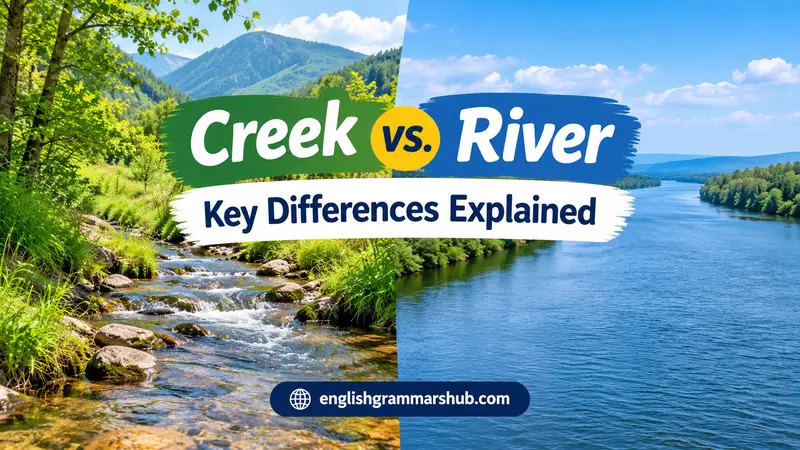
A creek is generally a smaller body of flowing water, while a river is usually larger, wider, and carries more water. Both move water across the land and may connect with other waterways. However, there is no universal size limit that officially separates a creek from a river. In the United States, the names often depend on local usage, geography, and the name a waterway has historically been given.
Quick Answer
The main difference between a creek and a river is their typical size and water volume. Creeks are usually smaller waterways, while rivers tend to have wider channels and larger drainage areas. Both can flow into other waterways, lakes, or larger rivers. The distinction is flexible, though, because geography does not have one universal rule for deciding when a creek becomes a river.
Creek vs. River: Key Differences at a Glance
| Feature | Creek | River |
| Typical size | Smaller | Larger |
| Channel width | Usually narrow | Usually wider |
| Water volume | Often lower | Often higher |
| Flow | May be seasonal or year-round | Often year-round, but can vary |
| Common surroundings | Woods, fields, valleys, and neighborhoods | Valleys, plains, forests, and cities |
| Connection to other waterways | May flow into a stream or river | May flow into another river, a lake, or the ocean |
| Common uses | Walking, fishing, wildlife habitat, and local recreation | Transportation, irrigation, drinking-water supplies, and recreation |
| Official size limit | None universally accepted | None universally accepted |
These are general patterns, not strict rules. A creek can carry substantial water after heavy rain, and a river can become shallow during a dry period.
What Is a Creek?
A creek is a natural waterway that is generally smaller than a river. It carries water through a channel and may receive water from rainfall, springs, groundwater, or smaller drainage channels.
Creeks often pass through forests, farmland, valleys, and residential areas. Some flow throughout the year, while others carry water mainly during wet seasons or after rainfall.
For example, a narrow waterway winding through a wooded park might commonly be called a creek. It may support fish, frogs, insects, birds, and plants that depend on freshwater habitats.
Common characteristics of a creek
- Smaller channel: Creeks are often narrow enough to see both banks easily.
- Lower water volume: They generally carry less water than nearby rivers.
- Local drainage: They may collect runoff from hills, fields, roads, and surrounding land.
- Variable flow: Some creeks slow down or dry up during extended periods without rain.
- Connection to larger waterways: A creek may feed into a stream or river, although this is not required.
Creeks can still become dangerous. Heavy rainfall, flash flooding, or fast-moving water can make even a small creek hazardous.
What Is a River?
A river is a natural waterway that carries flowing water through a defined channel. Rivers are generally larger than creeks and often collect water from many smaller waterways across a broad drainage area.
Rivers may begin as small streams in mountains, hills, wetlands, or springs. As these waterways receive more water from tributaries and surrounding land, they can form larger channels.
For example, the Mississippi River is a major river system in the United States. It collects water from a vast network of tributaries and carries it toward the Gulf of Mexico.
Common characteristics of a river
- Larger channel: Rivers generally have wider and more developed channels than creeks.
- Greater water volume: They often carry water collected from extensive drainage areas.
- Tributaries: Many rivers receive water from creeks, streams, and smaller rivers.
- Broad geographic reach: Rivers can cross multiple states or countries.
- Multiple human uses: Communities rely on rivers for water supplies, agriculture, transportation, energy, and recreation.
Not every river is enormous, and not every river flows continuously throughout the year. Their size, depth, and flow depend on the climate, landscape, geology, and water sources in the surrounding region.
Why Are Creeks Usually Smaller Than Rivers?
Creeks are usually smaller because they drain less land and receive water from fewer sources than larger rivers.
When rain falls, some water enters the soil, some evaporates, and some flows over the surface into low areas. This runoff can enter small channels and eventually reach larger waterways.
As smaller channels join together, they may contribute more water to a stream or river.
Consider this simplified example:
Rainfall and groundwater
Water enters the drainage system
Small creeks
Collect water from nearby land
Larger streams and rivers
Receive water from multiple channels
A lake, another river, or the ocean
A possible destination, depending on the drainage system
This is a simplified illustration, not a fixed sequence. A creek does not always become a river, and some waterways flow into lakes or wetlands instead of continuing toward the ocean.
Does a Creek Always Flow Into a River?
No. A creek does not have to flow into a river.
A creek may empty into a lake, join another creek, enter a wetland, or eventually reach the ocean. Its destination depends on the local landscape and drainage network.
For example, a creek flowing down a hillside might enter a lake directly. Another creek might join a larger stream that eventually connects with a river.
The important distinction is that creek describes a type of waterway, not a required position in a drainage system. Although creeks often feed into larger waterways, the name alone does not determine where they flow.
Can a Creek Be Bigger Than a River?
Yes. A waterway called a creek can be larger than another waterway called a river in some circumstances.
The names of geographic features do not always follow a consistent size system. Local naming traditions, historical usage, and regional preferences can influence whether a waterway is called a creek, stream, or river.
For example, one creek may be wider or carry more water than a small river elsewhere. The two names can remain unchanged even when their physical characteristics seem to contradict the usual distinction.
This is why you should not assume that a waterway’s name provides an exact measurement of its width, depth, or flow.
Is There an Official Difference Between a Creek and a River?
There is no universally accepted official size threshold that separates creeks from rivers in the United States.
The U.S. Geological Survey explains that terms such as creek, stream, and river do not have universally standardized definitions based on physical size. Geographic naming systems may classify these features under broader categories without establishing a strict hierarchy.
Scientists can measure a waterway’s width, depth, flow rate, and drainage area. Those measurements are more precise than relying on its name alone.
For everyday English, however, the usual distinction is straightforward:
- Use creek for a relatively small flowing waterway.
- Use river for a relatively large flowing waterway.
- Use the established name when referring to a specific geographic feature.
This approach is suitable for general writing, school assignments, and everyday conversation.
Creek vs. River vs. Stream
A stream is a general term for flowing water. It can describe waterways of different sizes, including those commonly called creeks and rivers.
| Term | General meaning | Typical size |
| Creek | A relatively small flowing waterway | Small |
| Stream | A general term for flowing water | Any size, depending on context |
| River | A relatively large flowing waterway | Large |
The terms overlap. A creek is commonly understood as a small stream, while a river is generally a larger stream. In scientific writing, stream may be preferred when the writer wants a broad term without implying a particular size.
Which term should you use?
Choose the word that best fits the context.
- Creek: “The children watched minnows swimming in the creek.”
- Stream: “The researchers measured the water quality in the stream.”
- River: “The cargo boat traveled along the river.”
All three sentences use the terms naturally in modern American English.
Everyday Examples of Creeks and Rivers
Understanding the words is easier when you see how they appear in ordinary situations.
Creek examples
- We followed a narrow trail beside the creek.
- Rainwater flowed into the creek after the storm.
- The family spent the afternoon fishing in a shallow creek.
- Several frogs were sitting on rocks along the creek.
River examples
- The river runs through the center of the city.
- Farmers use water from the river to irrigate their fields.
- The bridge connects the two sides of the river.
- The river rose after several days of heavy rain.
Comparing the terms in sentences
Both words can describe moving water, but they create different expectations about the setting.
- “We crossed the creek on a few stepping-stones” suggests a relatively small waterway.
- “We crossed the river on a long bridge” suggests a larger channel that may require a substantial crossing.
These are natural associations, not guaranteed descriptions of actual size.
Common Misconceptions About Creeks and Rivers
Every creek is shallow
False. Some creeks have deep pools, strong currents, or sudden changes in depth. Their conditions depend on rainfall, geology, and the shape of the channel.
Every river flows into the ocean
False. Some rivers flow into lakes, inland basins, wetlands, or other rivers. Their final destinations depend on the drainage system.
A river must be wider than a creek
Not necessarily. Although rivers are usually larger, the names of individual waterways do not always reflect their relative dimensions.
Creeks are always safe to cross
False. Fast-moving water can be dangerous even when it looks shallow. Heavy rain upstream can cause water levels to rise quickly.
A creek must flow into a river
False. Creeks can flow into several types of waterways or into other parts of the drainage system.
FAQs
Is a creek smaller than a river?
Usually, yes. A creek is generally smaller and carries less water than a river. However, there is no universal size limit separating the two, so individual waterways may not follow this pattern.
What is the main difference between a creek and a river?
The main difference is their typical size. Creeks are generally smaller waterways, while rivers tend to be wider and carry more water. Their names do not establish exact limits for depth, width, or flow.
Is a creek considered a stream?
Yes. In ordinary English, a creek is commonly considered a type of stream. The word stream is broader and can refer to many types of flowing waterways.
Can a creek dry up?
Yes. Some creeks are seasonal and may dry up during periods of low rainfall. Others receive enough groundwater or other inflows to maintain water throughout the year.
Is a river deeper than a creek?
Often, but not always. Rivers tend to have larger channels, yet a creek can have deep sections while a river can have shallow areas. Depth depends on the specific waterway and its conditions.
Which word is more appropriate in American English?
Both creek and river are standard American English terms. Use creek for a relatively small waterway and river for a relatively large one, while preserving the established name of a specific feature.
Conclusion
The difference between a creek and a river is mainly their typical size and the amount of water they carry. Creeks are usually smaller, while rivers are generally larger and collect water from broader drainage areas. However, no universal rule determines the exact point at which a creek becomes a river.
For everyday American English, remember this simple guideline: a creek is usually small, a river is usually large, and a stream is the general term for flowing water. When discussing a named waterway, use its established name rather than assuming its size from the label alone.