
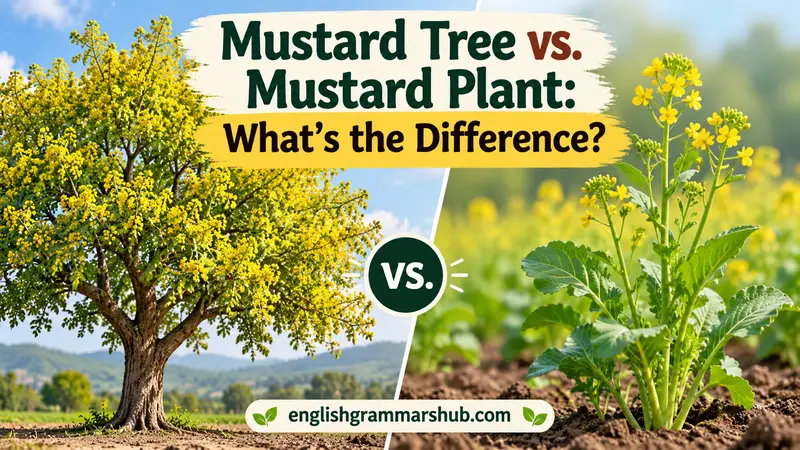
The difference between a mustard tree and a mustard plant isn’t as simple as their names suggest. Mustard plants are usually fast-growing herbs with yellow flowers and tiny seeds. However, the phrase mustard tree can describe either a large, tree-like mustard plant or a separate species that grows as a true woody tree.
This distinction becomes especially important when reading the Bible. Jesus describes a mustard seed growing into something large enough for birds to rest in its branches. Yet the mustard plants commonly grown for food aren’t trees in the botanical sense.
Understanding mustard tree vs. mustard plant helps explain their appearance, growth habits, seeds, everyday uses, and biblical meaning.
Quick Answer
A mustard plant is generally an herbaceous plant grown for its seeds, leaves, or agricultural benefits. A mustard tree can refer to a tall, branching mustard plant in biblical language or to a genuine woody species called Salvadora persica.
The main difference is that ordinary mustard plants complete their life cycle quickly and don’t develop permanent woody trunks. In contrast, Salvadora persica is an evergreen shrub or small tree that lives for many years.
TL;DR
- Mustard plant: Usually an annual herb with yellow flowers, edible leaves, and seeds used for seasoning.
- Mustard tree: May describe a tall mustard plant or the actual tree species Salvadora persica.
- Botanical difference: Common mustard plants belong to the Brassicaceae family, while Salvadora persica belongs to Salvadoraceae.
- Biblical meaning: The mustard seed represents remarkable growth from a small beginning.
- Food production: Prepared mustard generally comes from herbaceous mustard species, not the toothbrush tree.
What Is a Mustard Plant?
A mustard plant is an herbaceous flowering plant commonly cultivated for its seeds, leaves, or use as a cover crop. Most familiar mustard crops belong to the Brassicaceae family, which also includes cabbage, broccoli, kale, and cauliflower.
Mustard plants typically produce green leaves, upright stems, clusters of yellow flowers, and narrow seedpods. These pods contain the small seeds used in many foods.
Three important types of cultivated mustard are:
- Black mustard (Brassica nigra): Traditionally valued for its dark, pungent seeds. It can grow surprisingly tall under favorable conditions.
- White or yellow mustard (Sinapis alba): Produces relatively mild seeds commonly used in American yellow mustard.
- Brown or Indian mustard (Brassica juncea): Grown for its flavorful seeds and, in many varieties, its edible greens.
These species share some physical features, but they aren’t identical.
Most cultivated mustard plants are annuals. They sprout from seeds, develop leaves, flower, produce new seeds, and complete their life cycle within one growing season.
Unlike trees, they don’t normally survive for decades or develop thick, permanent trunks.
What Is a Mustard Tree?
The term mustard tree has two important meanings, depending on the context.
A Tall Mustard Plant Described as a Tree
In biblical discussions, a mustard tree usually refers to an unusually large mustard plant with spreading branches.
Black mustard is often suggested as the plant behind this description.
Under favorable growing conditions, it may reach approximately 6–10 feet tall. Its branching structure can give it a shrub-like or small-tree appearance.
However, height alone doesn’t make something a true tree. Black mustard remains an annual herb, even when it grows taller than a person.
A Real Tree Called Salvadora Persica
The name mustard tree also refers to Salvadora persica, commonly known as the toothbrush tree.
This evergreen species grows naturally in parts of Africa, the Middle East, and nearby regions of Asia.
It can develop a woody trunk, spreading branches, and a height of around 20 feet or more in suitable conditions.
Unlike common mustard crops, Salvadora persica belongs to the Salvadoraceae family.
Its stems and roots have traditionally been used as chewing sticks called miswak. The tree also produces small flowers and fleshy fruits.
The key point: A biblical mustard tree and the botanical species Salvadora persica shouldn’t automatically be treated as the same plant.
Mustard Tree vs. Mustard Plant: Key Differences
The following comparison uses the true mustard tree, Salvadora persica, and common cultivated mustard plants.
| Feature | Mustard Tree | Mustard Plant |
| Scientific identity | Salvadora persica | Species such as Brassica nigra and Sinapis alba |
| Plant family | Salvadoraceae | Brassicaceae |
| Growth type | Woody shrub or small tree | Herbaceous plant |
| Life cycle | Perennial | Usually annual |
| Typical appearance | Woody branches and evergreen leaves | Green stems and yellow flowers |
| Height | Can reach around 20 feet or more | Often 2–7 feet; some black mustard grows taller |
| Flowers | Small, often greenish or yellowish | Usually yellow, with four petals |
| Fruits | Fleshy, berry-like fruits | Dry seedpods |
| Main uses | Traditional chewing sticks and other local uses | Food seasoning, greens, oil, and cover crops |
| Biblical connection | Sometimes proposed, but identification is uncertain | Black mustard is a common proposed identification |
Although their common names overlap, these plants have different biological characteristics.
Is a Mustard Plant Actually a Tree?
No. A common mustard plant isn’t a true tree, even when it grows tall enough to resemble one.
The distinction comes from the plant’s structure and life cycle.
A typical mustard plant has green, nonwoody stems. It grows rapidly, flowers, and eventually dies after producing seeds.
A true tree develops persistent woody tissue that supports its trunk and branches over many growing seasons.
Black mustard may become tall and heavily branched, but it doesn’t develop into a permanent hardwood tree.
This explains why a mustard plant can appear tree-like without changing its botanical identity.
Consider a sunflower. Some sunflowers grow taller than small ornamental trees, yet they remain herbaceous plants. Mustard can create a similar impression.
The word tree sometimes describes appearance in everyday language, while botanical classification uses more specific characteristics.
Why Does the Bible Call Mustard a Tree?
The Bible uses the mustard plant as an illustration of extraordinary growth from a small beginning.
In Matthew 13:31–32, Jesus compares the kingdom of heaven to a mustard seed planted in a field. The seed grows into a large plant described as becoming a tree, with birds coming to its branches.
Similar imagery appears in Mark 4:30–32 and Luke 13:18–19.
The emphasis is on the contrast between the seed’s small size and the impressive growth that follows.
The Meaning of the Mustard Seed Parable
The mustard seed illustrates how something that appears small or insignificant can develop into something much greater.
In Christian interpretation, the parable is commonly connected with:
- Humble beginnings: Important developments don’t always begin with impressive appearances.
- Growth: Something small can expand beyond what people initially expect.
- God’s kingdom: The kingdom begins in a way that may seem modest but grows significantly.
- Shelter and inclusion: Birds resting in the branches can suggest the reach and welcoming character of the kingdom.
The exact theological emphasis can differ between interpretations.
However, the plant’s role in the story is clear: it creates a striking picture of growth.
Which Mustard Species Did Jesus Describe?
Black mustard, traditionally called Brassica nigra, is a leading proposed identification.
It grows in the Mediterranean region and can become tall enough to develop substantial branches.
White mustard, Sinapis alba, is another possible candidate.
The exact botanical identity isn’t completely settled. Historical descriptions don’t provide enough information to establish one species with certainty.
For that reason, it would be inaccurate to claim that researchers have definitively identified the biblical mustard plant.
What matters most to the parable is the contrast between a small seed and a large, branching plant.
How Big Does a Mustard Plant Grow Compared With a Mustard Tree?
A common mustard plant is usually much shorter than a mature Salvadora persica tree, although height varies by species and growing conditions.
Mustard Plant Height
White mustard often reaches approximately 1–3 feet tall.
Black mustard can reach around 6–10 feet in favorable conditions, although many plants remain shorter.
Brown mustard varies widely depending on its variety and growing environment.
Soil quality, sunlight, moisture, available space, and growing temperature can all influence plant height.
Mustard Tree Height
Salvadora persica may reach roughly 20–23 feet under suitable conditions.
It develops woody growth and can continue living and growing for many years.
However, many specimens grow as broad shrubs rather than tall, single-trunk trees.
This variation is important because the words shrub and tree describe different growth forms that can sometimes occur within the same species.
Remember: A 7-foot mustard plant isn’t necessarily a tree, and a 6-foot woody shrub can still belong to a genuine tree-forming species.
How Can You Identify a Mustard Tree and a Mustard Plant?
You can often distinguish these plants by checking their stems, flowers, leaves, and fruits.
Identifying a Common Mustard Plant
Look for these characteristics:
- Upright green stems that may branch near the top.
- Clusters of small, usually bright yellow flowers.
- Four petals arranged in a cross-like pattern.
- Green leaves that may be lobed or toothed.
- Long, narrow seedpods that form after flowering.
Young mustard plants often develop a leafy appearance before producing flowering stems.
As they mature, the seedpods become easier to notice.
Identifying Salvadora Persica
The true mustard tree has a different appearance.
Its identifying characteristics include:
- Woody branches and a persistent trunk or shrub base.
- Evergreen leaves that are often somewhat fleshy.
- Small flowers that may appear greenish or yellowish.
- Fleshy fruits that can turn red or dark purple when ripe.
- A spreading or irregular growth habit.
Unlike most herbaceous mustard plants, it doesn’t produce the familiar narrow seedpods associated with cultivated mustard crops.
These features provide useful clues, but visual identification alone may not establish the species.
If you’re identifying an unfamiliar plant, its scientific name and local growing conditions offer stronger evidence than a common name.
Do Mustard Trees and Mustard Plants Produce the Same Seeds?
No. Their seeds come from different botanical groups and serve different purposes.
Common cultivated mustard seeds are used in food preparation.
These seeds contain compounds responsible for mustard’s characteristic sharp flavor when the seeds are crushed and mixed with liquid.
White mustard seeds are generally milder, while brown and black mustard varieties produce stronger flavors.
The mustard tree, Salvadora persica, produces seeds inside fleshy fruits.
Although its seeds have been used as a source of oil, they aren’t the standard seeds used to manufacture American yellow mustard or Dijon-style mustard.
This distinction matters when buying seeds for planting or cooking.
A package labeled mustard seeds in the spice aisle usually contains seeds from herbaceous mustard crops.
It doesn’t normally refer to the seeds of the toothbrush tree.
What Are Mustard Plants Used For?
Mustard plants have several practical uses in agriculture, cooking, and gardening.
Cooking and Seasoning
Mustard seeds are ground or processed to make prepared mustard and dry mustard powder.
Different seed varieties produce different flavors.
Yellow mustard is widely used in American cooking, while stronger mustards often use brown or black seeds.
Edible Greens
Some mustard varieties produce tender leaves that people eat raw or cooked.
Mustard greens have a slightly bitter, peppery taste.
They can be prepared in soups, stir-fries, and vegetable dishes.
Agricultural Cover Crops
Farmers sometimes grow mustard as a cover crop to protect the soil or support crop management.
Certain mustard varieties are also used in agricultural practices involving the breakdown of naturally occurring plant compounds.
Their suitability depends on local soil conditions and crop-management goals.
Seed and Oil Production
Some mustard varieties are cultivated for oil production, particularly in parts of Asia.
The intended use and food regulations differ by region and mustard species.
Not every mustard plant is grown for the same purpose.
What Is the Mustard Tree Used For?
The actual mustard tree, Salvadora persica, has uses that differ from those of familiar culinary mustard plants.
Traditional Oral Cleaning
One of its best-known uses is the preparation of miswak sticks.
These sticks are made from suitable stems or roots and have a long history of use for cleaning teeth in several regions.
Their traditional use is well established, although they shouldn’t be presented as a complete replacement for professional dental care.
Local Food Uses
The tree produces small fleshy fruits that have been eaten in some communities.
Its leaves also have traditional food uses in certain regions.
However, this doesn’t mean every part of the tree should be eaten without proper identification and preparation.
Traditional Plant Uses
Different parts of Salvadora persica have appeared in local traditional practices.
The tree has also been valued for fuelwood, livestock-related uses, and its ability to grow in challenging environments.
Traditional medicinal use doesn’t automatically establish that a plant treats a disease.
Environmental Adaptation
The tree tolerates dry conditions and relatively salty soils.
This makes it well adapted to some arid landscapes where less tolerant plants may struggle.
It is particularly associated with warm regions of Africa and western Asia.
Can You Grow a Mustard Plant or Mustard Tree at Home?
You can grow common mustard plants in many American gardens, but growing Salvadora persica requires a different environment.
Growing a Mustard Plant
Mustard is often grown as a cool-season crop.
For home gardening, the basic process involves:
- Choose a sunny location with suitable drainage.
- Plant seeds in prepared garden soil.
- Keep the soil evenly moist during germination.
- Provide enough space for healthy growth.
- Harvest suitable leaves or allow the plants to flower and form seeds.
Mustard varieties differ in their preferred growing temperatures.
Many perform well in the cooler parts of spring or fall, especially where summer temperatures become very high.
Growing a Mustard Tree
Salvadora persica is better suited to warm climates and dry environments.
It is adapted to conditions that differ considerably from those preferred by common garden mustard crops.
Its long-term growth also requires space for woody branches and roots.
In the United States, successful outdoor cultivation depends on local climate, winter temperatures, soil conditions, and access to suitable planting material.
A gardener should check the scientific name before ordering seeds or a young plant.
Otherwise, a search for mustard tree could lead to an ordinary mustard crop instead.
Why Are Mustard Trees and Mustard Plants Often Confused?
The confusion comes from common names, biblical descriptions, and similarities in appearance.
A tall mustard plant can have many branches and may look like a small tree from a distance.
Religious language adds another layer because familiar plants are sometimes described through comparisons that focus on their symbolic importance.
Meanwhile, Salvadora persica really does carry the common name mustard tree.
As a result, one expression can refer to two different botanical ideas.
The simplest way to avoid confusion is to identify the context.
If the discussion concerns mustard seeds used in cooking, it probably refers to common cultivated mustard plants.
If it concerns the parable of the mustard seed, it generally refers to a tall, tree-like mustard plant.
If a botanical description specifically names Salvadora persica, it refers to an evergreen woody species.
The scientific name is usually the clearest way to identify which plant someone means.
Common Mistakes About Mustard Trees and Mustard Plants
Several widespread assumptions can make this topic more confusing than necessary.
Mistake: Every Mustard Tree Is a Mature Mustard Plant
A tall black mustard plant doesn’t eventually become Salvadora persica.
These are separate plant species from different families.
Mistake: Mustard Plants Cannot Grow Taller Than People
Some species, especially black mustard, can become much taller than an average adult under favorable conditions.
Being herbaceous doesn’t mean a plant must remain small.
Mistake: The Biblical Mustard Tree Has Been Identified With Certainty
Black mustard is a strong candidate, but the identification isn’t universally settled.
The ancient text doesn’t provide a modern scientific classification.
Mistake: Mustard Seeds Are the Smallest Seeds in the World
Mustard seeds are small, but they aren’t the smallest seeds among all plant species.
Some plants, including orchids, produce much smaller seeds.
The biblical comparison emphasizes the mustard seed’s smallness in a familiar agricultural setting.
Mistake: Mustard Plants and Mustard Trees Have the Same Uses
Culinary mustard plants supply familiar mustard seeds and greens.
Salvadora persica is especially known for its traditional chewing sticks and other regional uses.
These differences matter when choosing plants for cooking, gardening, or study.
Mustard Tree vs. Mustard Plant: Which Term Should You Use?
Choose the term that fits the specific subject you’re discussing.
Use mustard plant when referring to ordinary cultivated mustard crops, their seeds, leaves, flowers, or growing methods.
Use mustard tree when discussing the traditional biblical description or the genuine woody species called Salvadora persica.
When writing about the Bible, a clear sentence would be:
The mustard tree in Jesus’ parable is commonly understood as a large, tree-like mustard plant.
When discussing the botanical tree, a more precise sentence would be:
Salvadora persica is an evergreen shrub or small tree commonly called the mustard tree or toothbrush tree.
These examples show how adding a scientific name or brief explanation can prevent misunderstandings.
FAQs
Are a mustard tree and a mustard plant the same thing?
Not necessarily. In biblical language, a mustard tree may describe a large mustard plant. However, the common name mustard tree also refers to Salvadora persica, a true woody shrub or tree. Ordinary culinary mustard plants and Salvadora persica belong to different botanical families.
Does a mustard seed really grow into a tree?
A common mustard seed grows into an herbaceous mustard plant, not a permanent woody tree. Some mustard plants grow tall and develop spreading branches, which explains why they may be described as tree-like. Seeds of Salvadora persica, however, can grow into a woody shrub or small tree.
What kind of mustard tree is mentioned in the Bible?
Black mustard, Brassica nigra, is one of the leading proposed identifications of the plant in Jesus’ mustard seed parable. Its small seeds and potentially large branching form fit the illustration. Still, the precise species remains uncertain, and white mustard has also been considered.
Is the mustard seed the smallest seed in the world?
No. Mustard seeds are small compared with many familiar garden seeds, but other plants produce much smaller seeds. Some orchids, for example, produce extremely tiny seeds. The mustard seed’s importance in the biblical comparison comes from the striking difference between its small starting size and the plant’s eventual growth.
Is mustard a vegetable or a spice?
Mustard can be both, depending on which part of the plant is used. Its seeds serve as a spice or condiment ingredient, while the edible leaves of certain varieties are eaten as vegetables. The crop may also be grown for oil or agricultural purposes.
Does the mustard tree produce the mustard used in food?
The true mustard tree, Salvadora persica, isn’t the usual source of prepared mustard. Most commercial mustard condiments use seeds from species such as white or yellow mustard, brown mustard, and sometimes black mustard. The similar common names don’t mean these plants supply the same food products.
Conclusion
The main difference between mustard tree vs. mustard plant comes down to botanical identity, growth structure, and context.
Common mustard plants are usually annual herbs with yellow flowers and seeds used for food. They can sometimes grow tall enough to resemble small trees, but they don’t develop permanent woody trunks.
The genuine mustard tree, Salvadora persica, is an evergreen woody species with different leaves, fruits, and traditional uses.
In the Bible, the mustard tree is most often understood as a large, branching mustard plant used to illustrate remarkable growth from a small beginning.
When comparing these plants, remember one simple rule: check the scientific name and the context rather than relying on the common name alone.