
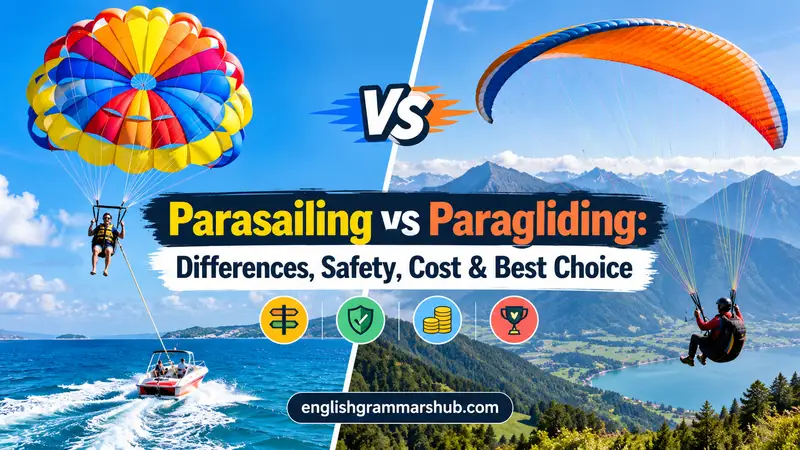
Parasailing and paragliding both offer incredible views from high above the ground. However, these outdoor adventures work in very different ways. One involves floating behind a moving boat, while the other allows you to glide through the air using a specially designed wing.
Understanding parasailing vs paragliding can help you choose the right experience for your next vacation or outdoor adventure.
Parasailing generally suits people who want a relaxing aerial ride without learning to fly. Paragliding offers a more independent flying experience, with greater control and opportunities for longer flights.
The differences go beyond how you take off. Safety, equipment, training, costs, and weather conditions also matter.
Quick Answer
Parasailing is a recreational activity where a boat pulls you through the air using a parachute-like canopy. Paragliding is a form of free flight where a pilot controls a lightweight wing without being continuously pulled by a boat.
Parasailing usually requires no previous experience. Paragliding requires training for solo flights, although beginners can experience it with a qualified tandem pilot.
The simplest distinction is that parasailing is primarily a guided ride, while paragliding is a piloted flying activity.
Parasailing vs Paragliding: Key Differences at a Glance
| Feature | Parasailing | Paragliding |
|---|---|---|
| Main activity | Boat-towed aerial ride | Free-flight air sport |
| Takeoff | Usually from a boat | Often from a hill or mountain |
| Power source | Moving boat creates lift | Gravity and rising air currents |
| Flight control | Boat operator | Paraglider pilot |
| Location | Beaches, lakes, coastal areas | Hills, mountains, suitable flying sites |
| Training | Usually none for passengers | Required for independent flying |
| Flight duration | Usually a short ride | Can range from minutes to hours |
| Landing | Often on the boat | Usually on designated ground |
| Experience | Relaxing sightseeing | Active, skill-based flying |
| Best for | Vacationers and casual adventurers | Flying enthusiasts and adventure seekers |
Neither activity is automatically safer than the other. Conditions, equipment, operator experience, and safety decisions play major roles.
What Is Parasailing?
Parasailing is an outdoor activity in which a person rises into the air beneath a specially designed canopy while being towed by a moving boat.
The boat creates the forward movement needed to generate lift. A strong towline connects the canopy to the vessel.
Participants usually wear a secure harness or sit in a specially designed passenger seat.
How does parasailing work?
A typical parasailing experience follows a simple process.
- The crew provides safety instructions and prepares the harness and equipment.
- The passenger attaches to the parasail system.
- The boat moves forward, allowing the canopy to rise.
- The operator gradually releases the towline as the passenger climbs.
- After the ride, the crew retrieves the passenger, often onto the boat’s rear platform.
Passengers generally do not steer the canopy themselves.
The boat operator controls the ride’s movement through the vessel and towline system.
Where can you go parasailing?
Parasailing is popular in coastal vacation destinations, including Florida, Hawaii, and other beach areas throughout the United States.
Some lakes also support commercial parasailing operations.
The activity appeals to travelers who want aerial views without spending days learning flight skills.
What Is Paragliding?
Paragliding is a recreational aviation sport that uses a lightweight fabric wing to glide through the air.
Unlike parasailing, a paraglider normally flies without remaining attached to a boat or another moving vehicle.
The pilot sits in a harness beneath the wing and controls direction using brake lines and weight shifting.
How does paragliding work?
Most recreational paragliding flights begin at an elevated launch location.
The pilot checks the equipment, evaluates the weather, and prepares the wing.
When conditions are suitable, the pilot raises the canopy overhead and runs forward to launch.
Once airborne, the wing generates lift as air flows around it.
Experienced pilots can use rising air currents, including thermals and ridge lift, to stay in the air longer.
Where is paragliding popular?
Paragliding often takes place near mountains, hills, and ridges.
In the United States, recreational flying locations include areas of California, Utah, Colorado, and other regions with suitable terrain and air conditions.
Some locations also support winch-assisted launches from relatively flat land.
Parasailing vs Paragliding: Flight Experience
The experience is one of the most noticeable differences between these activities.
Parasailing feels like a sightseeing ride
Parasailing passengers usually remain seated or suspended in a harness while the boat pulls them through the air.
They can enjoy views of beaches, boats, and the coastline.
The ride can feel surprisingly peaceful in smooth conditions, although wind, boat movements, and turbulence may affect comfort.
Because passengers do not normally control the flight, they can focus on the scenery.
Paragliding feels more like flying
Paragliding offers a different sensation.
The pilot controls direction, turns, and the approach to landing. During a tandem flight, the experienced pilot manages these tasks while the passenger enjoys the experience.
Paragliders can travel along ridges, glide over valleys, and sometimes gain altitude through rising air.
For many enthusiasts, this freedom makes paragliding especially rewarding.
Which Is Higher: Parasailing or Paragliding?
Paragliding can reach much greater altitudes than ordinary recreational parasailing, although actual heights depend on location, conditions, and airspace restrictions.
Parasailing height: Commercial parasailing generally takes place at controlled heights determined by operating limits, towline length, and local rules. In the United States, federal aviation rules generally limit parasail operations to 500 feet above the surface unless an appropriate waiver or authorization applies.
Paragliding height: A paraglider may launch from an elevated hillside and climb much higher when weather conditions and permitted airspace allow.
Importantly, the height of the launch site is not the same as the height above the ground during flight.
Pilots must observe airspace limitations and choose conditions appropriate to their training.
Parasailing vs Paragliding: Which Is Safer?
Both activities involve real risks. Neither should be described as completely safe or risk-free.
There is no reliable universal rule showing that one activity is always safer than the other.
Parasailing safety risks
Parasailing safety depends heavily on the commercial operator and weather conditions.
Potential hazards include:
- Sudden changes in wind speed
- Damaged or poorly maintained towlines
- Equipment or attachment failures
- Boat operation problems
- Unsafe launches or landings
- Unexpected storms
Passengers should choose an experienced operator who explains safety procedures and cancels trips when conditions are unsuitable.
Paragliding safety risks
Paragliding involves aviation hazards that require training and judgment.
These may include:
- Strong or turbulent winds
- Wing collapses or loss of control
- Incorrect takeoff or landing technique
- Poor assessment of weather
- Flying too close to obstacles or terrain
- Inadequate training or unsuitable equipment
Proper instruction, suitable equipment, and conservative decision-making help manage these risks.
Safety comparison
| Safety consideration | Parasailing | Paragliding |
|---|---|---|
| Main responsibility | Commercial crew and operator | Pilot or tandem instructor |
| Weather sensitivity | High | High |
| Equipment inspection | Essential | Essential |
| Beginner training | Usually not required | Essential for solo flights |
| Landing risks | Boat or water-related | Terrain and landing approach |
| Main safety priority | Professional operator | Competent pilot and suitable conditions |
For either activity, avoid providers who dismiss safety questions or pressure customers to fly in questionable weather.
Parasailing vs Paragliding: Which Is Cheaper?
Parasailing is often the simpler choice for someone seeking a one-time vacation experience.
Commercial parasailing usually involves paying for one short ride. The company supplies the boat, equipment, and operating crew.
Paragliding costs depend on whether you choose a tandem experience or want to become an independent pilot.
Parasailing costs
Prices vary according to:
- Tourist destination
- Season and demand
- Ride duration
- Number of participants
- Photo or video packages
A single parasailing ride generally involves no long-term training expense.
Paragliding costs
A tandem paragliding experience involves paying for a flight with a trained pilot.
Learning to paraglide independently requires a larger commitment. Expenses can include professional lessons, a wing, a harness, a helmet, a reserve parachute, and other equipment.
Travel, site access, inspections, and replacement equipment may add further costs.
Best choice for budget-conscious beginners: Parasailing is often easier to arrange as a single recreational purchase. However, local tandem paragliding prices can sometimes be competitive, so compare actual packages before booking.
Which Is Better for Beginners?
Parasailing generally offers the more straightforward introduction to aerial adventures.
Passengers usually receive a short briefing before the ride. They do not need to learn how to launch, steer, or land the canopy.
Paragliding requires a different approach.
Beginners can take tandem flights with qualified pilots without first completing a solo training course.
However, flying independently demands structured lessons and supervised practice.
Choose parasailing if you:
- Want a simple vacation adventure.
- Prefer an activity that requires little preparation.
- Enjoy ocean and beach scenery.
- Don’t want to control an aircraft.
- Have limited time for training.
Choose paragliding if you:
- Want to experience free flight.
- Enjoy mountains and outdoor sports.
- Are interested in learning aviation skills.
- Prefer a potentially longer aerial experience.
- Want more personal control after proper training.
Both can provide memorable first-time experiences when conducted under suitable conditions.
Parasailing vs Paragliding: Equipment Differences
Although both use fabric canopies, their equipment serves different purposes.
Parasailing equipment
A commercial parasailing system typically includes a specially designed canopy, towline, harness or passenger seating system, attachment hardware, and towing vessel.
The canopy is designed for stable flight while connected to the boat.
The equipment must accommodate the pulling forces created during towing.
Paragliding equipment
A typical paragliding setup includes a flexible wing, suspension lines, harness, helmet, and reserve parachute.
Pilots may also carry instruments that provide flight information.
The wing is built to glide efficiently and respond to pilot control inputs.
Unlike a traditional round parachute, a paraglider wing has an airfoil shape that supports forward flight and controlled turns.
Can You Parasail or Paraglide Without Experience?
You can usually parasail without previous experience, provided you meet the operator’s participation requirements.
A commercial crew manages the equipment and towing process.
You can also take a tandem paragliding flight without solo flying experience. However, you must follow the pilot’s instructions, especially during launch and landing.
Flying a paraglider independently is different.
Solo pilots need appropriate instruction in:
- Weather and wind assessment
- Equipment inspection
- Wing control
- Launch and landing techniques
- Emergency procedures
- Flight planning and airspace awareness
A beginner should never attempt independent paragliding without suitable professional training.
Which Activity Is More Thrilling?
Paragliding often appeals more to people seeking an active aviation experience.
The pilot can turn, change direction, and use rising air to extend a flight.
However, tandem paragliding does not have to be intense. A gentle sightseeing flight can feel peaceful in favorable conditions.
Parasailing can also be exciting, particularly during takeoff or when soaring above open water.
The better choice depends on the kind of thrill you enjoy.
Parasailing emphasizes elevated sightseeing. Paragliding emphasizes the experience of free flight.
What Happens If the Wind Stops?
Weather affects both activities, but the consequences differ.
During parasailing, the moving boat provides the airflow needed to keep the canopy aloft. A major change in wind or boat speed can affect its flight.
The crew manages the towline and vessel according to operating procedures.
A paraglider does not need a continuous strong natural wind to remain airborne.
As long as sufficient airspeed flows over the wing, it can glide downward through still air.
However, without rising air, the pilot gradually loses altitude and must eventually land.
This distinction explains why a paraglider can fly in calm conditions while still relying on appropriate weather for a safe launch and landing.
Common Misconceptions About Parasailing and Paragliding
Misconception 1: Both activities use the same equipment
They use different canopy designs and operating systems. Parasailing equipment supports towing, while paragliding equipment supports controlled gliding flight.
Misconception 2: Paragliding always requires jumping off a cliff
Most recreational paragliding launches involve controlled foot launches from suitable slopes. Pilots raise their wings and accelerate into flight rather than jumping blindly from an edge.
Misconception 3: Parasailing passengers steer themselves
Passengers normally do not control the canopy. The boat operator directs the movement and manages the towline.
Misconception 4: Paragliding requires a motor
Traditional paragliding does not require a motor. Powered paragliding, often called paramotoring, is a related but different activity.
Misconception 5: One sport is completely safe
Every aerial activity involves risk. Experienced operators, sound equipment, favorable weather, and responsible decisions are essential.
FAQs
Is parasailing the same as paragliding?
No. Parasailing involves a canopy connected to a moving boat, while paragliding involves flying a controllable wing without continuous towing. Both provide aerial experiences, but their equipment, flight methods, and required skills differ significantly.
Is parasailing or paragliding scarier?
The answer depends on personal comfort and the flight conditions. Parasailing may feel less demanding because passengers do not control the ride. Paragliding can feel more adventurous because of its open-air flight and maneuverability. A gentle tandem flight, however, may be comfortable for many first-time passengers.
Can you paraglide over the ocean?
Yes, paragliding can take place near coastlines when the site, conditions, and applicable rules permit. Coastal ridge lift can support soaring flights. Pilots must assess wind, terrain, landing areas, and water-related hazards carefully.
Can you go parasailing if you cannot swim?
Some operators may allow nonswimmers to participate because flights usually begin and end on the boat. However, emergency water landings are possible. Swimming ability, life jacket requirements, and operator policies should be discussed before booking.
Is paragliding physically demanding?
Solo paragliding requires enough physical ability to manage the wing, launch, and land safely. Tandem flights may involve less effort, but passengers often need to walk or run during takeoff and landing. Requirements vary by launch site and operator.
How long does parasailing last compared with paragliding?
Parasailing flights usually last only several minutes, although the full boat excursion may be longer. Paragliding flights can range from short introductory rides to extended soaring flights, depending on weather, location, and pilot experience.
Can two people go parasailing or paragliding together?
Yes. Some commercial parasailing systems carry two or more passengers, subject to equipment and operating limits. Tandem paragliders carry a qualified pilot and one passenger. Always confirm the provider’s capacity and participation requirements.
Conclusion
The best choice in parasailing vs paragliding depends on the kind of adventure you want.
Choose parasailing if you prefer a convenient, guided experience with beautiful coastal views and no need for flight training.
Choose paragliding if you want to experience free flight, explore mountain scenery, or eventually learn to fly independently.
Both offer unique perspectives from the sky. Before booking either activity, review the operator’s experience, safety procedures, equipment practices, and weather cancellation policy.
A well-planned experience matters more than choosing the activity that appears most exciting.
Do you like this personality?