
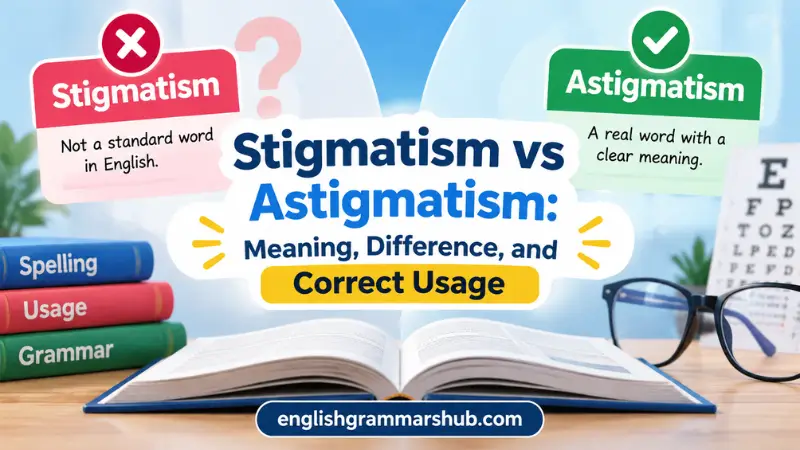
Many people search for stigmatism vs astigmatism because the two words look and sound almost identical. However, they do not have the same meaning. In most eye-care conversations, astigmatism is the correct medical term for a common vision condition caused by an irregularly shaped cornea or lens.
Stigmatism is a real word, but it usually refers to a different concept in biology or optics and is not the standard term for the common eye condition. Understanding this difference helps you use the right word when discussing vision, glasses, contact lenses, or eye exams.
Quick Answer
Astigmatism is the correct term for a common eye condition that causes blurred or distorted vision because light does not focus evenly on the retina. Stigmatism is not the usual word for this vision problem. In everyday eye-care discussions, use astigmatism.
TL;DR
- Astigmatism is a vision condition caused by an irregular curve in the eye’s cornea or lens.
- Stigmatism is a separate term with limited uses and is not the normal name for an eye problem.
- Many people accidentally drop the prefix “a-” and say “stigmatism.”
- Eye doctors, optometrists, and medical sources use astigmatism.
- If you are talking about blurry vision or needing special lenses, astigmatism is almost certainly the word you need.
What Is the Difference Between Stigmatism and Astigmatism?
The main difference is that astigmatism is an eye-related medical term, while stigmatism has different meanings unrelated to the common vision condition.
| Feature | Stigmatism | Astigmatism |
| Common meaning | A specialized term used in some fields | A common eye condition affecting vision |
| Used in eye care? | Usually no | Yes |
| Related to blurry vision? | No | Yes |
| Medical diagnosis? | No for ordinary vision problems | Yes |
| Commonly used by eye doctors? | No | Yes |
The confusion happens because astigmatism contains the word stigmatism inside it. Many speakers shorten the word accidentally and remove the first syllable.
What Is Astigmatism?
Astigmatism is a common refractive error that affects how the eye focuses light.
Normally, the cornea (the clear front surface of the eye) has a round shape similar to a basketball. In people with astigmatism, the cornea or lens may have a more oval shape, similar to a football.
Because of this uneven curve, light may focus at multiple points instead of one clear point on the retina. This can cause vision to appear:
- Blurry
- Distorted
- Stretched
- Difficult to focus at certain distances
Astigmatism can occur along with other vision problems, such as:
- Nearsightedness (myopia)
- Farsightedness (hyperopia)
What Does Stigmatism Mean?
Stigmatism is a valid word, but it is not the term used for the common eye condition.
The word comes from the Greek root related to stigma, meaning a mark or point. Depending on the field, it may describe concepts involving marks, points, or characteristics.
However, in everyday English, most people do not use stigmatism when discussing eyesight.
For example:
Incorrect: I have stigmatism, so I need special glasses.
Correct: I have astigmatism, so I need special glasses.
Why Do People Confuse Stigmatism and Astigmatism?
The confusion mainly comes from pronunciation and spelling.
The word astigmatism begins with the prefix “a-.” In many English words, prefixes can be difficult to hear, especially during fast speech.
Examples of similar confusion:
- Asymmetry → symmetry
- Atypical → typical
- Apolitical → political
Because “astigmatism” is longer and less familiar, some speakers shorten it to “stigmatism.”
However, removing the “a-” changes the word and removes the medical meaning people usually intend.
Is “Stigmatism” Incorrect?
It depends on the meaning.
Stigmatism is not always an incorrect word. It exists in specialized contexts. However, using it to describe a vision problem is generally considered incorrect.
Compare:
Correct medical usage:
“My eye doctor diagnosed me with astigmatism.”
Not standard for vision:
“My eye doctor diagnosed me with stigmatism.”
The issue is not spelling alone. The two words refer to different concepts.
How Do You Pronounce Astigmatism?
The common US pronunciation is:
Astigmatism: /ə-ˈstiɡ-mə-ˌti-zəm/
Syllable breakdown:
a-stig-ma-tism
The main stress falls on the second syllable:
STIG
Many speakers shorten or blur the beginning sound, which may contribute to the common mistake.
Example:
- Correct: a-STIG-ma-tism
- Common mistake: STIG-ma-tism
Examples of Correct Usage
Talking about eyesight
✅ My doctor said I have astigmatism.
✅ Astigmatism can make objects look blurry or distorted.
✅ These glasses are designed to correct my astigmatism.
Talking about eye exams
✅ The optometrist checked whether I had astigmatism during my eye exam.
Incorrect usage
❌ I have stigmatism in my left eye.
The intended word in this sentence is astigmatism.
Astigmatism vs Other Vision Problems
Astigmatism is different from other common refractive errors.
| Condition | What Happens | Common Effect |
| Astigmatism | Uneven focusing due to irregular eye shape | Blurry or distorted vision |
| Myopia | Light focuses in front of the retina | Distant objects look blurry |
| Hyperopia | Light focuses behind the retina | Close objects may be harder to see |
| Presbyopia | Age-related loss of focusing ability | Difficulty reading nearby text |
A person can have more than one of these conditions at the same time.
Common Mistakes When Using Astigmatism
1. Saying “I have stigmatism”
This is the most common mistake.
Use:
✅ “I have astigmatism.”
Not:
❌ “I have stigmatism.”
2. Confusing Astigmatism With a Disease
Astigmatism is not usually described as a disease. It is a refractive error, meaning the eye does not focus light perfectly.
3. Thinking Astigmatism Only Affects Distance Vision
Astigmatism can affect vision at different distances. The effect depends on the individual’s eye shape and the severity of the condition.
Memory Trick: How to Remember Astigmatism
Remember:
Astigmatism = A for affected vision
The extra “A” helps you remember that astigmatism is the eye-related term.
Another way:
A + stigmatism = astigmatism
Keep the beginning “a” because it is part of the medical word.
FAQs
Is stigmatism the same as astigmatism?
No. Stigmatism and astigmatism are different words. Astigmatism is the standard medical term for a common vision condition. Stigmatism is not the usual term for an eye problem.
Why do people say stigmatism instead of astigmatism?
People often say “stigmatism” because they shorten the word or drop the first syllable during speech. The correct medical term is astigmatism.
Can an eye doctor diagnose stigmatism?
Eye doctors diagnose astigmatism, not “stigmatism” as a vision condition. An eye exam can identify astigmatism and determine whether corrective lenses are needed.
Is astigmatism serious?
Astigmatism is common and can often be corrected with glasses, contact lenses, or other vision treatments recommended by an eye-care professional.
How do you spell astigmatism?
The correct spelling is:
A-S-T-I-G-M-A-T-I-S-M
A common misspelling is:
S-T-I-G-M-A-T-I-S-M
which removes the first letter A.
Do glasses fix astigmatism?
Glasses with special lenses can correct the way light enters the eye and improve vision for many people with astigmatism.
Conclusion
When comparing stigmatism vs astigmatism, the correct word for a common vision problem is astigmatism. The extra “a” at the beginning is important because it creates the medical term used by eye-care professionals.
If you are talking about blurry vision, corrective lenses, or an eye exam, choose astigmatism. While stigmatism exists as a separate word, it does not describe the typical eye condition people mean in everyday conversation.


