
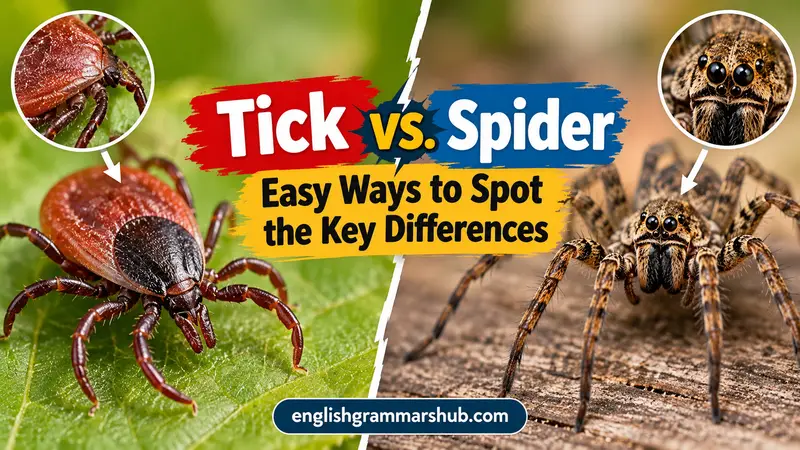
A tick and a spider can look surprisingly similar at first glance. Both have multiple legs, small bodies, and a habit of appearing in places where people least expect them. However, knowing the difference between a tick vs. spider matters, especially when you find one on your skin, clothing, or pet.
Ticks are blood-feeding parasites that may spread diseases. Spiders are mainly predators that hunt insects and other small creatures. Although both belong to the arachnid family tree, they have different body shapes, feeding habits, and ways of interacting with humans.
This guide explains how to identify ticks and spiders, compare their bites, understand their health risks, and respond safely when you encounter either one.
Quick Answer
The main difference between a tick and a spider is how they feed and how their bodies are shaped. Ticks are small parasites with compact, oval bodies that attach to animals or people to drink blood. Spiders have two distinct body sections connected by a narrow waist and generally hunt other small animals. Both have eight legs as adults, but young tick larvae have only six.
Tick vs. Spider: Key Differences at a Glance
The following comparison shows the most useful differences between ticks and spiders.
| Feature | Tick | Spider |
| Animal group | Arachnid, closely related to mites | Arachnid |
| Main body shape | Compact, oval, or flattened | Two distinct sections with a narrow connection |
| Adult legs | Eight | Eight |
| Young legs | Larvae have six | Spiderlings have eight |
| Typical size | Usually very small; can swell after feeding | Varies greatly by species |
| Food | Blood from animal hosts | Mostly insects and other small animals |
| Feeding method | Attaches and feeds through specialized mouthparts | Captures prey using fangs |
| Silk production | Does not produce spider silk | Produces silk |
| Common locations | Grass, leaf litter, brush, and animals | Homes, gardens, vegetation, and sheltered spaces |
| Human health risk | Some species transmit infectious diseases | Most bites are minor; a few species can cause serious reactions |
| Attachment to skin | Some remain attached for days | Do not normally remain attached |
| Main identification clue | Rounded body without a distinct narrow waist | Separate abdomen connected by a narrow waist |
The easiest first step is to examine the body shape. A rounded creature with legs clustered toward the front may be a tick. An animal with a clearly separate front section and abdomen is more likely a spider.
What Is a Tick?
A tick is a small, blood-feeding arachnid closely related to mites. Unlike insects, ticks do not have antennae or wings.
Ticks feed on animals with backbones, including mammals, birds, reptiles, and amphibians. Humans can also become hosts.
A tick usually begins its search for a host from vegetation or another suitable location. Many species wait on grass or leaves with their front legs extended. This behavior is called questing.
When a host brushes against the vegetation, the tick grabs onto it. It then searches for a suitable feeding spot.
After attaching, many hard tick species remain in place for several days while feeding. Their bodies can expand considerably as they take in blood.
Common Types of Ticks in the United States
Several tick species are important for people and pets in the United States.
Blacklegged tick: Also called the deer tick, this species can transmit Lyme disease bacteria and other pathogens.
Lone star tick: This tick is common in parts of the eastern and central United States. Adult females have a recognizable white spot on their backs.
American dog tick: Often found in grassy areas, this species can transmit pathogens responsible for illnesses such as Rocky Mountain spotted fever.
Brown dog tick: This species commonly feeds on dogs and can sometimes establish populations inside buildings.
Not every tick carries a disease-causing organism. However, identifying and removing attached ticks promptly is an important precaution.
What Is a Spider?
A spider is an eight-legged arachnid belonging to the order Araneae. Most spiders are predators that eat insects and other small animals.
Unlike ticks, spiders have a body divided into two main sections.
The front section, called the cephalothorax, contains the eyes, mouthparts, and legs. The abdomen forms the rear section.
A narrow connection joins these two parts.
Spiders also produce silk through special organs called spinnerets. They use silk for several purposes, including building shelters, protecting eggs, and capturing prey.
Not every spider builds a web to catch food. Some actively chase prey, while others hide and wait for an opportunity.
Common Spiders Found in the United States
Jumping spiders: These compact spiders have prominent front-facing eyes and can jump to catch prey.
Wolf spiders: Active hunters that usually search for food on the ground instead of building capture webs.
Orb-weaver spiders: Known for constructing circular webs in gardens, wooded areas, and around buildings.
Black widow spiders: Recognizable by the red markings found on many adult females. Their bites can cause serious symptoms.
Brown recluse spiders: Found mainly in parts of the central and southern United States. Their bites can sometimes lead to significant skin injuries.
Most spiders encountered around American homes are not medically dangerous.
How to Tell a Tick From a Spider
The most reliable way to distinguish a tick from a spider is to examine several physical features together.
Body Shape
Ticks usually have a compact body that appears oval, rounded, or flattened.
Their body regions are closely joined, so they do not have the obvious narrow waist seen in spiders.
Spiders have a distinct front section and abdomen connected by a narrow stalk.
Even small spiders often show this separation when viewed closely.
A tick that has fed may look like a swollen gray, brown, or reddish bead.
Number of Legs
Adult ticks and spiders both have eight legs, so leg count alone is not enough to identify them.
However, there is one important exception.
Tick larvae have six legs, while spiderlings have eight.
Ticks develop an additional pair of legs when they reach the nymph stage.
Because young ticks are tiny, a magnifying glass may be needed to count their legs accurately.
Leg Position
A tick’s legs often appear grouped around the front half of its body.
Spiders have legs attached to their cephalothorax. Their legs may appear longer and more spread out relative to the body.
However, leg length is not a dependable rule by itself. Some spiders have short legs, and certain ticks have relatively long ones.
Movement
Ticks crawl. They cannot fly or jump.
Many ticks find hosts by waiting on vegetation until an animal or person brushes against them.
Spiders also crawl, but some species can move quickly or jump.
Jumping spiders, for example, can leap between surfaces while searching for prey.
Movement provides useful clues, although it cannot confirm the animal’s identity on its own.
Tick vs. Spider Size: Which Is Bigger?
Spiders are often larger than ticks, but size depends on species and age.
Some immature ticks are no larger than tiny specks. Adult ticks are generally easier to see, although many remain only a few millimeters long before feeding.
A female hard tick may expand dramatically after taking a blood meal.
Spiders vary much more in size. Some are extremely small, while others have large bodies and long leg spans.
A small jumping spider might be confused with a tick, especially when viewed quickly.
Size alone is not a reliable way to identify a tick or spider. Body structure, leg arrangement, and behavior provide better clues.
Are Ticks and Spiders Related?
Yes. Ticks and spiders are both arachnids, meaning they belong to the class Arachnida.
This group also includes scorpions, mites, and harvestmen.
Arachnids belong to the larger group called arthropods, which includes animals with jointed legs and external skeletons.
However, ticks are more closely associated with mites than with true spiders.
Spiders belong to the order Araneae, while ticks belong to the order Ixodida.
Their shared ancestry explains several similarities, such as jointed legs and the absence of antennae.
Despite these similarities, they developed different ways of feeding, moving, and surviving.
Tick Bite vs. Spider Bite: What Is the Difference?
Tick bites and spider bites are different because ticks and spiders use their mouthparts for different purposes.
A tick attaches to a host to obtain blood. A spider typically uses its fangs to capture prey or defend itself.
What Does a Tick Bite Look Like?
A tick bite may initially leave a small red bump or irritated area.
Sometimes there is little noticeable reaction.
Because tick bites are often painless, a person may not realize a tick has attached.
If a tick carries certain pathogens, symptoms can develop days or weeks after the bite.
Depending on the infection, warning signs may include fever, headache, fatigue, muscle aches, or a developing rash.
For example, Lyme disease can produce an expanding skin rash. Although some rashes develop a bull’s-eye appearance, many do not.
A small red spot immediately after removal does not automatically mean that an infection has occurred.
What Does a Spider Bite Look Like?
Spider bites may cause localized redness, swelling, itching, or pain.
Most spider bites result in mild symptoms or no significant injury.
However, bites from certain species can be more serious.
A black widow bite may cause intense pain and muscle cramping.
A brown recluse bite can sometimes lead to a worsening skin wound.
It is also important to recognize that many skin problems blamed on spiders are caused by something else.
You cannot reliably identify a tick bite or spider bite from the appearance of a skin mark alone.
Seeing the animal or obtaining a reliable identification is much more helpful.
Which Is More Dangerous: A Tick or a Spider?
Ticks generally present a more common disease-related concern in the United States because certain species transmit infectious organisms.
Spiders are more often a concern because of their venom, although medically significant bites are uncommon.
The type of exposure matters more than the animal’s appearance.
Health Risks From Ticks
Depending on the tick species and location, tick bites can transmit infections such as:
- Lyme disease
- Anaplasmosis
- Ehrlichiosis
- Babesiosis
- Rocky Mountain spotted fever
These diseases do not occur equally in every region, and not all ticks carry the same pathogens.
Prompt removal can reduce the risk of certain infections.
Anyone who develops fever, an expanding rash, or unusual symptoms after a possible tick bite should contact a healthcare professional.
Health Risks From Spiders
Most spiders are not a serious threat to people.
Many species avoid humans and bite only when trapped against the skin or handled.
Two medically important spiders in the United States are black widows and brown recluses.
Severe pain, spreading skin damage, or significant muscle cramping after a suspected spider bite requires prompt medical evaluation.
Difficulty breathing, trouble swallowing, or other severe symptoms require emergency care.
The practical difference: Ticks deserve attention because of possible disease transmission, while certain spider bites require attention because of venom-related effects.
Where Do Ticks and Spiders Usually Live?
Ticks and spiders may occupy the same outdoor environment, but their preferred locations and habits often differ.
Common Tick Habitats
Ticks are frequently encountered in:
- Tall grass and brush
- Wooded areas
- Leaf litter
- Gardens and yards
- Areas used by deer, rodents, and other animals
- Places where dogs and other pets spend time
Some tick species can also survive indoors under suitable conditions.
Ticks do not fall from trees or jump onto people. They usually make contact when a host brushes past them.
Common Spider Habitats
Spiders can be found in:
- Gardens and shrubs
- Basements and garages
- Corners of rooms
- Window frames
- Woodpiles
- Storage boxes
- Beneath rocks and logs
Many spiders live near people because buildings provide shelter and attract insects.
Finding an eight-legged animal in a web strongly suggests a spider rather than a tick.
However, a spider does not need to be sitting in a web to be identified as one.
What Should You Do If You Find a Tick on Your Skin?
If you discover an attached tick, remove it promptly rather than waiting for it to detach naturally.
The correct removal method is straightforward.
- Use clean, fine-tipped tweezers.
- Grasp the tick as close to the skin as possible.
- Pull it away using steady, even pressure.
- Avoid twisting, jerking, or squeezing the tick’s body.
- Clean your skin and hands after removal.
- Check the rest of your body for additional ticks.
If small mouthparts remain embedded and cannot be removed easily, avoid digging into the skin.
Do not use heat, nail polish, petroleum jelly, or other substances to force the tick to release.
If possible, take a clear photograph of the tick for identification and make a note of when the bite occurred.
Seek medical advice if you develop concerning symptoms. A clinician can also advise whether preventive treatment is appropriate after a particular tick exposure.
What Should You Do If You Find a Spider on Your Skin?
A spider crawling on your skin does not automatically mean you have been bitten.
Avoid squeezing or crushing it against your body.
Instead, gently brush it away or allow it to move onto another surface.
If a bite occurs, wash the affected area with soap and water.
A cold compress may help reduce mild pain and swelling.
Avoid scratching or cutting the area.
If you suspect a dangerous spider or experience severe symptoms, seek medical attention promptly.
Trying to identify a spider is useful only when it can be done safely. Do not attempt to capture a potentially dangerous spider with your bare hands.
How to Prevent Tick and Spider Encounters
Ticks and spiders require somewhat different prevention methods.
For ticks, focus on limiting contact with areas where they wait for hosts.
Wear protective clothing in grassy or wooded areas. Use an EPA-registered repellent according to its label.
Permethrin-treated clothing and gear can provide additional protection, but permethrin intended for clothing should not be applied directly to skin.
After outdoor activities, examine your skin, clothing, and pets.
For spiders, reducing clutter and limiting insect activity around the home can help.
Seal gaps around doors and windows, and wear gloves when moving stored materials or handling woodpiles.
Shaking out shoes or clothing that have been stored in sheltered areas is another useful precaution.
Neither prevention method requires eliminating every arachnid from your yard.
Many spiders play a helpful role by feeding on insects.
Common Mistakes People Make When Identifying Ticks and Spiders
Misidentification often happens because people focus on just one feature.
Mistake: All eight-legged creatures are spiders.
Ticks, mites, scorpions, and several other arachnids also have eight legs as adults.
Mistake: Ticks are baby spiders.
Ticks are separate animals with their own life cycle. They do not grow into spiders.
Mistake: Every tick carries Lyme disease.
Only certain ticks transmit the bacteria responsible for Lyme disease, and not every individual tick is infected.
Mistake: Every spider bite is dangerous.
Most spider bites are harmless or cause only minor symptoms.
Mistake: A spider must build a web.
Many spiders hunt without constructing prey-catching webs.
Mistake: A tick always looks round and swollen.
Unfed ticks may appear small and flat. The swollen appearance becomes more obvious after feeding.
These distinctions help prevent unnecessary worry while encouraging appropriate care when there is a genuine health concern.
FAQs
Is a tick a type of spider?
No. A tick is not a spider, although both belong to the arachnid class. Ticks are closely related to mites and feed on blood. Spiders belong to a different group and typically hunt insects or other small animals. Their similar leg structure reflects their broader biological relationship.
Can a tick look exactly like a spider?
Some ticks can resemble very small spiders, especially before feeding. However, a close examination usually reveals important differences. Ticks have compact bodies without a distinct narrow waist, while spiders have two visibly separate body sections. Leg arrangement and behavior may provide additional clues.
Do ticks have eight legs like spiders?
Adult ticks and nymphs have eight legs, just like spiders. However, tick larvae have only six legs. Spiders develop with eight walking legs, including during their early stages. This difference can help identify a young tick, although the legs may be difficult to count without magnification.
Can ticks jump like jumping spiders?
No. Ticks cannot jump or fly. Many species wait on vegetation and grab onto passing animals or people. Jumping spiders, by contrast, can leap between surfaces while hunting. Not all spiders jump, but the ability to jump is a useful clue when identifying certain spider species.
Can spiders spread Lyme disease?
No. Lyme disease is transmitted to people through bites from infected blacklegged ticks. Spiders are not recognized as vectors of Lyme disease. Although a spider bite can cause local irritation or other symptoms, it should not be confused with the specific infection risks associated with certain ticks.
What is the easiest way to identify a tick on a dog?
Look for a small, attached creature with an oval or rounded body. Ticks may be found around a dog’s ears, neck, toes, or other areas. Their bodies can become swollen after feeding. If you find an attached tick, remove it carefully and consult your veterinarian about tick prevention.
Which is worse to find in your house, a tick or a spider?
A tick generally calls for checking people and pets for possible attachment because some ticks can transmit disease. Most household spiders are harmless and help control other pests. However, the actual risk depends on the species, whether anyone has been bitten, and whether concerning symptoms develop.
Conclusion
Understanding the differences between a tick vs. spider makes identification easier and helps you respond appropriately.
Ticks are blood-feeding parasites with compact bodies and no obvious narrow waist. Spiders are predators with two distinct body sections and silk-producing organs. Although both belong to the arachnid group and usually have eight legs as adults, their feeding habits and health risks differ substantially.
When identifying an unfamiliar arachnid, examine its body shape, leg arrangement, and behavior rather than relying on size or color alone.
Most importantly, remove attached ticks promptly, take possible bite symptoms seriously, and avoid handling unfamiliar spiders unnecessarily.