
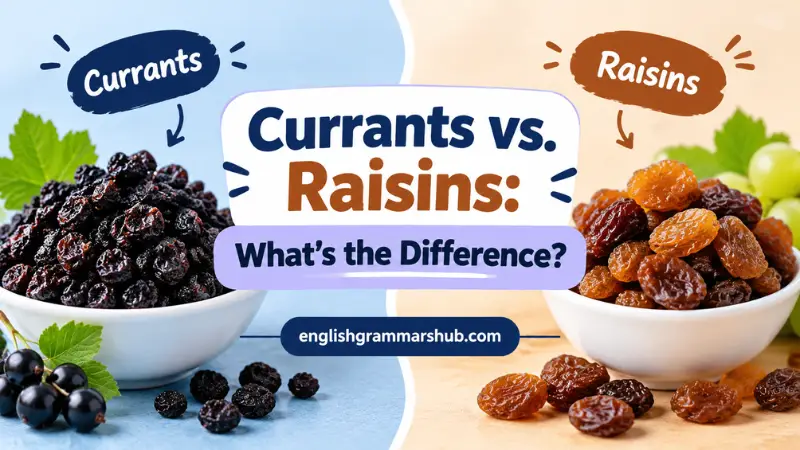
Currants vs. raisins can be confusing because the word currant can refer to two very different things. In American grocery stores and many recipes, “currants” usually means Zante currants, which are tiny dried grapes. In botanical terms, however, true currants are berries from the Ribes genus and are unrelated to grapes.
Raisins, by contrast, are dried grapes. Zante currants are therefore a specialized type of dried grape that is closely related to raisins, while true black, red, or white currants are completely different fruits. The distinction matters when reading recipes, shopping for ingredients, comparing flavors, or deciding whether one ingredient can replace another.
Quick Answer
Raisins are dried grapes, while Zante currants are very small dried grapes, usually made from Black Corinth grapes. They are smaller and often more intensely flavored than ordinary raisins. However, true currants—such as blackcurrants and redcurrants—are berries from the Ribes family and are not raisins at all. In the United States, the word currants commonly refers to Zante currants rather than true currant berries.
Currants vs. Raisins at a Glance
| Feature | Currants | Raisins |
| Common U.S. meaning | Usually Zante currants | Dried grapes |
| Botanical source | Usually Black Corinth grapes when referring to Zante currants | Various grape varieties |
| Fruit family | Zante currants are grapes; true currants are Ribes berries | Grapes |
| Size | Very small | Usually larger |
| Color | Usually dark purple to nearly black | Brown, dark, golden, or other colors depending on variety |
| Texture | Small, relatively firm, and concentrated | Generally larger and chewy |
| Flavor | Sweet with a concentrated, sometimes tangy character | Generally sweet and fruity |
| Typical use | Baking, puddings, breads, cakes, savory dishes | Baking, snacks, cereals, breads, desserts |
| Relationship | Zante currants are a type of raisin | Broad category of dried grapes |
| Main source of confusion | The name “currant” also refers to true berries | The term generally refers to dried grapes |
The most important point is that “currant” has more than one meaning. When the word refers to Zante currants, it describes a tiny dried grape. When it refers to blackcurrants, redcurrants, or white currants, it describes berries from the Ribes genus.
What Are Raisins?
Raisins are dried grapes. They are produced by removing much of the water from grapes, concentrating their sugars, flavor, and texture.
The word raisin is commonly used as a broad term for dried grapes, although the exact grape variety, drying method, color, size, and processing method can differ considerably. U.S. agricultural standards recognize several varietal and processing categories of raisins, including seedless raisins and Zante currant raisins.
Raisins can vary significantly in appearance. Some are dark brown or nearly black, while others are golden or lighter in color. Some varieties are plump and soft, whereas others are smaller and firmer.
Their natural sweetness makes raisins popular in both sweet and savory foods. Drying concentrates the sugars already present in the grapes, which gives raisins their characteristic rich sweetness.
Raisins are not one single grape variety
A common misconception is that all raisins come from one particular kind of grape. They do not.
Different grape varieties can be dried to produce different kinds of raisins. Their final characteristics depend on factors such as:
- The grape variety
- Whether the grapes contain seeds
- The drying method
- Processing conditions
- Moisture level
- Final size and texture
- Whether the grapes are treated before drying
This explains why two products can both be labeled as raisins but look or taste noticeably different.
Raisins in American English
In the United States, raisin is the familiar general term for dried grapes.
The word can cover many forms of dried grapes, including products that are marketed under more specific names. Zante currants are officially recognized within U.S. raisin standards as a category of raisin. Federal regulations also define Zante Currant as a varietal type of raisin associated with Black Corinth or White Corinth grapes.
That official classification helps explain why the relationship between currants and raisins is more complicated than the names suggest.
What Are Currants?
The word currant has two major meanings, and separating them is essential.
First, currant can mean a Zante currant, which is a tiny dried grape. Second, it can refer to a true currant, such as a blackcurrant or redcurrant, which is a berry from the Ribes genus.
These are not the same fruit.
Zante currants
Zante currants are tiny dried grapes traditionally associated with the Black Corinth grape. They are sometimes called:
- Zante currants
- Corinth raisins
- Corinthian raisins
- Currants
The USDA’s raisin standards specifically recognize Zante currant raisins as a category of raisins.
This means that when a recipe calls for currants, it may actually be asking for a small type of dried grape.
True currants
True currants belong to the Ribes genus. Blackcurrants, redcurrants, and white currants are examples.
These fruits grow on shrubs rather than grapevines. They are berries, not dried grapes.
True currants can be eaten fresh or processed into foods such as:
- Jams
- Jellies
- Sauces
- Preserves
- Desserts
- Beverages
Their flavor is generally more acidic and berry-like than the flavor of raisins.
Why the name causes confusion
The problem comes from the fact that Zante currants are not true currants botanically.
The name became associated with tiny dried grapes through historical trade and naming. The term is now firmly established in culinary language, even though the fruit itself is a grape.
For this reason, simply seeing the word currant does not tell you whether the product is a berry or a dried grape.
Are Currants and Raisins the Same Thing?
Zante currants and raisins are closely related, but they are not identical in everyday culinary terms.
A Zante currant is a very small dried grape, while raisin is the broader term for dried grapes.
This relationship can be understood simply:
Grape → dried grape → raisin
And within the broad group of dried grapes:
Black Corinth grape → dried → Zante currant
U.S. agricultural standards support this relationship by treating Zante currants as a recognized type of raisin.
However, the word currant can also mean a completely different fruit:
Ribes berry → true currant
That is why the answer changes depending on what kind of currant is being discussed.
The easiest way to remember it
If the package contains tiny dried grapes, you are probably dealing with Zante currants.
If the product is a fresh black, red, or white berry from a shrub, it is a true currant.
If the product is a larger dried grape, it is generally a raisin.
The Biggest Difference Between Currants and Raisins
The biggest practical difference between Zante currants and ordinary raisins is size and grape type.
Zante currants are made from very small grapes and are much smaller than many conventional raisins. Their small size gives them a concentrated presence in baked foods.
Raisins are available in many sizes and varieties. Depending on the product, they can be large and plump, medium-sized, or relatively small.
The difference is therefore not simply that one is dried and the other is fresh. Both Zante currants and raisins can be dried grapes.
The more accurate distinction is:
- Raisin: a general category of dried grape
- Zante currant: a particular small dried grape traditionally made from Black Corinth grapes
- True currant: a berry belonging to the Ribes genus
This three-part distinction eliminates most of the confusion surrounding the terms.
Size and Appearance
Size is one of the easiest ways to distinguish Zante currants from ordinary raisins.
Zante currants
Zante currants are notably small. Their compact size allows many individual pieces to be distributed throughout a baked product without creating large, chewy pockets of fruit.
They are generally dark in color and can appear almost black or deep purple-brown.
Raisins
Raisins have a much wider range of sizes and colors.
Depending on the variety and processing method, raisins may be:
- Dark brown
- Deep purple-brown
- Golden
- Light brown
- Nearly black
Some are relatively small, while others are noticeably larger and plumper.
True currants
True currants are different again.
Fresh blackcurrants, redcurrants, and white currants are small berries. They have a fresh, juicy appearance rather than the wrinkled appearance of dried grapes.
Once dried, true currants may become darker and smaller, which can create even more confusion. That is why product labeling matters.
Taste and Flavor
Taste is another useful distinction.
Raisin flavor
Raisins are generally known for their concentrated sweetness and fruity grape flavor.
Drying removes water and concentrates the sugars and other flavor compounds already present in the grape. The result is a sweet, chewy fruit that works well in many foods.
Different raisin varieties can have different levels of sweetness, acidity, fruitiness, and richness.
Zante currant flavor
Zante currants are also sweet, but their very small size gives them a more concentrated character.
They can contribute a combination of sweetness and a slightly tangy or intense fruit flavor, depending on the product.
Because they are small, their flavor can be distributed evenly through a dish rather than appearing in large individual bites.
True currant flavor
True currants are generally more acidic and berry-like.
Blackcurrants are particularly distinctive, with a strong tart flavor that is quite different from the mellow sweetness of a raisin.
Redcurrants are also notably tart and bright.
This means that substituting true currants for raisins can change the overall flavor of a recipe much more dramatically than substituting Zante currants for raisins.
Texture Differences
Texture is an important reason cooks sometimes prefer one dried fruit over another.
Raisins are generally chewy. Larger raisins can provide noticeable pieces of fruit within bread, oatmeal, cereal, desserts, or baked goods.
Zante currants are much smaller and therefore create a different eating experience. Instead of producing large chewy pieces, they tend to be dispersed throughout the food.
Their small size can be particularly useful when a recipe needs dried fruit throughout the mixture rather than large pieces concentrated in certain bites.
True currants, when fresh, have a completely different texture because they are berries containing juice rather than dried grape flesh.
Nutritional Differences
Zante currants and raisins are both dried fruits, so their nutrients are more concentrated than those of their fresh grape counterparts.
Their nutritional profiles depend on the particular fruit, variety, preparation method, serving size, and processing.
Because Zante currants are essentially dried grapes, their basic nutritional characteristics overlap substantially with other raisins.
Both can contribute:
- Carbohydrates
- Naturally occurring sugars
- Dietary fiber
- Small amounts of various vitamins and minerals
However, it is better not to assume that every type of raisin or currant has exactly the same nutritional profile.
Serving size matters
Dried fruits contain much less water than fresh fruit.
As a result, a relatively small serving can contain a substantial amount of carbohydrate and natural sugar compared with the same weight of fresh grapes.
This does not make raisins or Zante currants nutritionally identical to candy, but it does mean that portion size is relevant when considering them as part of a diet.
What about true currants?
True currants are a separate nutritional category because they are berries rather than dried grapes.
Fresh blackcurrants, redcurrants, and white currants contain significant amounts of water and have different nutrient profiles from dried grapes.
The form of the food matters just as much as the name.
How Currants and Raisins Are Used in Cooking
Zante currants and raisins overlap in many culinary applications, but their size makes them particularly useful in different situations.
Baking
Both can be used in baked goods.
Raisins are common in:
- Breads
- Cookies
- Cakes
- Muffins
- Breakfast foods
- Oat-based baked goods
- Puddings
Zante currants are especially associated with traditional baked goods where very small pieces of dried fruit are desirable.
Their small size allows them to blend into dough and batter more evenly.
Breakfast foods
Raisins are commonly added to cereals, oatmeal, granola, and similar foods.
Zante currants can also be used in breakfast dishes when a smaller dried-fruit texture is preferred.
Savory cooking
Dried grapes are not limited to desserts.
Raisins can appear in savory dishes where their sweetness provides contrast with salty, spicy, sour, or savory ingredients.
Zante currants can serve a similar purpose because their concentrated sweetness and small size make them useful in dishes where large pieces of dried fruit would be distracting.
Desserts
Both can be incorporated into puddings, cakes, pastries, and other desserts.
The best choice often depends on the desired texture rather than a major difference in basic function.
Can You Substitute Currants for Raisins?
Zante currants can often replace raisins, but the result will not be exactly the same.
The substitution works because both are dried grapes.
However, the smaller size of Zante currants changes the texture and distribution of fruit throughout the finished food.
A recipe designed around large, soft raisins may have a different texture if tiny currants are used instead.
When the substitution works well
Zante currants are generally a practical substitute when:
- The recipe uses dried grapes for sweetness.
- A smaller fruit size is acceptable.
- You want the dried fruit spread more evenly throughout the dish.
- A slightly more concentrated flavor is desirable.
- The appearance of the finished food is not dependent on large raisins.
When substitution may be less suitable
The swap may be less appropriate when:
- The recipe depends on large pieces of dried fruit.
- The size of the raisins is part of the intended texture.
- The recipe specifically relies on a particular raisin variety.
- The visual appearance of large raisins is important.
The reverse substitution also works in many situations, but larger raisins may produce a more noticeable chew.
Can Raisins Replace Currants?
Raisins can often replace Zante currants, but they are not a perfect one-to-one texture match.
The main issue is size.
If a recipe specifically calls for tiny currants, ordinary raisins may be too large. Chopping them can make the texture more similar, although it still will not reproduce the exact characteristics of the smaller grape.
If the recipe uses the dried fruit primarily for sweetness and general fruit flavor, the substitution may work well.
If the recipe depends heavily on the small size of currants, the difference will be more noticeable.
Can You Substitute True Currants for Raisins?
Not without changing the character of the dish.
True currants are not dried grapes. They are berries from the Ribes genus.
Their flavor is generally more acidic and berry-like than the sweet, concentrated grape flavor of raisins.
A recipe designed around raisins may therefore become noticeably more tart if true currants are substituted.
The distinction is especially important when a recipe uses the word currants without specifying the type.
If the ingredient list is calling for tiny dried fruit, it is likely referring to Zante currants. If it is referring to a fresh berry, it may mean true currants.
Why Recipes Cause So Much Confusion
Recipes from different countries and culinary traditions may use the word currant differently.
This is especially important when comparing American recipes with recipes from the United Kingdom, Ireland, or other English-speaking regions.
In many traditional baking contexts, currants means the tiny dried grape known as a Zante currant.
That can surprise readers who know currant primarily as a berry.
The word therefore cannot always be interpreted literally as referring to a fresh berry.
Recipe context matters
When a recipe calls for currants, check the surrounding information:
- Is the ingredient listed among dried fruits?
- Is the recipe for bread, cake, pudding, or pastry?
- Does the recipe describe the fruit as dried?
- Does the ingredient appear near raisins or sultanas?
- Does the recipe specify “Zante currants”?
- Is the fruit supposed to be fresh?
These clues can usually reveal which meaning is intended.
Currants, Raisins, and Sultanas
A discussion of currants and raisins often leads to sultanas, because all three are commonly associated with dried grapes.
The terminology can vary by country.
In broad terms:
- Raisins are dried grapes and can include many varieties.
- Zante currants are very small dried grapes associated with Black Corinth grapes.
- Sultanas are another type of dried grape associated historically with the Sultana grape.
The exact naming conventions differ between markets, so the terms should not always be treated as perfectly standardized worldwide.
In the United States, terms such as golden raisins are common for certain light-colored dried grapes.
The key point is that currants are not automatically the same as sultanas, and sultanas are not simply another name for every raisin.
Why Are Zante Currants Called Currants?
The name has a long historical connection with Corinth and the trade in small dried grapes.
Zante currants are associated with grapes historically known as Corinth grapes. The name currant developed through historical language and trade terminology rather than because the fruit belongs to the same botanical group as true currants.
The modern result is unusual but well established: a grape product carries a name that is also used for an unrelated berry.
This is why the phrase “Zante currant” is useful. It removes much of the ambiguity.
When precision matters, saying Zante currant makes it clear that the ingredient is a small dried grape rather than a Ribes berry.
Zante Currants vs. True Currants
This is one of the most important distinctions in the entire topic.
| Feature | Zante Currants | True Currants |
| What they are | Tiny dried grapes | Small berries |
| Plant group | Grape, Vitis | Ribes |
| Main association | Black Corinth grapes | Blackcurrant, redcurrant, white currant |
| Fresh form | Grapes before drying | Fresh berries |
| Usually sold as | Dried fruit | Fresh, frozen, dried, preserved, or processed fruit |
| Flavor | Sweet and concentrated | Tart, acidic, berry-like |
| Relationship to raisins | A type of raisin | Not a raisin |
| Relationship to grapes | Direct | None |
This table provides the easiest way to resolve the terminology.
Zante currants are dried grapes. True currants are berries.
Why Zante Currants Are Often Considered Raisins
The answer comes down to classification.
A raisin is a dried grape. Zante currants are produced by drying small grape varieties associated with Black Corinth.
The USDA specifically places Zante currant raisins within its standards for raisins, and federal regulations identify Zante Currant as a varietal type of raisin.
Therefore, saying that Zante currants are closely related to raisins is accurate. More precisely, Zante currants are a specific kind of raisin.
The everyday language can still be confusing because consumers often encounter “currants” and “raisins” as separate ingredient labels.
That distinction reflects culinary naming rather than a completely separate botanical origin.
Are Currants Healthier Than Raisins?
There is no simple universal answer because “currants” can refer to different foods.
If you mean Zante currants versus raisins, both are dried grapes, so their nutritional characteristics overlap.
If you mean true currants versus raisins, you are comparing fresh or processed berries with dried grapes, which is a much different comparison.
The nutritional value of either food also depends on:
- Serving size
- Fresh versus dried form
- Processing
- Added ingredients
- Overall diet
- Individual nutritional needs
It is therefore misleading to declare one universally healthier without specifying exactly which type of currant and which type of raisin are being compared.
Do Currants Have Seeds?
Zante currants are generally associated with small seedless grapes.
The Black Corinth grape used for Zante currants is known for its small size and seedless character.
Raisins, however, can be either seeded or seedless depending on the variety.
U.S. raisin standards distinguish among different types, including raisins with seeds and seedless categories.
True currants are different because they are berries and contain their own small seeds.
So the question “Do currants have seeds?” cannot be answered accurately without identifying which meaning of currant is intended.
Are Blackcurrants the Same as Currants?
Blackcurrants are true currants.
The word blackcurrant usually refers to a berry in the Ribes genus.
That is different from a Zante currant, which is a tiny dried grape.
This distinction is particularly useful when shopping because product names can look deceptively similar:
- Blackcurrant → true berry
- Redcurrant → true berry
- White currant → true berry
- Zante currant → tiny dried grape
The similarity in names does not mean the fruits are closely related.
Are Currants Raisins in the United States?
When “currants” means Zante currants, yes, they fall within the raisin category.
U.S. agricultural and regulatory classifications explicitly recognize Zante currant raisins as a type of raisin.
But the word currants by itself can still refer to true Ribes berries.
So the most precise answer is:
Zante currants are a type of dried grape and therefore a type of raisin; true currants are berries and are not raisins.
That distinction is more accurate than simply saying “currants are raisins” or “currants are not raisins.”
How to Tell What a Package Means by “Currants”
Packaging usually provides useful clues.
Look for terms such as:
- Zante currants
- Dried currants
- Black Corinth
- Corinth raisins
- Blackcurrant
- Redcurrant
- White currant
A product labeled Zante currants is referring to tiny dried grapes.
A product labeled blackcurrant is referring to a true Ribes berry.
The form of the product also helps. A small, dark, wrinkled dried fruit is likely to be a Zante currant if the package uses the word currant. A fresh berry product labeled blackcurrant is a different ingredient entirely.
Which Is Better for Baking?
The better choice depends on the texture and flavor the recipe needs.
Raisins are a practical choice when a recipe benefits from larger, chewy pieces of dried fruit.
Zante currants are useful when a recipe calls for smaller pieces that distribute evenly through a mixture.
Neither is universally better.
For dense baked goods, the small size of Zante currants can be useful because the dried fruit can be spread throughout the dough or batter.
For foods where dried fruit is meant to stand out as a larger component, raisins may be more appropriate.
True currants are a separate choice and can introduce considerably more acidity and berry flavor.
Which Is Sweeter: Currants or Raisins?
If you are comparing Zante currants with ordinary raisins, both are sweet dried grapes, but the flavor intensity can differ by variety and product.
Zante currants often have a concentrated sweet-tart character because they are made from very small grapes.
Raisins vary much more widely because the category includes many grape varieties and processing styles.
If you are comparing true currants with raisins, raisins are generally much sweeter in the familiar dried-fruit sense, while true currants are more acidic and tart.
The word currant must therefore be defined before making a direct taste comparison.
Which Is More Common in Recipes?
Raisins are broadly familiar in American cooking and baking.
Zante currants are also used in many traditional baked goods, but they are a more specialized ingredient.
True currants are less interchangeable with raisins because they have a different botanical identity, flavor, and texture.
The type of cuisine also matters. Traditional recipes from different English-speaking regions may use currants to mean Zante currants, even when an American reader initially assumes the recipe is referring to fresh berries.
Common Confusion About Currants and Raisins
Several misconceptions repeatedly cause problems.
“Currants are just fresh raisins.”
Not exactly.
A Zante currant is a dried grape, so it is related to raisins. But true currants are berries and have nothing to do with grapes.
“All currants are berries.”
Not in culinary terminology.
True currants are berries, but Zante currants are dried grapes.
“All raisins are the same.”
They are not.
Raisins can come from different grape varieties and can vary in size, color, seed content, flavor, and processing.
“Currant and raisin always mean the same thing.”
They do not.
The term currant is ambiguous. Raisin generally refers to a dried grape, while currant can refer either to Zante currants or true Ribes currants.
“Zante currants are unrelated to raisins.”
That is incorrect.
Zante currants are made from grapes and are recognized as a type of raisin in U.S. standards.
A Simple Decision Guide
When choosing between currants and raisins, first identify which kind of currant is involved.
If the recipe calls for Zante currants
Treat them as a small dried grape.
They can often be replaced with raisins when exact size and texture are not critical.
If the recipe calls for blackcurrants or redcurrants
Do not automatically replace them with raisins.
These are true berries with a different flavor and structure.
If you want larger chewy pieces
Raisins are generally more suitable.
If you want very small dried fruit pieces
Zante currants are usually the more appropriate choice.
If you want tart berry flavor
True currants are the relevant ingredient.
If you simply see “currants” in a traditional baking recipe
Consider the recipe’s origin and surrounding ingredients. In many baking contexts, the term refers to Zante currants rather than true berries.
Currants vs. Raisins: A More Precise Definition
The confusion becomes easy to resolve when the terms are defined precisely.
Raisin: a dried grape.
Zante currant: a small dried grape, traditionally associated with Black Corinth grapes; recognized as a type of raisin in U.S. standards.
True currant: a berry belonging to the Ribes genus.
From these definitions, the relationship becomes clear:
All Zante currants are dried grapes, but not all raisins are Zante currants.
And:
True currants are not raisins.
That is the key distinction readers should remember.
FAQs
Are currants and raisins the same?
Zante currants and raisins are closely related, and Zante currants are recognized as a type of raisin. Both are dried grapes. The main difference is that Zante currants come from very small grapes and are much smaller than many ordinary raisins. True currants, such as blackcurrants and redcurrants, are berries from the Ribes genus and are completely different from raisins.
What is the main difference between currants and raisins?
The main difference is the meaning of the word currant. When it refers to Zante currants, the product is a very small dried grape and a type of raisin. When it refers to true currants, the fruit is a berry from the Ribes genus. Ordinary raisins are dried grapes from various grape varieties.
Can I use raisins instead of currants?
If the recipe means Zante currants, raisins can often be substituted. The biggest change will usually be size and texture. Raisins are generally larger, so the finished dish may contain more noticeable pieces of dried fruit. If the recipe means true currants, however, raisins are not an equivalent substitute because the flavor and botanical identity are different.
Are Zante currants actually grapes?
Yes. Zante currants are made from small grape varieties associated with Black Corinth grapes. They are dried rather than eaten as fresh grapes. This is why U.S. agricultural standards classify Zante currant raisins within the raisin category.
Are blackcurrants the same as Zante currants?
No. Blackcurrants are true currants from the Ribes genus, while Zante currants are tiny dried grapes. Despite the similar names, they are botanically different and have different culinary characteristics.
Why are currants called currants if they are grapes?
The name developed through historical trade and language associated with Corinth and small dried grapes. Over time, the term currant became established as a culinary name for these tiny dried grapes. The modern name therefore does not mean that Zante currants belong to the same botanical group as true currants.
Are currants sweeter than raisins?
It depends on which currants you mean. Zante currants are sweet dried grapes with a concentrated flavor, while raisins vary widely by grape variety and processing method. True currants are generally much more tart and acidic than raisins. Because the word currant has two meanings, a direct comparison requires identifying the specific fruit.
Which is better for baking, currants or raisins?
Neither is universally better. Zante currants are useful when a recipe benefits from very small pieces of dried fruit, while raisins are useful when larger, chewy pieces are desired. The best choice depends on the recipe’s intended texture, flavor, and appearance.
Conclusion
The simplest way to understand currants vs. raisins is to separate Zante currants from true currants.
Raisins are dried grapes. Zante currants are tiny dried grapes and are considered a type of raisin. True currants, such as blackcurrants and redcurrants, are berries from the Ribes genus and are not raisins.
For cooking and baking, Zante currants can often substitute for raisins, but their smaller size creates a different texture and distribution. True currants are a different ingredient altogether and should not automatically be treated as a raisin substitute.
When a recipe simply says currants, check the context. In traditional baking, it often means Zante currants. When the recipe specifies blackcurrants, redcurrants, or another Ribes fruit, it means a true berry.


