
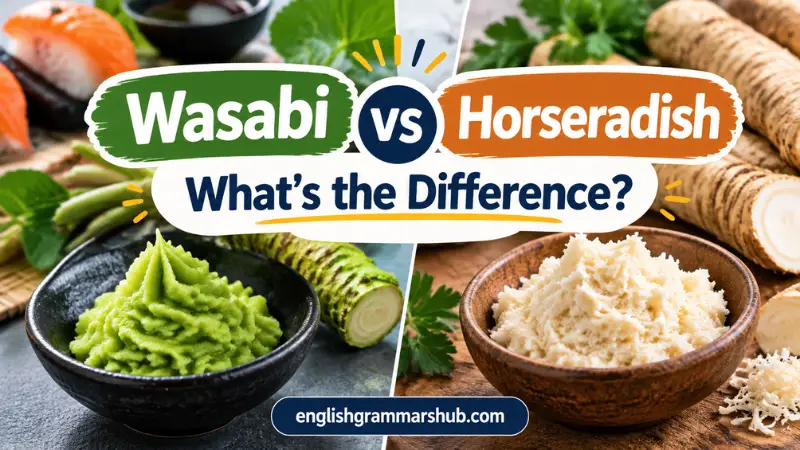
Wasabi and horseradish are often treated as the same thing because they have a similar sharp, nose-tingling heat. They are closely related plants in the mustard family, but they are not the same plant. True wasabi comes from Eutrema japonicum, while horseradish comes from Armoracia rusticana.
The confusion becomes greater because many prepared wasabi products contain a substantial amount of horseradish. The two plants can produce a similar type of pungent sensation, making horseradish a practical ingredient in many commercial wasabi-style products.
The main differences are their plant species, appearance, growing conditions, flavor, texture, availability, and traditional culinary uses. True wasabi is generally more delicate and complex, while horseradish has a stronger, sharper, more straightforward pungency.
Quick Answer
Wasabi and horseradish are different plants, but they belong to the same botanical family and have similar pungent flavors. Wasabi is Eutrema japonicum, traditionally associated with Japanese cuisine and often grated from its rhizome. Horseradish is Armoracia rusticana, a hardy plant grown mainly for its large root. Many commercial wasabi products use horseradish because true wasabi is more difficult to cultivate and less widely available.
Wasabi vs Horseradish at a Glance
| Feature | Wasabi | Horseradish |
|---|---|---|
| Botanical name | Eutrema japonicum | Armoracia rusticana |
| Plant family | Brassicaceae | Brassicaceae |
| Main edible part | Rhizome, with other parts also edible | Root |
| Traditional association | Japanese cuisine | European and American cuisine |
| Natural color | Green to pale green | White or cream |
| Typical flavor | Sharp, fresh, aromatic, slightly sweet and complex | Strong, sharp, peppery, mustard-like |
| Heat sensation | Fast, pungent, and relatively short-lived | Strong nasal heat that can feel more forceful |
| Growing conditions | Cool, moist environments; some cultivation uses flowing water | Much more adaptable and easier to grow |
| Availability | Relatively limited | Widely available |
| Commercial cost | Usually higher | Usually lower |
| Common culinary use | Sushi, sashimi, soba, sauces | Roast beef, sauces, dips, seafood, prepared condiments |
The most important point is simple: wasabi is not simply green horseradish. The plants are related, but they are botanically distinct.
What Is Wasabi?
Wasabi is a perennial plant scientifically accepted as Eutrema japonicum. It belongs to the Brassicaceae family, the same broad plant family that includes horseradish, mustard, cabbage, broccoli, and several other familiar vegetables.
Wasabi is native to East Asia, particularly Japan, and has traditionally been associated with cool, moist environments. It is especially famous for cultivation in areas with clean, cool water. Japanese agricultural sources distinguish between types grown in water-associated conditions and field-grown wasabi.
The part most commonly associated with the condiment is the thickened underground stem known as a rhizome. It is finely grated to produce the familiar green condiment served with Japanese foods.
The terminology can cause some confusion. People often call the wasabi rhizome a root because it grows underground. Botanically, however, the primary condiment-producing structure is a rhizome rather than a true root.
Wasabi is also not limited to its rhizome. Leaves, stems, flowers, and other plant parts can be used as food in Japanese cuisine. The rhizome remains the part most familiar internationally because of its use as a freshly grated condiment.
Wasabi’s botanical identity is well established: Kew’s Plants of the World Online recognizes Eutrema japonicum as the accepted scientific name.
What Is Horseradish?
Horseradish is a different perennial plant scientifically known as Armoracia rusticana. Like wasabi, it belongs to the Brassicaceae family.
Unlike wasabi, horseradish is primarily grown for its large underground root. The root is typically white or cream-colored and develops into a substantial, tapered structure.
Horseradish is much more adaptable to ordinary agricultural conditions than wasabi. It has been cultivated widely and is now grown in many parts of the world. In the United States, commercial production occurs in several states, including Illinois, California, New Jersey, Virginia, and Wisconsin.
The root is normally grated, crushed, or processed to produce the pungent condiment associated with horseradish. It can be used fresh or incorporated into prepared sauces and other foods.
The University of Wisconsin Extension identifies Armoracia rusticana as horseradish and distinguishes it from Japanese wasabi, despite their shared plant family.
Are Wasabi and Horseradish the Same Plant?
No. Wasabi and horseradish are separate plant species.
Wasabi is Eutrema japonicum, while horseradish is Armoracia rusticana. Their relationship is similar to that of other related plants within the Brassicaceae family: they share important biological characteristics without being the same species.
Their similar culinary effects explain much of the confusion.
Both plants contain compounds that contribute to pungency. When their plant tissues are damaged through grating, crushing, or similar processing, chemical reactions produce volatile compounds responsible for the characteristic sharp sensation.
This means the two condiments can seem remarkably similar even though their botanical origins are different.
The distinction is particularly important when discussing true wasabi. A product labeled or described as wasabi may not consist entirely of freshly grated Eutrema japonicum. Some commercial products rely heavily on horseradish and other ingredients to reproduce the familiar appearance and pungency.
Why Do Wasabi and Horseradish Taste Similar?
The similarity comes largely from their shared chemistry and evolutionary relationship.
Both plants belong to the Brassicaceae family and contain glucosinolates. When plant cells are damaged, enzymes help convert these compounds into pungent products, including isothiocyanates.
These compounds are responsible for the familiar sharp sensation that seems to rise through the nose and sinuses rather than producing only the lingering tongue burn associated with many chili peppers.
This is one reason wasabi and horseradish are commonly compared with each other.
However, chemical similarity does not mean identical flavor. The exact compounds and their relative concentrations differ between species. Research comparing wasabi and horseradish has documented differences in their isothiocyanate profiles.
As a result, the experience of eating fresh wasabi can be noticeably different from eating fresh horseradish, even though both produce a powerful pungent sensation.
What Does Wasabi Taste Like?
True wasabi is usually described as pungent, fresh, aromatic, and more complex than the simple heat associated with many commercial wasabi-style products.
Its heat is often perceived as immediate and nasal, but it does not necessarily remain intense for a long time. Freshly grated wasabi can also have subtle sweet, green, herbal, or floral qualities depending on the plant, growing conditions, preparation, and freshness.
The flavor is influenced by how the rhizome is grated and how quickly it is consumed afterward. Freshly prepared wasabi is particularly valued because its volatile flavor compounds change after preparation.
This makes fresh wasabi different from a long-lasting bottled condiment.
Another important characteristic is its texture. Properly prepared fresh wasabi tends to have a finer, more delicate texture than many inexpensive prepared wasabi products.
The overall impression is not simply “hot.” True wasabi combines pungency with a more layered flavor profile.
What Does Horseradish Taste Like?
Horseradish has a strong, sharp, pungent flavor with a distinctive mustard-like character.
Freshly grated horseradish can be extremely intense. Its volatile compounds create a powerful nasal sensation that can become apparent almost immediately after the root is grated.
Compared with fresh wasabi, horseradish is often perceived as more straightforward and aggressive in flavor. It has less of the delicate, fresh character associated with high-quality fresh wasabi.
The final flavor also depends on how horseradish is processed. Freshly grated horseradish behaves differently from prepared horseradish that has been mixed with other ingredients and treated to stabilize its flavor.
Preparation matters because the pungent compounds responsible for the heat are volatile and can change over time.
Is Wasabi Hotter Than Horseradish?
There is no simple universal rule that says one is always hotter.
Both can deliver intense nasal pungency, but the perceived strength depends on the plant variety, freshness, preparation, concentration, and chemical composition.
Fresh wasabi is often considered more nuanced rather than simply hotter. Horseradish can provide a particularly forceful and familiar sharpness, while fresh wasabi may combine its pungency with more noticeable aromatic and sweet characteristics.
The way the heat behaves is also important.
Neither condiment produces heat in exactly the same way as a chili pepper. Chili peppers primarily rely on capsaicin, which activates heat-sensitive receptors and tends to create a burning sensation in the mouth. Wasabi and horseradish rely heavily on volatile isothiocyanates, which produce a different kind of pungency.
That difference explains why the sensation can feel concentrated in the nose and upper airways.
Why Does Wasabi Make Your Nose Burn?
Wasabi produces a sharp nasal sensation because its pungent compounds are volatile.
When fresh wasabi is grated, plant cells are broken open. Enzymatic reactions produce volatile isothiocyanates. These compounds can travel into the nasal passages and stimulate sensory receptors associated with irritation and pungency.
The result is the familiar sudden sensation that seems to travel upward through the nose.
Horseradish behaves similarly.
This is one of the strongest reasons people associate the two foods. Their chemical mechanisms are sufficiently similar to create a comparable eating experience, even though their flavor profiles are not identical.
The sensation also tends to fade relatively quickly compared with the prolonged burning that can result from very spicy chili peppers.
Wasabi vs Horseradish: Botanical Differences
The botanical distinction is one of the clearest ways to separate the two.
Wasabi:
- Scientific name: Eutrema japonicum
- Family: Brassicaceae
- Native range includes Japan, Korea, and Sakhalin
- Commonly associated with cool, moist growing environments
- Traditionally cultivated in water-associated conditions as well as fields
- Primarily valued for its pungent rhizome
Horseradish:
- Scientific name: Armoracia rusticana
- Family: Brassicaceae
- Historically associated with Europe and western Asia
- Cultivated widely around the world
- More tolerant of ordinary agricultural conditions
- Primarily valued for its large root
Kew recognizes Eutrema japonicum as the accepted name for wasabi, while horticultural references identify Armoracia rusticana as horseradish.
So although “Japanese horseradish” is a common name for wasabi, it should not be interpreted as meaning that wasabi and horseradish are botanically identical.
Wasabi Rhizome vs Horseradish Root
One of the most useful distinctions is the part of the plant used.
Wasabi is mainly valued for its rhizome. A rhizome is a modified stem that grows horizontally underground or close to the soil surface. It can resemble a root, but it has a different botanical structure.
Horseradish is primarily grown for its root, which is a true root structure.
This distinction matters because both structures are processed into pungent condiments even though they develop differently.
Wasabi’s rhizome is generally green to pale green on the inside, while horseradish root is usually white or cream-colored.
The difference is particularly noticeable when comparing fresh plant material rather than prepared commercial products.
Why Is Real Wasabi So Expensive?
True wasabi is generally more expensive because it is difficult to cultivate and has relatively demanding growing requirements.
The plant is associated with cool, moist environments and, in traditional water-grown systems, carefully managed flowing water. It also takes time to reach a harvestable size.
North Carolina State University’s plant profile notes that wasabi can take years to reach a suitable harvest size and that cultivation can be difficult even under favorable conditions.
Horseradish is considerably easier to grow on a commercial scale. It is a hardy perennial crop that can be cultivated in ordinary agricultural environments.
The difference in production difficulty affects availability and price.
This is also one reason commercial food manufacturers often use horseradish as a major ingredient in products marketed as wasabi. Horseradish provides a similar type of pungency while being easier to source and generally less expensive.
Is the Green Wasabi Served With Sushi Real Wasabi?
Not necessarily.
The green condiment served with sushi can be made from genuine wasabi, but many prepared products contain horseradish as a major ingredient. Some formulations also use mustard and coloring to create the familiar green appearance and sharp flavor.
This does not mean every green wasabi-style condiment is identical. Formulations vary considerably between manufacturers and restaurants.
The safest distinction is between freshly grated true wasabi and prepared wasabi-style products.
True wasabi comes from Eutrema japonicum. A prepared product may contain some genuine wasabi, mostly horseradish, or a combination of ingredients.
The ingredient list is therefore more useful than the word “wasabi” alone when determining what a packaged product actually contains.
Commercial wasabi preparations have long been associated with horseradish-based formulations, particularly because of the difficulty and expense of producing genuine wasabi.
How Can You Tell Real Wasabi From Horseradish-Based Wasabi?
The most reliable method is to examine the ingredients and preparation rather than relying only on color.
Freshly grated true wasabi is naturally green and usually has a more delicate, complex appearance and flavor. Commercial imitation products may be brighter green and have a stronger, simpler pungency.
However, appearance alone is not enough.
A product can contain genuine wasabi and still include horseradish. Likewise, the color of a prepared product can vary according to its ingredients.
For packaged products, check the ingredient list for the presence and position of wasabi and horseradish. If horseradish appears prominently while actual wasabi is absent or present only in a small amount, the product is primarily a horseradish-based wasabi-style condiment.
For restaurant dishes, the only dependable answer may come from the restaurant or supplier because visual inspection cannot establish the botanical composition with certainty.
Wasabi vs Horseradish: Flavor Differences
The biggest culinary distinction is not simply heat but flavor complexity.
Wasabi tends to have a cleaner, fresher, more aromatic character. High-quality fresh wasabi may have subtle sweet, green, herbal, or floral notes beneath its pungency.
Horseradish generally has a stronger mustard-like sharpness. Its flavor is more direct and earthy, with an intense pungency that works particularly well with rich or fatty foods.
The difference becomes more obvious when the two are tasted fresh rather than in highly processed condiments.
Prepared versions can blur the distinction because manufacturers may combine several ingredients, adjust the texture, alter the color, and modify the intensity.
Wasabi vs Horseradish: Appearance Differences
Fresh wasabi and horseradish are relatively easy to distinguish when the plant material is intact.
Wasabi’s edible rhizome is generally green on the outside and inside, although the exact shade can vary.
Horseradish has a much larger, elongated root that is typically cream-colored or white inside.
Prepared condiments are more difficult to distinguish visually.
A green color is strongly associated with wasabi, but that does not prove that a product contains genuine wasabi. Green coloring may be added to horseradish-based products to imitate the appearance of traditional wasabi.
Therefore, green color is not reliable evidence of true wasabi.
Wasabi vs Horseradish: Growing Conditions
Growing conditions are another major difference.
Wasabi has demanding environmental requirements. It grows naturally in cool, moist areas and has a strong association with mountain streams and clean water. Some traditional Japanese production systems use flowing water to create suitable conditions.
Wasabi can also be grown in field environments, but successful cultivation still requires a suitable cool climate and careful management.
Horseradish is much less demanding.
It can grow in ordinary garden and agricultural environments and is capable of producing a large root under conditions that would not be suitable for traditional water-grown wasabi.
This difference in cultivation explains much of the difference in availability.
Wasabi’s demanding production environment contributes to its limited supply, while horseradish’s adaptability has allowed it to become a widely distributed crop.
Wasabi vs Horseradish: Culinary Uses
Wasabi is strongly associated with Japanese cuisine.
Its traditional uses include sushi, sashimi, soba, sauces, pickled preparations, and other Japanese foods. Freshly grated wasabi is particularly valued because of its distinctive aroma and short-lived pungency.
Horseradish has a different culinary history.
It is commonly associated with meat dishes, sauces, seafood, sandwiches, and prepared condiments. In American cuisine, horseradish is especially familiar as a sharp accompaniment to rich foods.
The two can sometimes be substituted for each other when the goal is simply to add pungency.
However, substitution does not reproduce the exact flavor of the original ingredient.
Using horseradish in place of fresh wasabi may provide the desired sharpness but will usually produce a stronger, less delicate flavor profile.
Can Horseradish Be Used Instead of Wasabi?
Yes, horseradish can often serve as a practical substitute when genuine wasabi is unavailable.
The substitution works because both plants provide a strong nasal pungency and belong to the same botanical family.
However, horseradish should not be treated as an exact flavor replacement.
Fresh wasabi has its own aroma, sweetness, texture, and chemical profile. Horseradish generally has a stronger mustard-like character.
For everyday cooking, the substitution may be perfectly functional when the primary goal is heat and pungency. For dishes where the distinctive flavor of genuine wasabi is central, the difference is more noticeable.
The amount may also need adjustment because prepared horseradish can be more intense than fresh wasabi.
Can Wasabi Be Used Instead of Horseradish?
Wasabi can also replace horseradish in some situations, but the result will be different.
Fresh wasabi can provide the desired pungency while adding a more delicate and aromatic flavor.
The main limitation is availability and cost.
Using genuine wasabi for a dish traditionally built around inexpensive horseradish may not be practical, especially when a large quantity of condiment is required.
Wasabi is better understood as an alternative source of pungency and flavor rather than a perfect one-to-one replacement.
Why Is Wasabi Sometimes Called Japanese Horseradish?
Wasabi is commonly known as Japanese horseradish because it resembles horseradish in flavor and culinary use.
The name is descriptive rather than a statement that the plants are identical.
The distinction is important because the term “Japanese horseradish” can make it sound as though wasabi is simply a Japanese variety of Armoracia rusticana. It is not.
Wasabi belongs to the genus Eutrema, while horseradish belongs to the genus Armoracia.
Japanese sources also use terminology that distinguishes native wasabi from Western-style horseradish used as a substitute. JETRO describes native Japanese wasabi as “hon-wasabi” and distinguishes it from Western horseradish.
Are Wasabi and Horseradish Related?
Yes. They are related members of the Brassicaceae family.
The Brassicaceae family includes a wide range of familiar food plants, including cabbage, broccoli, mustard, radish, horseradish, and wasabi.
Their relationship helps explain why wasabi and horseradish share several characteristics:
- Both develop pungency after their tissues are damaged.
- Both contain glucosinolates and related compounds.
- Both can produce volatile isothiocyanates.
- Both create a strong nasal sensation.
- Both are used as pungent condiments.
- Both are related to mustard and other Brassicaceae plants.
Their shared family explains the similarity, but their separate genera and species explain why they are not interchangeable in every culinary context.
Which Is Milder: Wasabi or Horseradish?
Fresh wasabi is often perceived as milder or more refined than horseradish, but this should not be treated as an absolute rule.
Heat perception varies according to freshness, variety, preparation method, concentration, and the exact product being compared.
True wasabi tends to be valued for a balance between pungency and aromatic flavor. Horseradish can have a particularly forceful sharpness, especially when freshly grated.
Prepared wasabi products complicate the comparison because many contain horseradish and may have been formulated specifically for a strong, familiar punch.
Therefore, comparing the plants themselves is more meaningful than comparing two random packaged condiments.
Which Has a Stronger Flavor?
Horseradish generally has the more direct and forceful flavor, while genuine wasabi is often described as more complex.
That does not mean genuine wasabi lacks heat. Fresh wasabi can be extremely pungent. The difference is that its flavor can include aromatic and subtly sweet characteristics that make the experience feel more rounded.
Horseradish tends to emphasize sharpness.
This distinction is particularly important for people who are familiar only with commercial green wasabi paste. A product based largely on horseradish may taste much closer to horseradish than to freshly grated Japanese wasabi.
Wasabi vs Horseradish for Sushi
Wasabi is the traditional choice for sushi and sashimi in Japanese cuisine.
Its pungency can complement raw fish without completely overwhelming the food when used appropriately. Freshly grated wasabi also has an aromatic character that contributes to the overall flavor.
Horseradish can imitate some of the same functional qualities, which is why horseradish-based wasabi products are common.
However, using horseradish instead of genuine wasabi changes the flavor.
For an authentic fresh-wasabi experience, the relevant ingredient is Eutrema japonicum, not simply any green horseradish-based paste.
Wasabi vs Horseradish for Roast Beef and Meat
Horseradish is the more traditional choice for many Western meat dishes.
Its intense sharpness works particularly well with rich foods, especially beef. The pungency can cut through fatty flavors and provide contrast.
Wasabi can also work with meat, particularly in modern fusion cooking, sauces, dressings, and marinades.
However, the choice changes the character of the dish. Horseradish generally creates a more traditional sharp and savory profile, while wasabi introduces a distinctly different aromatic quality.
The two should therefore be viewed as related but not identical condiments.
Does Freshness Matter?
Yes. Freshness is especially important for both wasabi and horseradish because their pungent flavor depends heavily on volatile compounds produced and released after the plant tissue is damaged.
Freshly grated material can have a much more pronounced aroma and sharper initial character than older prepared material.
Over time, the volatile compounds responsible for pungency can diminish or change.
This is one reason freshly prepared wasabi is considered substantially different from shelf-stable or long-stored products.
The same general principle applies to fresh horseradish.
Storage, preparation, and processing therefore have a major effect on the final eating experience.
Why Does Grated Wasabi Lose Its Punch?
Freshly grated wasabi does not maintain exactly the same aroma and pungency indefinitely.
The compounds responsible for its characteristic flavor are volatile and can change after the plant tissue is disrupted.
The preparation process itself triggers the chemistry that creates the pungent compounds. Once the wasabi has been grated, the resulting mixture begins to change.
This helps explain why freshly grated wasabi is often prepared close to serving time.
It also explains why packaged wasabi products require different formulations and preservation methods. Manufacturers need the product to maintain an acceptable flavor and texture over a much longer period.
Is Wasabi a Root or a Rhizome?
The main part of the wasabi plant used for the traditional condiment is technically a rhizome, not a true root.
This is an important botanical distinction.
A rhizome is a modified underground stem. It can produce roots and shoots and may look very similar to a root when viewed as food.
Horseradish, in contrast, is primarily valued for its true root.
The distinction is rarely important in everyday cooking, but it matters when explaining why the plants are botanically different.
Calling the wasabi rhizome a “root” in casual conversation is understandable, but “rhizome” is the more precise botanical term.
Is Green Horseradish the Same as Wasabi?
No.
Green horseradish is not automatically genuine wasabi.
A horseradish-based condiment can be colored green and marketed as a wasabi-style product. Its green appearance may make it look like the traditional Japanese condiment, but the underlying plant material can be predominantly horseradish.
True wasabi comes from Eutrema japonicum.
This distinction is particularly important when buying prepared products. The ingredient list provides more useful information than the color alone.
A product can legitimately be sold as a wasabi-flavored condiment while containing horseradish as a major component.
Does Wasabi Contain Horseradish?
Fresh, genuine wasabi does not need horseradish to be wasabi.
However, many commercial products sold as wasabi contain horseradish.
The two situations should be kept separate:
True wasabi:
Made from the wasabi plant, Eutrema japonicum.
Horseradish-based wasabi:
Uses horseradish as a major source of pungency and may include other ingredients.
Blended wasabi products:
May contain both genuine wasabi and horseradish in different proportions.
Therefore, the word “wasabi” by itself does not always tell you the exact botanical composition of a prepared condiment.
Nutritional Differences
Wasabi and horseradish are both strongly flavored condiments, so typical serving sizes are small.
Their nutritional contribution depends heavily on whether the food is fresh or processed.
Fresh plant material naturally contains water, carbohydrates, fiber, and small amounts of other nutrients. Prepared products can contain additional ingredients such as starches, oils, salt, sweeteners, acids, or other flavoring components depending on the formulation.
For this reason, it is not useful to assume that every product labeled wasabi has the same nutritional profile as fresh wasabi.
The same caution applies to prepared horseradish.
If nutrition is a major concern, the ingredient list and nutrition facts panel of the specific product are more meaningful than broad comparisons between the two plants.
Common Misconceptions
Misconception 1: Wasabi is simply green horseradish
This is incorrect.
True wasabi and horseradish are different plants. Their similarity comes from their botanical relationship and similar pungent chemistry.
Misconception 2: Every green wasabi product contains real wasabi
Not necessarily.
Many prepared products use horseradish as a major ingredient. Some may contain genuine wasabi as well, while others may contain little or none.
Misconception 3: Wasabi and horseradish taste exactly the same
They do not.
They share a strong nasal pungency, but their flavor profiles differ. Fresh wasabi can have a more complex aromatic character, while horseradish is typically sharper and more direct.
Misconception 4: Wasabi is always hotter
There is no reliable universal rule.
Heat depends on freshness, variety, concentration, preparation, and chemical composition.
Misconception 5: Wasabi grows only in water
This is an oversimplification.
Wasabi is strongly associated with cool, water-rich environments, and traditional water cultivation is important. However, field-grown wasabi also exists.
Wasabi vs Horseradish: Which One Should You Choose?
The right choice depends on the purpose.
Choose true wasabi when the goal is the distinctive flavor and aroma associated with freshly prepared Japanese wasabi.
Choose horseradish when you want a strong, sharp condiment for foods traditionally paired with horseradish or when availability and affordability matter.
Choose a horseradish-based wasabi product when the goal is a convenient, inexpensive condiment with a wasabi-like appearance and pungency.
Choose a blend containing genuine wasabi when you want some authentic wasabi character while using a more accessible prepared product.
The important point is to decide based on the flavor and ingredient composition you actually want rather than assuming all wasabi products are made from fresh wasabi.
Wasabi vs Horseradish: The Main Differences
The central differences can be summarized in five areas.
1. Plant identity:
Wasabi is Eutrema japonicum. Horseradish is Armoracia rusticana.
2. Plant part:
Wasabi is primarily valued for its rhizome, while horseradish is primarily grown for its root.
3. Flavor:
Wasabi generally has a more delicate, aromatic, and complex flavor. Horseradish is typically sharper, stronger, and more mustard-like.
4. Cultivation:
Wasabi has demanding growing requirements and is difficult to produce on a large scale. Horseradish is much easier to cultivate.
5. Commercial availability:
Horseradish is widely available, while genuine wasabi is comparatively limited and expensive.
These differences explain why horseradish is frequently used as an ingredient in commercial wasabi-style products.
FAQs
Is wasabi just horseradish?
No. True wasabi and horseradish are different plants. Wasabi is Eutrema japonicum, while horseradish is Armoracia rusticana. They belong to the same plant family and produce similar pungency, which is why they are often confused.
Why is horseradish used in wasabi?
Horseradish is widely used in prepared wasabi products because it provides a strong pungent flavor similar to that of wasabi and is easier to cultivate, obtain, and process. True wasabi is comparatively difficult to grow and is less widely available.
Is real wasabi green?
Yes. Fresh wasabi naturally has a green appearance, although the exact shade can vary. However, green color alone does not prove that a prepared condiment contains genuine wasabi because horseradish-based products can also be colored green.
Is horseradish hotter than wasabi?
Not in every situation. Perceived heat depends on freshness, variety, concentration, and preparation. Horseradish often has a stronger, more direct sharpness, while genuine wasabi can provide intense pungency with a more complex flavor.
Can horseradish replace wasabi?
Yes, in many recipes and casual uses. Horseradish provides a similar type of nasal pungency, making it a practical substitute. However, it does not reproduce the exact flavor, aroma, or texture of fresh wasabi.
Can wasabi replace horseradish?
Yes, but the result will taste different. Wasabi can provide pungency in sauces and other foods, but its more delicate flavor and higher cost can make it less practical for applications where horseradish is traditionally used.
Why is genuine wasabi expensive?
Genuine wasabi is expensive largely because the plant is difficult to cultivate, requires specialized environmental conditions, and takes significant time to develop. Horseradish is much more adaptable and therefore easier to produce commercially.
What plant family do wasabi and horseradish belong to?
Both belong to the Brassicaceae family, which also includes mustard, cabbage, broccoli, and several other familiar plants.
Is wasabi a root?
The part commonly grated to make traditional wasabi is technically a rhizome, which is a modified underground stem. It is commonly called a root in everyday speech, but “rhizome” is the more precise botanical term.
Is Japanese horseradish really horseradish?
“Japanese horseradish” is a common name for wasabi, but it does not mean that wasabi is the same species as Western horseradish. Wasabi belongs to Eutrema, while horseradish belongs to Armoracia.
Conclusion
Wasabi and horseradish are closely related but distinctly different plants. True wasabi comes from Eutrema japonicum and is traditionally associated with Japanese cuisine, while horseradish comes from Armoracia rusticana and is widely used in European and American cooking.
Their similar pungency explains why they are often confused and why horseradish is commonly used in prepared wasabi products. However, genuine wasabi has its own flavor, aroma, texture, growing requirements, and culinary identity.
The simplest way to remember the difference is this: wasabi is the Japanese plant traditionally grated into a green condiment, while horseradish is a separate, more widely cultivated plant known for its strong white root and sharp flavor.


