
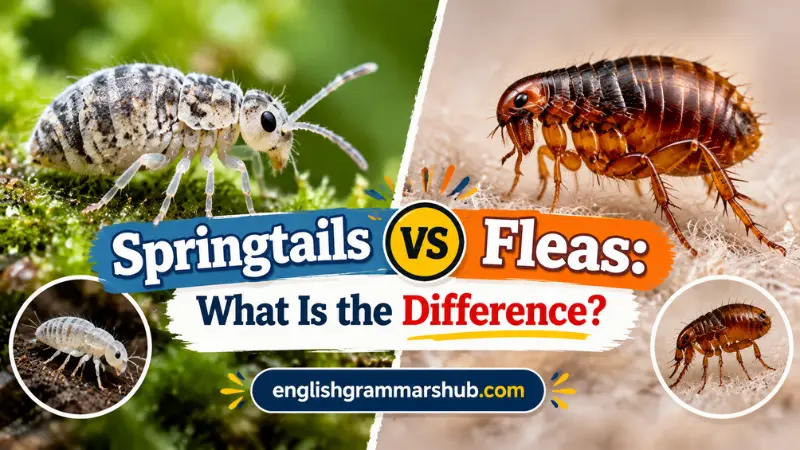
Springtails vs fleas is a common identification problem because both creatures are tiny, fast-moving, and can appear suddenly inside homes. Many people see small insects jumping on floors, furniture, or near pets and assume they are fleas. However, springtails and fleas are very different organisms with different behaviors, risks, and control methods.
Springtails are harmless moisture-loving creatures that usually feed on fungi, decaying plant material, and organic matter. Fleas are parasitic pests that feed on the blood of animals and can cause itchy bites on pets and humans.
The biggest difference is simple: springtails jump to escape and do not bite, while fleas jump to find hosts and feed. Correct identification helps you choose the right solution and avoid unnecessary pest treatments.
Quick Answer
Springtails and fleas may both jump, but they are not the same. Springtails are harmless moisture-loving organisms that usually live in soil, plants, and damp areas. Fleas are parasites that feed on blood and can bite pets and people. If you see jumping pests indoors, check their appearance, location, and behavior before deciding how to handle them.
TL;DR
- Springtails are tiny, harmless organisms that live in moist environments.
- Fleas are parasitic pests that bite animals and humans.
- Springtails usually appear near water, soil, plants, and damp areas.
- Fleas are commonly found on pets, carpets, bedding, and animal resting areas.
- Springtails jump using a tail-like structure called a furcula.
- Fleas jump using powerful legs and can survive by feeding on blood.
- Springtails do not require flea treatments because they are not parasites.
Springtails vs Fleas: Key Differences at a Glance
| Feature | Springtails | Fleas |
| Type | Tiny soil-dwelling arthropods | Parasitic insects |
| Main food source | Fungus, mold, organic matter | Blood from animals and sometimes humans |
| Bite humans? | No | Yes |
| Harm pets? | No | Yes |
| Common location | Moist soil, plants, bathrooms, basements | Pets, carpets, bedding, animal areas |
| Jumping method | Uses furcula (springing organ) | Uses powerful legs |
| Body shape | Soft, elongated or rounded | Flattened, hard-bodied |
| Size | Usually very small | Usually about 1–3 mm |
| Control focus | Reduce moisture | Treat pets and environment |
What Are Springtails?
Springtails are tiny arthropods commonly found in soil, leaf litter, gardens, compost, and damp indoor areas. They belong to a group called Collembola.
Although they are often mistaken for insects, springtails are not classified as true insects because they have different body structures and evolutionary characteristics.
They are named “springtails” because many species have a special jumping structure called a furcula. This fork-like appendage stays folded under the body and releases quickly when the creature feels threatened, launching it into the air.
Springtails commonly live in places with moisture, including:
- Garden soil
- Flower pots
- Greenhouses
- Compost piles
- Wet basements
- Bathrooms
- Areas with mold or excess humidity
They usually feed on:
- Fungi
- Algae
- Decaying plants
- Organic material
- Microorganisms
Unlike fleas, springtails do not seek animals for food.
What Are Fleas?
Fleas are small parasitic insects that survive by feeding on blood. They are well-known because they commonly affect household pets such as dogs and cats.
The most common household flea is the cat flea, which can affect both cats and dogs.
Fleas are adapted for living on animal hosts. Their bodies are:
- Small
- Dark brown
- Flattened from side to side
- Covered with strong outer structures
This flattened shape helps fleas move through animal fur.
Fleas feed by biting the skin and consuming blood. Their bites can cause:
- Itching
- Red bumps
- Skin irritation
- Allergic reactions
Pets with flea infestations may show:
- Excessive scratching
- Biting or licking fur
- Restlessness
- Hair loss in affected areas
Why Are Springtails and Fleas Confused?
The biggest reason people confuse springtails and fleas is their jumping behavior.
Both can suddenly disappear and reappear because they move quickly.
However, their reasons for jumping are different.
Springtails Jump to Escape
Springtails use their jumping ability as a defense mechanism.
They jump when:
- They are disturbed
- They feel threatened
- Their environment changes
They are not jumping toward humans or pets.
Fleas Jump to Find Hosts
Fleas jump because they need animals for survival.
They use their powerful legs to:
- Reach pets
- Move between hosts
- Find feeding opportunities
A flea’s jump is part of its parasitic lifestyle.
Appearance Differences Between Springtails and Fleas
Correct identification requires looking closely.
Springtail Appearance
Springtails vary in shape and color, but many are:
- White
- Gray
- Black
- Brown
Common features:
- Very small body
- Soft appearance
- Rounded or elongated shape
- Sometimes visible antennae
- Quick movement
Many springtails are less than a few millimeters long.
Because they are so small, they may look like moving specks.
Flea Appearance
Fleas have a more recognizable insect-like appearance.
Common features:
- Dark brown or reddish-brown color
- Flattened body
- Six legs
- Hard outer body
- No wings
Their bodies are designed to move through fur and resist pressure from scratching.
Size Comparison: Springtails vs Fleas
Both creatures are tiny, but their size and structure differ.
Springtails
Springtails are often extremely small.
Many species measure around:
- Less than 1–6 millimeters
Some are difficult to see without close inspection.
Fleas
Adult fleas are usually:
- About 1–3 millimeters long
They may be easier to recognize because of their darker color and body shape.
Size alone is not enough for identification because both can appear as tiny moving dots.
Jumping Ability: Springtails vs Fleas
Jumping is one of the biggest similarities between them.
How Springtails Jump
Springtails use a structure called a furcula.
The process:
- The furcula is held under the body.
- It releases suddenly.
- The body launches upward or forward.
Their jumps are often unpredictable.
They may appear to bounce randomly.
How Fleas Jump
Fleas have extremely powerful hind legs.
They use jumping to:
- Move between animals
- Escape danger
- Find hosts
Flea jumps are controlled and purposeful.
Where Are Springtails Usually Found?
Springtails prefer moisture.
Common locations include:
Indoor Areas
- Bathrooms
- Kitchens with leaks
- Basements
- Around sinks
- Damp window areas
Outdoor Areas
- Gardens
- Mulch
- Compost
- Wet soil
- Under leaves
If your home has high humidity or water problems, springtails may appear.
Where Are Fleas Usually Found?
Fleas are usually connected to animals.
Common locations include:
- Pet bedding
- Carpets
- Rugs
- Furniture
- Animal resting areas
- Cracks in floors
Flea eggs and larvae may develop in the environment even when adult fleas are mostly found on animals.
Do Springtails Bite Humans?
No. Springtails do not bite humans.
They do not:
- Drink blood
- Attack people
- Spread typical flea-like bites
If you see small jumping creatures but have no bites or pet problems, springtails may be the cause.
However, large numbers indoors can indicate moisture problems that should be addressed.
Do Fleas Bite Humans?
Yes. Fleas can bite humans.
Flea bites commonly appear as:
- Small red bumps
- Itchy spots
- Groups of bites
They often occur around:
- Ankles
- Lower legs
- Areas exposed while resting
Some people experience stronger reactions because of sensitivity to flea saliva.
Springtails vs Fleas on Pets
Springtails and Pets
Springtails do not live on pets.
If you find tiny jumping organisms near your pet, they are unlikely to be springtails on the animal.
They may simply be nearby in:
- Plant soil
- Bedding areas
- Damp locations
Fleas and Pets
Fleas commonly infest pets.
Signs include:
- Frequent scratching
- Restlessness
- Flea dirt (small dark particles)
- Excessive grooming
How to Identify Springtails vs Fleas at Home
When you notice tiny jumping creatures indoors, the first step is proper identification. Treating the wrong pest can waste time and money because springtails and fleas require completely different approaches.
A few simple observations can help you determine what you are seeing:
- Where are they found?
- Are pets affected?
- Are there bites?
- What do they look like?
- How do they move?
Check the Location
The location where you find tiny jumping creatures often provides the biggest clue.
Signs You May Have Springtails
Springtails are more likely if you find them:
- Around houseplants
- Near damp soil
- In bathrooms
- Around sinks
- In basements
- Near leaks or moisture problems
- Around outdoor mulch or compost
They often gather in groups in wet areas.
Example:
You notice dozens of tiny white jumping specks around the soil of a houseplant after watering it. These are more likely springtails than fleas.
Signs You May Have Fleas
Fleas are more likely if you find them:
- On pets
- In pet bedding
- On carpets
- On furniture where animals rest
- Near areas where pets spend time
Example:
Your dog keeps scratching, and you notice tiny dark insects moving through its fur. Fleas are a likely possibility.
Look for Bites and Skin Reactions
One of the easiest differences between springtails and fleas is their effect on humans and animals.
Springtails
Springtails:
- Do not bite
- Do not feed on blood
- Do not cause flea-like skin irritation
If you see jumping insects but no bites or pet scratching, springtails may be responsible.
Fleas
Fleas:
- Bite humans and animals
- Can cause itching
- May create red bumps
- Can trigger allergic reactions
If family members or pets have unexplained itchy bites, fleas should be considered.
The “White Speck” Problem
Many homeowners become concerned when they see tiny white jumping creatures.
White or pale springtails are especially confusing because people often mistake them for flea eggs or baby fleas.
However:
- Fleas do not look like tiny white jumping dots.
- Flea eggs are not jumping insects.
- Springtails commonly appear as tiny white moving specks.
If the creatures are jumping rapidly in damp areas, springtails are more likely.
Do Springtails and Fleas Live in the Same Places?
Usually, no.
Their preferred environments are very different.
Springtail Environment
Springtails need moisture.
They thrive in:
- Wet soil
- Organic debris
- Moldy areas
- Damp plant material
They are part of natural ecosystems and help break down organic matter.
Flea Environment
Fleas need animals and suitable places for development.
They commonly exist where:
- Pets sleep
- Animals spend time
- Eggs can develop in carpets or fabrics
The presence of pets strongly increases the chance of fleas.
Life Cycle Differences
Understanding the life cycle explains why control methods differ.
Springtail Life Cycle
Springtails develop through simple stages.
They:
- Hatch from eggs.
- Grow through immature stages.
- Become adults.
They do not have a complicated insect life cycle like fleas.
Because springtails depend heavily on moisture, reducing humidity often reduces their numbers.
Flea Life Cycle
Fleas have four main life stages:
- Egg
- Larva
- Pupa
- Adult
Adult fleas feed on animals, while immature stages develop in the environment.
This is why flea problems can continue even after removing visible adult fleas. Eggs and larvae may remain hidden in:
- Carpets
- Bedding
- Furniture
- Cracks
How to Get Rid of Springtails
Springtail control focuses mainly on removing moisture.
Because springtails are not dangerous pests, the goal is usually population reduction rather than aggressive elimination.
1. Reduce Moisture
The most effective step is controlling humidity.
Actions include:
- Fixing leaks
- Drying wet areas
- Improving ventilation
- Using a dehumidifier
- Allowing damp soil to dry
Example:
If springtails appear near a bathroom sink, fixing a moisture problem may solve the issue.
2. Manage Houseplants Carefully
Indoor plants can provide an ideal springtail environment.
Helpful steps:
- Avoid overwatering
- Allow soil surfaces to dry
- Remove dead leaves
- Improve drainage
Springtails in plant soil are usually harmless.
3. Remove Organic Material
Springtails feed on organic matter and fungi.
Reduce food sources by:
- Cleaning mold
- Removing decaying plant material
- Keeping areas dry
How to Get Rid of Fleas
Flea control requires a different strategy because fleas are parasites.
You usually need to treat both:
- The animal
- The environment
1. Treat Pets Properly
If pets have fleas, consult a veterinarian or use appropriate flea-control products.
Treatment options may include:
- Veterinary flea medications
- Flea shampoos
- Flea prevention products
Always follow product instructions carefully.
2. Clean the Home
Flea eggs and larvae can survive in the environment.
Helpful steps:
- Vacuum carpets regularly
- Wash pet bedding
- Clean furniture areas
- Dispose of vacuum contents properly
3. Continue Monitoring
Flea control may require repeated efforts because different life stages develop at different times.
Seeing fewer adult fleas does not always mean the entire problem is gone.
Springtails vs Fleas: Which One Is More Dangerous?
The answer depends on what you mean by “dangerous.”
Springtails
Springtails are generally harmless.
They:
- Do not bite
- Do not feed on humans
- Do not infest pets
However, a large number may indicate:
- Excess moisture
- Mold growth
- Water problems
Fleas
Fleas can be a real household pest.
They:
- Bite humans and animals
- Cause itching
- Affect pet health
- Can reproduce quickly
Fleas require more active control.
Common Mistakes When Identifying Springtails and Fleas
Mistake 1: Assuming Every Jumping Bug Is a Flea
Jumping does not automatically mean flea.
Springtails also jump.
Better approach:
Look at:
- Location
- Color
- Behavior
- Presence of pets
- Bite symptoms
Mistake 2: Treating Springtails With Flea Products
Flea treatments are designed for parasites.
They do not address the main cause of springtails, which is moisture.
Better solution:
Reduce humidity and remove damp conditions.
Mistake 3: Ignoring Moisture Problems
If springtails keep returning, the problem may not be the creatures themselves.
The real issue may be:
- Plumbing leaks
- Poor ventilation
- Wet soil
- High indoor humidity
Mistake 4: Treating Only Adult Fleas
Fleas have multiple life stages.
Removing visible adult fleas may not solve the problem if eggs and larvae remain.
Springtails vs Fleas: Quick Identification Checklist
Ask these questions:
Are they near moisture?
Yes → More likely springtails.
Are pets scratching?
Yes → More likely fleas.
Are there bites?
Yes → More likely fleas.
Are they in plant soil?
Yes → More likely springtails.
Are they in carpets and pet bedding?
Yes → More likely fleas.
Are they tiny white jumping dots?
More likely springtails.
Are they dark brown insects on animals?
More likely fleas.
Can Springtails Turn Into Fleas?
No.
Springtails and fleas are completely different organisms.
They have:
- Different biology
- Different feeding habits
- Different life cycles
- Different control methods
Seeing springtails does not mean a flea infestation is developing.
Can Fleas Live in Soil Like Springtails?
Fleas do not live in soil in the same way springtails do.
Outdoor fleas may exist where animals spend time, but they depend on animal hosts and suitable environments for reproduction.
Springtails naturally live in soil because that is where they find moisture and organic food.
Are Springtails Beneficial?
Yes, springtails can actually be useful in nature.
They help:
- Break down organic material
- Support soil health
- Recycle nutrients
Gardeners often consider them part of a healthy soil ecosystem.
Their presence outdoors is usually normal.
Are Fleas Beneficial?
Fleas do not provide benefits inside homes.
They are mainly known as parasites because they depend on animals for blood meals.
In natural ecosystems, they are part of food chains, but in homes they are considered unwanted pests.
FAQs
How can I tell the difference between springtails and fleas?
The easiest way is to check location and behavior. Springtails usually appear in damp areas and do not bite. Fleas are often found on pets or carpets and can cause itchy bites.
Do springtails bite dogs or cats?
No. Springtails do not bite pets or live on animals. If your pet is scratching, fleas or another parasite are more likely.
Why do I see tiny jumping bugs in my bathroom?
Tiny jumping bugs in bathrooms are often springtails because bathrooms provide moisture. Check for leaks, humidity, and damp areas.
Can fleas jump like springtails?
Yes, fleas are excellent jumpers. However, their jumping purpose is different. Fleas jump to find hosts, while springtails jump mainly as an escape response.
Should I worry if I find springtails indoors?
Usually, no. Springtails are harmless, but their presence may indicate excess moisture that should be corrected.
How long does it take to remove fleas from a home?
Flea control can take time because eggs, larvae, and pupae may remain in the environment. Consistent cleaning and proper treatment are usually necessary.
Can I use flea spray to kill springtails?
Flea sprays are not usually the best solution for springtails. Reducing moisture is often more effective because springtails depend on damp environments.
Conclusion
The difference between springtails vs fleas comes down to lifestyle and behavior. Springtails are tiny moisture-loving organisms that are usually harmless and often found near soil, plants, and damp areas. Fleas are parasitic pests that feed on blood and can cause problems for pets and people.
If you see tiny jumping creatures, do not assume they are fleas immediately. Check where they appear, whether pets are affected, and whether bites are present. Correct identification leads to the right solution: moisture control for springtails and proper flea treatment for flea infestations.


