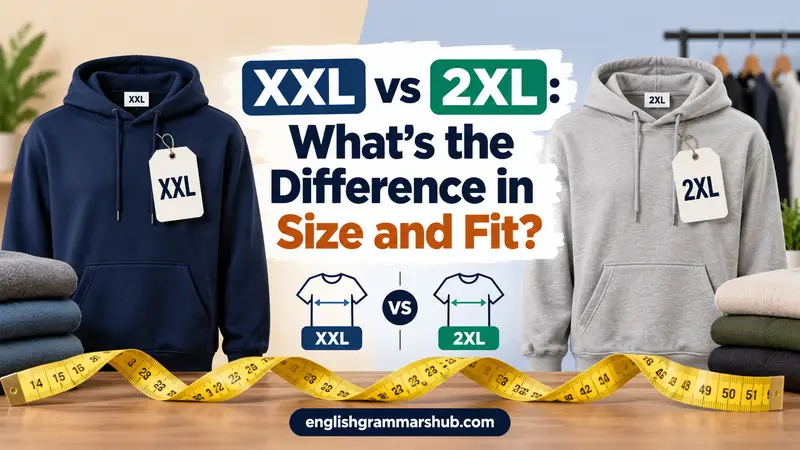
XXL vs 2XL can be confusing when shopping for clothes. Both labels stand for double extra large, but they don’t always describe the same fit. Some clothing brands use them interchangeably, while others separate regular XXL clothing from 2XL styles designed for broader body proportions.
The difference matters when buying T-shirts, hoodies, jackets, or other clothing online. Two shirts with similar size labels might fit differently around your chest, stomach, shoulders, and waist.
Knowing how these sizes work can help you choose clothes that feel comfortable without looking too tight or unnecessarily oversized.
Quick Answer
XXL and 2XL can mean the same size, but they aren’t always identical. XXL usually means double extra large in a standard clothing size range. In some men’s big-and-tall collections, 2XL identifies a roomier cut intended for broader body proportions.
However, clothing manufacturers don’t follow one universal naming system. Some use XXL and 2XL as interchangeable labels. Others offer them as separate sizes with different measurements.
The safest choice is to compare the brand’s actual measurements rather than relying on the label alone.
XXL vs 2XL: Key Differences at a Glance
The following table explains how these labels may differ, especially when a brand separates regular and big sizing.
| Feature | XXL | 2XL |
| Full meaning | Double extra large | Double extra large |
| Typical category | Standard extended sizing | Standard or big sizing |
| Chest fit | Based on regular size proportions | May provide broader proportions |
| Waist and stomach | Often follows a regular size pattern | May offer additional room |
| Shoulder fit | Depends on the garment’s cut | May be broader in big-size collections |
| Length | Regular or tall options | Regular, big, or tall options |
| Common availability | Mainstream clothing collections | Standard and extended-size collections |
| Best choice | When standard XXL measurements fit | When 2XL measurements suit your body |
| Interchangeable? | Sometimes | Sometimes |
These are possible distinctions, not universal sizing rules. The manufacturer’s chart determines whether the labels represent different garments.
What Does XXL Mean in Clothing?
XXL stands for double extra large. It describes a clothing size generally positioned above XL and below XXXL or 3XL.
You may see XXL on:
- T-shirts and polo shirts
- Hoodies and sweatshirts
- Jackets and coats
- Sportswear and activewear
- Dresses and casual tops
XXL clothing is often part of a brand’s regular size range, where the proportions increase from smaller sizes.
For example, a company might offer shirts in S, M, L, XL, XXL, and XXXL. Each size increases according to that company’s measurements.
However, XXL doesn’t guarantee a specific chest or waist measurement across all brands.
A relaxed-fit XXL shirt may feel much larger than a slim-fit XXL shirt, even when both come from the same manufacturer.
What Does 2XL Mean in Clothing?
2XL also means double extra large. The number 2 replaces the two Xs in XXL.
Many clothing companies use 2XL simply as another way to write XXL. However, some brands use 2XL in extended-size collections.
In those collections, the clothing may be designed with different body proportions, such as additional room around the midsection, chest, or upper arms.
For example, a brand might sell regular XXL shirts alongside 2XL big-size shirts.
Both could accommodate similar chest measurements, but their shapes might differ.
Important: A 2XL label doesn’t automatically mean the shirt is wider, longer, or larger than XXL. The difference exists only when the brand defines separate sizing categories.
Is 2XL Bigger Than XXL?
2XL isn’t automatically bigger than XXL.
When a manufacturer treats the two labels as equivalent, there may be no difference at all.
However, some manufacturers separate regular XXL clothing from 2XL big-size garments. In those cases, the 2XL version may provide a roomier fit through the waist, stomach, or upper body.
Consider two hypothetical shirts:
Shirt A: Regular XXL
- Designed for a standard extended-size range
- Follows regular shoulder and torso proportions
- Has a relatively straight body shape
Shirt B: Big-size 2XL
- Designed for a broader body shape
- May include more room through the waist
- May have different sleeve or torso proportions
Both could accommodate the same chest measurement while fitting differently elsewhere.
Therefore, comparing the actual garment dimensions is more reliable than assuming 2XL is one size larger.
XXL vs 2XL Size Chart: Understanding Measurements
There isn’t one official XXL vs 2XL size chart used by every clothing manufacturer.
For example, some men’s clothing charts list XXL and 2XL with the same chest measurement range but different cuts. Other charts include only one of these labels.
Here is an illustrative comparison showing how two garments might differ despite sharing a chest measurement.
| Measurement | Regular XXL example | Big-size 2XL example |
| Intended chest measurement | 50–52 inches | 50–52 inches |
| Waist fit | Standard proportions | Potentially roomier |
| Shoulder shape | Regular size grading | May have different proportions |
| Sleeve fit | Standard cut | May provide additional room |
| Body length | Depends on style | Depends on style |
These examples illustrate possible fit differences; they are not a universal size chart.
Also, pay attention to the distinction between body measurements and garment measurements.
A chart listing a 50-inch chest may mean the shirt fits a person with a 50-inch chest. It doesn’t necessarily mean the shirt itself measures 50 inches around.
Manufacturers add different amounts of extra fabric depending on whether clothing is slim, regular, relaxed, or oversized.
XXL vs 2XL in Men’s Clothing
Men’s clothing is one area where XXL and 2XL may represent different sizing systems.
Many manufacturers divide their products into regular, big, and tall categories.
Regular XXL
Regular XXL clothing usually follows the proportions of the brand’s standard size range.
It may suit someone who needs a larger chest and shoulder fit without substantially different torso proportions.
Still, regular XXL clothing varies between brands.
Big-Size 2XL
In certain collections, 2XL is used for big-size garments.
These clothes may provide additional space around the stomach and waist while maintaining appropriate shoulder and chest proportions.
Big-size clothing isn’t necessarily designed for taller people.
Tall Sizes
Tall sizing addresses length rather than simply increasing width.
For instance, a 2XLT or 2XL Tall shirt may have a longer torso and sleeves than its regular-length equivalent.
If a standard XXL fits around your chest but feels too short, a tall version may solve the problem better than moving to a wider size.
XXL vs 2XL in Women’s Clothing
Women’s sizing can be different from men’s sizing, particularly when comparing standard and plus-size collections.
Some women’s brands use XXL as part of their regular clothing range. Plus-size collections may instead use labels such as 1X, 2X, and 3X.
These labels aren’t necessarily equivalent.
For example, a women’s XXL top and a women’s 2X top might differ in their bust, waist, hip, and overall shape.
Plus-size clothing may also be designed using different proportions.
However, the exact differences depend on the brand.
Don’t automatically treat women’s XXL, 2XL, and 2X as the same size. Review the appropriate women’s size chart before ordering.
How Do XXL and 2XL Fit Different Body Types?
The best fit depends more on your measurements and the garment’s design than on the size label.
Broad Shoulders and Chest
Someone with broad shoulders may prefer a garment that provides additional upper-body room.
Look for chest and shoulder measurements rather than assuming 2XL will automatically fit better.
Fuller Stomach or Waist
If shirts regularly feel tight around your stomach but comfortable across your shoulders, consider garments with a roomier midsection.
Certain big-size styles may help, although relaxed-fit clothing can also provide extra comfort.
Tall Body Frame
Someone with a longer torso may need tall sizing.
A wider garment doesn’t necessarily add enough length, so check the body-length measurement separately.
Preference for Loose Clothing
If you enjoy oversized outfits, either label might work.
A relaxed or oversized XXL can be roomier than a fitted 2XL from another collection.
Fabric, style, and garment measurements all influence the final result.
XXL vs 2XL in T-Shirts and Hoodies
T-shirts and hoodies can fit differently even when they carry identical size labels.
T-shirts made from lightweight cotton or stretch fabric may follow the shape of your body more closely.
Hoodies often include additional room for movement or layering.
For example, consider someone who wears a regular XXL T-shirt comfortably but wants a hoodie to wear over another shirt.
A relaxed-fit XXL hoodie might already provide enough space. Moving to 2XL wouldn’t necessarily improve the fit.
Meanwhile, someone whose T-shirt feels tight around the stomach may benefit from a different cut rather than simply choosing another label.
When comparing T-shirts and hoodies, check:
- Chest width
- Body length
- Sleeve length
- Shoulder construction
- Fabric stretch
- Regular, slim, relaxed, or oversized fit
Garment design can affect comfort just as much as the printed size.
Why Do Clothing Brands Use Different Size Labels?
Clothing brands use different sizing systems because garment dimensions aren’t controlled by one universal standard.
Some companies write XXL, while others use 2XL for the same general size.
Others maintain separate standard and big-size ranges.
Clothing measurements also vary because of design choices.
For example, a fashion brand may produce narrow, fitted shirts, while a workwear company may offer roomier cuts designed for movement.
Even within one brand, a regular-fit shirt can have different measurements from an oversized shirt.
This is why a size that fits perfectly in one store might feel uncomfortable in another.
The label provides a starting point, but the actual dimensions determine the fit.
How to Choose Between XXL and 2XL When Shopping Online
Choosing the right size online becomes easier when you follow a consistent process.
First, open the size chart for the exact product you’re buying.
Next, determine whether the chart lists XXL and 2XL separately.
If both labels appear, compare their measurements and fit descriptions.
Then, look at the garment’s cut. A slim-fit XXL may feel different from a relaxed-fit 2XL.
Finally, compare the product dimensions with a similar garment that already fits you well.
Quick Size Selection Guide
Does the brand show XXL and 2XL as separate options?
Both labels have the same measurements
The measurements are different
I’m not sure
What’s your preferred fit?
Regular fit
Roomier fit
Sizing guidance
Start with the product’s size chart and compare it with a garment you already own.
Common Mistakes When Comparing XXL and 2XL
One common mistake is assuming that 2XL must be larger because it contains a number.
The labels usually communicate the same general size level.
Another mistake is treating chest size as the only important measurement. A shirt may fit across your chest but feel tight at the waist or too short at the hem.
Shoppers also sometimes confuse big sizing with tall sizing.
Big-size garments focus on body proportions and circumference. Tall-size garments usually include additional length.
Finally, buying the same labeled size across every brand can lead to poor-fitting clothes.
Check individual product measurements whenever possible, especially when trying a new manufacturer.
Easy Way to Remember the Difference
Remember this simple rule:
XXL and 2XL mean double extra large, but the fit depends on the brand.
The letters and numbers alone cannot tell you whether a garment will be wider or longer.
Use this three-part check:
- Label: Does the brand treat XXL and 2XL as identical?
- Measurements: Are the chest, waist, and length dimensions different?
- Fit: Is the garment regular, relaxed, big, or tall?
Checking these details is more useful than relying on the size name alone.
FAQs
Are XXL and 2XL exactly the same size?
XXL and 2XL are the same general size designation, but they aren’t always identical in actual measurements. Some brands use the terms interchangeably. Others use separate labels for regular and extended-size clothing. Check the brand’s size chart to understand the difference.
Which is bigger, XXL or 2XL?
Neither is universally bigger. Some brands make XXL and 2XL equivalent, while others design 2XL for different body proportions. When both sizes are available, compare their chest, waist, and garment-length measurements to determine which one is actually larger.
Is XXL the same as 2X?
Not necessarily. In women’s clothing, XXL may belong to a regular size range, while 2X often refers to plus-size clothing. The two may have different bust, waist, and hip proportions. The exact relationship depends on the manufacturer.
What chest size is XXL?
XXL doesn’t have one universal chest measurement. For example, some US men’s clothing charts associate this size with a 50–52-inch chest, but other brands use different ranges. Always check whether the measurement refers to the wearer’s body or the actual garment.
Is 2XL suitable for a big stomach?
A 2XL garment may suit someone with a fuller stomach when its cut provides extra room through the midsection. However, not every 2XL design is roomier than XXL. Check the waist and garment-width measurements instead of relying only on the label.
Is XXL or 2XL better for tall people?
Neither label automatically indicates extra length. Tall individuals should look for options specifically marked Tall, such as XXLT or 2XLT. These versions generally add length to the torso or sleeves, though the exact adjustments depend on the manufacturer.
Can I wear 2XL if I usually wear XXL?
Yes, you may be able to wear 2XL if the manufacturer’s measurements and garment cut suit your body. Since some companies treat XXL and 2XL as equivalent, switching labels might make no difference. Compare the sizing chart before purchasing.
Conclusion
The main difference between XXL vs 2XL comes down to how clothing brands define their sizes. Both labels mean double extra large, and many companies use them interchangeably.
However, some manufacturers distinguish regular XXL clothing from 2XL garments designed with broader proportions.
Neither label guarantees a larger or more comfortable fit.
For the best results, measure your chest and waist, check the product’s length, and compare those numbers with the manufacturer’s chart.
The right size is the one that matches your measurements and preferred fit, regardless of whether the label says XXL or 2XL.