
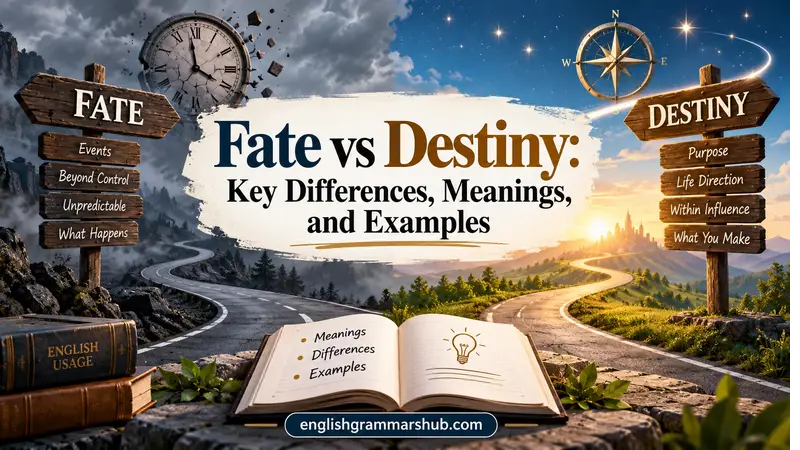
Fate vs destiny is a common comparison because both words describe what happens in life and whether the future is already decided. Although people often use them as synonyms, they can express different ideas about control, purpose, and personal choice.
Fate usually suggests an outcome that seems unavoidable or beyond someone’s control. Destiny often suggests a future path, especially one connected to a person’s purpose, potential, or achievements.
However, the difference isn’t absolute. Both words can describe positive or negative outcomes, and both can refer to events believed to be predetermined.
Understanding their usual meanings helps you choose the right word in conversations, stories, essays, and everyday writing.
Quick Answer
The main difference between fate and destiny is their usual emphasis. Fate often describes an unavoidable event or final outcome, especially an unfortunate one. Destiny often refers to a person’s future path or what they may be meant to achieve. Both words can suggest that events are predetermined, so neither word always means that personal choices can or cannot change the future.
A simple way to remember the difference is:
- Fate: What happens to you, sometimes beyond your control.
- Destiny: The future path your life follows or the purpose you may fulfill.
For example, losing a championship because of an unexpected injury might be described as fate. Becoming a respected athlete after years of training might be described as fulfilling a destiny.
These are differences in emphasis, not strict rules.
Fate vs Destiny: Key Differences at a Glance
The following table explains how the words usually differ in modern English.
| Feature | Fate | Destiny |
| Basic meaning | An outcome or force believed to determine events | A future course of events or supposed life purpose |
| Main emphasis | Inevitability and outcomes | Future direction and significance |
| Personal control | Often suggests limited control | Can emphasize choices or a predetermined future |
| Emotional tone | Often negative, serious, or neutral | Often positive, hopeful, or neutral |
| Common context | Tragedy, chance, final results | Goals, achievements, purpose |
| Typical expression | Accept your fate | Shape your destiny |
| Example | His fate was decided by the court. | She believed her destiny was to teach. |
| Part of speech | Noun; also a verb in certain forms | Noun |
The most important distinction is how each word presents an event.
Fate often draws attention to the outcome itself. Destiny often draws attention to a larger story or future direction.
What Does Fate Mean?
Fate means the events that happen to someone or something, especially when those events seem unavoidable or beyond personal control.
It can also describe a power that people believe determines future events.
In simple terms, fate is what happens when circumstances, chance, or forces outside our control seem to decide an outcome.
Fate as an Unavoidable Outcome
People often use fate when discussing situations they believe cannot be changed.
Examples:
- The passengers feared their fate when the ship began sinking.
- The final vote would decide the company’s fate.
- He accepted his fate after losing the competition.
- Nobody knew what fate awaited the missing hikers.
In these sentences, fate refers to an uncertain or final result.
The word does not necessarily mean a supernatural force caused the outcome.
Fate as a Mysterious Force
Sometimes, fate refers to the belief that certain events are meant to happen.
For example:
“After meeting by chance in three different cities, they believed fate had brought them together.”
Here, fate describes an apparent pattern that seems too meaningful to be a coincidence.
This is a personal interpretation rather than proof that events were predetermined.
Is Fate Always Negative?
No. Fate can describe positive, negative, or neutral experiences.
However, it often appears in serious situations involving danger, death, loss, or major life changes.
Compare these examples:
- Negative: The soldiers faced a terrible fate.
- Positive: By a fortunate twist of fate, she found her missing dog.
- Neutral: The committee will determine the building’s fate.
All three sentences use the word correctly.
What Does Destiny Mean?
Destiny refers to the future events that may happen to a person or thing. It can also mean a future path or purpose that someone believes is meant for them.
The word often carries a sense of importance or significance.
For example:
“She believed it was her destiny to become a doctor.”
This sentence suggests that becoming a doctor feels connected to her purpose in life.
It does not necessarily mean she believes her success will happen without effort.
Destiny as a Life Purpose
People often use destiny when talking about ambitions, personal growth, or meaningful achievements.
Examples:
- He believed his destiny was to help others.
- The young musician dreamed of fulfilling her destiny.
- She worked hard to create the future she wanted.
- The hero discovered his destiny during the journey.
The word can make an ordinary goal sound more important or deeply personal.
Destiny as a Predetermined Future
Destiny can also describe something believed to be impossible to avoid.
For example:
“The ancient prophecy claimed that the prince could not escape his destiny.”
In this sentence, destiny refers to a future supposedly fixed in advance.
This meaning is especially common in myths, fantasy stories, and religious or philosophical discussions.
Can Destiny Be Negative?
Yes. Although destiny often sounds hopeful, it can also describe tragedy.
For example:
“The character struggled against a tragic destiny.”
The sentence suggests that a painful future may be unavoidable.
Therefore, describing destiny as always positive would be inaccurate.
Fate vs Destiny: The Role of Free Will
One reason fate and destiny are confusing is that both connect to the idea of free will.
Free will means the ability to make choices rather than having every decision completely determined by outside forces.
In some interpretations, fate suggests that people cannot change a particular outcome.
Destiny, meanwhile, is sometimes presented as a future that people help shape through their decisions.
For example, consider a student who wants to become a scientist.
A writer emphasizing fate might say:
“Fate placed her in the right classroom at the right moment.”
A writer emphasizing personal destiny might say:
“She spent years studying because she wanted to shape her own destiny.”
The first sentence highlights circumstances. The second highlights personal effort and future direction.
However, this is not a fixed philosophical distinction. Some beliefs treat destiny as completely predetermined, while others allow human choice to influence the future.
Fate vs Destiny in Everyday Life
People use fate and destiny in ordinary conversations without necessarily thinking about philosophy.
Their word choice often depends on the feeling they want to express.
Fate in Everyday Situations
Imagine someone misses a flight but later learns that the delay allowed them to attend an important family event.
They might say:
“Maybe it was fate that I missed that flight.”
The speaker suggests that an unexpected event had a meaningful result.
Other examples include:
- It must have been fate that we met again.
- We cannot predict the fate of the old restaurant.
- A sudden storm changed the travelers’ fate.
Destiny in Everyday Situations
Destiny often appears when people talk about their goals or future direction.
Examples:
- You have the power to shape your destiny.
- She felt that teaching was her destiny.
- He moved to New York to pursue his dreams and build his future.
The phrase shape your destiny emphasizes personal responsibility.
It does not require a belief that the future has already been written.
Fate vs Destiny in Love and Relationships
Both words frequently appear in romantic conversations, movies, books, and songs.
However, they can create slightly different impressions.
What Does Fate Mean in Love?
Fate in love often suggests that two people met because of forces beyond their control.
For example:
“We met unexpectedly at the airport. It felt like fate.”
The speaker believes the meeting was unusually meaningful.
Another example:
“After years apart, fate brought them together again.”
Here, fate emphasizes the unexpected circumstances of their reunion.
What Does Destiny Mean in Love?
Destiny in love often suggests that a relationship belongs to someone’s larger life story.
For example:
“She believed they were destined to be together.”
This sentence describes a belief that the relationship was meant to happen.
The words overlap considerably in romantic contexts.
Someone might say either “We were brought together by fate” or “We were destined to meet” without a major change in meaning.
Neither expression proves that a relationship is predetermined.
Fate vs Destiny in Literature and Storytelling
Writers use fate and destiny to explore difficult questions about freedom, responsibility, and the future.
These ideas are especially important in tragedy, mythology, fantasy, and adventure stories.
Fate in Tragic Stories
In tragedies, fate often represents a powerful outcome that characters struggle to avoid.
A well-known example is Oedipus Rex.
In the play, a prophecy predicts that Oedipus will kill his father and marry his mother.
The attempts to avoid this predicted future become part of the story that leads to its fulfillment.
The play raises an important question: Can someone escape an outcome that appears to have been decided in advance?
Fate is central to this conflict.
Destiny in Heroic Stories
Destiny often appears in stories about heroes who discover an important role or mission.
For example, a young character may learn that they are expected to save a kingdom.
The story then follows their struggle to understand that responsibility.
The character’s destiny provides a sense of direction, while their choices create conflict and growth.
Still, destiny does not always lead to success. A story may challenge whether the supposed future should be accepted at all.
Fate and Destiny in Shakespeare
In Romeo and Juliet, the lovers are described as star-crossed.
This expression suggests that forces associated with the stars or destiny work against their relationship.
The play connects the idea of an unlucky future with the characters’ decisions, family conflict, and tragic circumstances.
It also shows why fate and destiny cannot always be separated into simple categories.
Fate and Destiny in Greek Mythology
Ancient Greek mythology offers an important historical example of fate as a force governing life.
The Moirai, commonly called the Fates, were three figures associated with the course of human life.
They are traditionally known as:
- Clotho: Associated with spinning the thread of life.
- Lachesis: Associated with allotting or measuring life’s portion.
- Atropos: Associated with cutting the thread of life.
Together, they represented the idea that human lives have limits and that some events are beyond individual control.
The famous image of a thread being spun, measured, and cut helped connect fate with the length and course of life.
Not every Greek myth presents human freedom and divine control in exactly the same way. Different stories explore different relationships between prophecy, gods, personal choice, and necessity.
Today, references to the Fates often appear in fantasy books, games, poetry, and discussions of mythology.
Fate vs Destiny in Philosophy
Philosophy examines whether events happen through necessity, chance, personal decisions, or some combination of these factors.
Fate and destiny are useful everyday words, but they do not correspond to one universally accepted philosophical theory.
Fatalism
Fatalism is the view that certain outcomes are unavoidable regardless of what people do.
For example, someone expressing a fatalistic attitude might say:
“There is no point trying because the result will be the same.”
This viewpoint focuses on the inevitability of an outcome.
However, a person can casually talk about fate without accepting fatalism as a philosophical position.
Determinism
Determinism is the view that events are determined by prior conditions and laws or causes.
It differs from fatalism because causes and actions still matter within a deterministic explanation.
For example, studying may cause a student to perform better on an exam.
A deterministic account can treat the student’s decision to study as part of the chain of causes producing the result.
Fatalism, in contrast, emphasizes that a particular outcome cannot be avoided regardless of attempts to change it.
Personal Choice and Destiny
Some people use destiny to express the idea that life has a purpose.
Others use it to describe a future they actively build.
For example:
“Your choices today can shape your destiny tomorrow.”
This is motivational language, not a philosophical proof about whether the future is predetermined.
The distinction matters because ordinary English often uses these words more flexibly than formal philosophy does.
Fate vs Destiny: Which Word Should You Use?
Choose the word that best communicates your intended meaning and emotional tone.
Use fate when you want to emphasize an outcome, an unexpected turn of events, or something beyond personal control.
Use destiny when you want to emphasize a future path, personal purpose, or a meaningful achievement.
Consider the following situations.
Situation: An unexpected reunion
“Fate brought the childhood friends together again.”
This sounds natural because the sentence emphasizes coincidence.
Situation: A lifelong ambition
“She believed her destiny was to become a writer.”
Destiny sounds natural because the sentence emphasizes purpose.
Situation: A final legal decision
“The judge’s ruling determined his fate.”
Fate works better because the focus is the result.
Situation: Taking responsibility for the future
“He refused to let others control his destiny.”
Destiny works well because the emphasis is future direction.
These choices reflect common usage, not rules that forbid swapping the words.
Common Expressions With Fate and Destiny
English contains several established expressions that make the difference easier to understand.
Common Expressions With Fate
A twist of fate
An unexpected event that changes what happens.
“By a strange twist of fate, the former neighbors became coworkers.”
Tempt fate
To take an unnecessary risk or act as though something bad cannot happen.
“Don’t tempt fate by driving through the flooded road.”
Seal someone’s fate
To make a particular outcome certain, often an unpleasant one.
“The final mistake sealed the team’s fate.”
Accept your fate
To stop resisting an outcome that seems unavoidable.
“After the announcement, he accepted his fate and began planning his next move.”
Leave something to fate
To allow events to develop without trying to control them.
“Instead of making a decision, they left the matter to fate.”
Common Expressions With Destiny
Fulfill your destiny
To achieve something believed to be part of your future or purpose.
“She felt she was fulfilling her destiny when she opened the school.”
Shape your destiny
To influence your future through decisions and actions.
“He believed education could help him shape his destiny.”
Control your destiny
To direct your own future rather than allowing others to decide it.
“Starting her own business gave her a greater sense of control over her destiny.”
Manifest destiny
This expression has a specific historical meaning in American history.
It refers to the nineteenth-century belief that the United States was destined to expand across North America.
That belief was used to justify territorial expansion and was closely connected with the displacement of Indigenous peoples and conflicts over land.
Because of this history, Manifest Destiny should not be treated as simply another motivational expression.
Fate vs Destiny: Example Sentences
The following original examples show how both words work in different contexts.
| Context | Fate Example | Destiny Example |
| Career | A factory closure changed his fate. | She believed her destiny was to become an engineer. |
| Education | The exam results would decide his academic fate. | He worked hard to shape his educational destiny. |
| Love | Fate brought them together at the wedding. | They believed they were destined to meet. |
| Sports | One missed shot sealed the team’s fate. | The athlete dreamed of fulfilling her destiny. |
| Adventure | The travelers could not predict their fate. | The explorer believed an extraordinary destiny awaited her. |
| Family | An unexpected inheritance changed the family’s fate. | She wanted to create a better destiny for her children. |
Notice that the words sometimes overlap.
For example, the sentence “She accepted her destiny” is possible, especially when someone believes that their future cannot change.
Similarly, “He changed his fate” is a natural expression, even though fate often suggests inevitability.
English speakers choose these words according to context and emphasis.
Common Mistakes When Using Fate and Destiny
Several misunderstandings can make these words difficult for learners.
Mistake: Fate Always Means Something Bad
Fate often appears in negative situations, but it does not always mean misfortune.
Incorrect assumption: Every use of fate describes tragedy.
Better understanding: Fate can describe any significant outcome or a supposed force controlling events.
For example:
“It was a lucky twist of fate that helped them meet.”
This is a positive use.
Mistake: Destiny Always Means Success
Destiny can describe hope and achievement, but it can also describe failure or tragedy.
For example:
“The villain could not escape his tragic destiny.”
The word remains correct even though the outcome is negative.
Mistake: Destiny Always Involves Free Will
Some people associate destiny with personal choice.
However, destiny can also refer to a future believed to be fixed.
Consider:
“The prophecy said the queen could not escape her destiny.”
Here, destiny implies little or no freedom to avoid the predicted outcome.
Mistake: The Words Are Never Interchangeable
Fate and destiny have overlapping meanings.
Consider:
“It seemed like fate that they met.”
“It seemed like destiny that they met.”
Both sentences are natural.
The second may sound more connected to a larger life story, but the core message is similar.
Mistake: Using the Wrong Preposition
Certain word combinations sound more natural than others.
Less natural: “She believed in destiny for become famous.”
Natural: “She believed it was her destiny to become famous.”
Less natural: “He was destined for become a doctor.”
Natural: “He was destined to become a doctor.”
The usual patterns are destined to + verb and destined for + noun or noun phrase.
Fate, Destiny, Luck, and Chance: What’s the Difference?
Fate and destiny are also confused with luck and chance.
These concepts are related, but each highlights a different aspect of an event.
Fate suggests an outcome or force that seems beyond personal control.
Destiny often suggests a future path or purpose, sometimes believed to be predetermined.
Luck describes good or bad fortune, especially when the result is not fully controlled by skill or planning.
Chance refers to possibility or the occurrence of events without deliberate planning.
Compare these sentences:
- Fate: “Their unexpected meeting felt like fate.”
- Destiny: “She believed her destiny was to become a leader.”
- Luck: “He had good luck finding his lost wallet.”
- Chance: “They met by chance at a bookstore.”
The distinctions depend on how the speaker views the event.
A person might describe the same meeting as chance, luck, or fate.
Each choice communicates a different interpretation.
Easy Memory Trick for Fate vs Destiny
A useful memory trick is to connect each word with a simple question.
Fate = What happened?
Think about an outcome, coincidence, or event outside your control.
Destiny = Where is life heading?
Think about a future path, purpose, or significant life direction.
For example, imagine two people discussing a successful artist.
One person says:
“By a twist of fate, she met a famous producer.”
This sentence focuses on an unexpected meeting.
Another says:
“She believed becoming a musician was her destiny.”
This sentence focuses on a larger life goal.
Remember that the memory trick describes common associations rather than absolute definitions.
FAQs
Are fate and destiny the same thing?
Fate and destiny have similar meanings, and people sometimes use them interchangeably. Both can refer to future events or a force believed to control what happens.
The difference is usually one of emphasis. Fate often highlights an unavoidable result or unexpected circumstance, while destiny often suggests a future path or personal purpose.
Is fate stronger than destiny?
Neither word is inherently stronger. Fate can sound more final or unavoidable, especially in tragic situations. Destiny can sound equally powerful when it refers to a future that cannot be changed.
The strength of either word depends on the sentence and the speaker’s beliefs.
Can you change your fate or destiny?
In everyday English, people commonly say that they can change their fate or shape their destiny.
Whether the future is actually predetermined is a philosophical question, not something settled by the meanings of these words.
Both expressions can communicate hope, determination, or the desire to overcome difficult circumstances.
Is destiny always positive?
No. Destiny can refer to positive, negative, or neutral future events.
Although it often appears in hopeful expressions about purpose and success, it can also describe tragedy.
For example, a character in a novel may struggle against a destiny that promises suffering or loss
What is the difference between fate and destiny in love?
Fate in love often highlights an unexpected meeting or coincidence that feels meaningful.
Destiny often suggests that a relationship is part of a larger life path.
For example, “Fate brought us together” emphasizes circumstances, while “We were destined to be together” emphasizes the belief that the relationship was meant to happen.
Does fate mean everything is predetermined?
Not always. Fate can describe a supposed force controlling events, but it can also mean a person’s outcome without any claim about supernatural control.
For example, “The jury will decide his fate” simply means that the jury will determine what happens to him.
The sentence does not require a belief in predetermination
Which is correct: destined to or destined for?
Both are correct, but they follow different grammatical patterns.
Use destined to before a base verb, as in “She was destined to succeed.”
Use destined for before a noun or noun phrase, as in “He seemed destined for greatness.”
Choosing the right form makes your sentence sound natural.
Conclusion
The difference between fate vs destiny becomes clearer when you focus on how each word is used.
Fate usually emphasizes an outcome or event beyond someone’s control. Destiny often emphasizes a future path, personal purpose, or meaningful direction.
Both words can describe predetermined events, and neither is limited to positive or negative situations.
When choosing between them, think about the message you want to communicate. If you are describing an unexpected result or unavoidable situation, fate may be the better choice. If you are discussing future purpose or direction, destiny may sound more natural.
The key is to use the word that best matches the context, rather than treating the two terms as completely different ideas.