
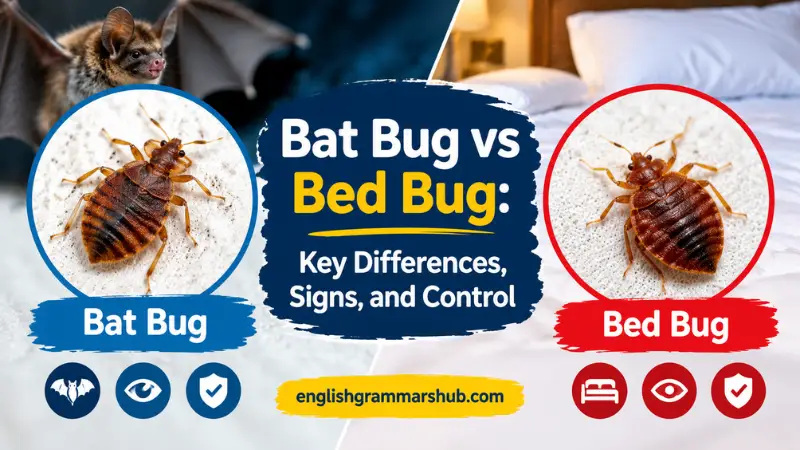
Bat bug vs bed bug can be a surprisingly difficult comparison because the two insects look extremely similar. Both belong to the family Cimicidae, can bite people, and may turn up inside homes. However, they have different primary hosts and require different approaches to control.
The biggest practical clue is not simply color, size, or body shape. Under magnification, the hairs along the pronotum—the area just behind the head—are longer on bat bugs than on bed bugs. Because this distinction can be difficult to see in ordinary photographs, professional identification is often worthwhile before treating an infestation.
Quick Answer
A bat bug primarily feeds on bats, while a bed bug primarily feeds on humans. They are so similar in appearance that reliable identification may require magnification or microscopic examination.
The most useful physical difference is the length of the hairs on the pronotum. Bat bug hairs are longer than the width of the eye; bed bug hairs are shorter than the eye width. Habitat provides another important clue: bat bugs are associated with bat roosts, often in attics, eaves, or wall spaces, while bed bugs are commonly found around beds, furniture, and other places where people rest.
If you find a suspected specimen, avoid assuming it is a bed bug based only on its shape. Correct identification can change the entire management strategy.
Bat Bug vs Bed Bug at a Glance
| Feature | Bat Bug | Bed Bug |
|---|---|---|
| Primary host | Bats | Humans |
| Scientific examples | Cimex adjunctus, Cimex pilosellus | Cimex lectularius |
| Appearance | Very similar to bed bugs | Very similar to bat bugs |
| Pronotum hairs | Longer than eye width | Shorter than eye width |
| Common association | Bat roosts, attics, eaves | Beds, mattresses, furniture |
| Can bite people? | Yes, especially when bats are unavailable | Yes |
| Can reproduce on human blood? | Not normally | Yes |
| Main control focus | Address the bat roost and prevent reentry | Eliminate the bed bug infestation |
| Identification difficulty | High | High when compared with bat bugs |
The distinction between the two is important because treating the wrong pest can waste time and money. Iowa State University Extension specifically recommends professional identification when either bat bugs or bed bugs are suspected.
What Is a Bat Bug?
A bat bug is a blood-feeding insect in the family Cimicidae that normally lives with bats. Several bat-associated species exist; in North America, examples include the eastern bat bug (Cimex adjunctus) and western bat bug (Cimex pilosellus).
Bat bugs are closely related to bed bugs and can look almost identical without magnification. Their normal hosts are bats, but they may bite humans when their preferred hosts are unavailable.
This is particularly relevant when bats occupy an attic, wall void, eave, chimney, or another part of a building. After bats leave or are excluded, surviving bat bugs may move through the structure looking for another blood meal.
Where Are Bat Bugs Usually Found?
Look for them in places associated with bats, such as:
- Attics
- Eaves
- Wall voids
- Roof spaces
- Areas near bat entry points
- Cracks and crevices close to a bat roost
Signs of bats, such as droppings or repeated bat activity around the structure, can therefore provide an important clue.
However, finding a bug in an attic does not automatically prove it is a bat bug. Physical identification is still important.
What Is a Bed Bug?
A bed bug is a blood-feeding insect that primarily uses humans as its host. The common bed bug is Cimex lectularius. Bed bugs are established household pests and can occur in homes, hotels, dormitories, hospitals, and other places where people spend time.
Adult bed bugs are small, oval, wingless insects. They are generally light brown to reddish brown and become more visibly reddish after feeding.
They hide in narrow cracks and protected locations during the day and emerge to feed when a host is available.
Common places to inspect include:
- Mattress seams
- Box springs
- Bed frames
- Headboards
- Couches and chairs
- Cracks in furniture
- Baseboards
- Other protected crevices near sleeping or resting areas
A suspected bed bug should still be identified rather than assumed from appearance alone.
Why Do Bat Bugs and Bed Bugs Look So Similar?
Bat bugs and bed bugs are closely related members of the same insect family. Their overall body shape, size, and coloration can be extremely similar.
Research reviewing medically and veterinary important cimicids notes that bat bugs can be mistaken for bed bugs because they appear nearly identical macroscopically. Some of the distinguishing characteristics are easiest to see under magnification.
That is why a casual visual inspection can be misleading.
A bug that looks like a bed bug may actually be a bat bug—or another closely related cimicid.
How to Tell a Bat Bug From a Bed Bug
1. Examine the Pronotum Hairs
The pronotum is the section of the insect’s thorax immediately behind the head.
This is one of the most useful identification features.
- Bat bug: hairs along the pronotum are longer than the width of the eye.
- Bed bug: these hairs are shorter than the width of the eye.
Iowa State University Extension describes this hair-length comparison as a key way to separate the two.
The feature can be difficult to see without magnification, which is why photographs taken from a normal distance may not provide enough information.
2. Look at the Habitat
Habitat can provide supporting evidence.
Bat bugs are associated with bats and may be found around:
- Attics
- Eaves
- Roof spaces
- Wall cavities
- Bat roosts
Bed bugs are more strongly associated with places where humans sleep or rest, including:
- Beds
- Mattresses
- Bed frames
- Couches
- Upholstered furniture
Extension specialists emphasize that bat bugs are commonly associated with bat roosts, while bed bugs are associated with human living spaces.
Habitat is useful evidence, but it should not replace specimen identification.
3. Look for Evidence of Bats
If suspected bat bugs are present, inspect the building for evidence of bats.
Potential clues include:
- Bat droppings
- Repeated bat activity around the roof
- Bats entering or leaving gaps at dusk
- Openings around eaves or vents
- A known bat roost in an attic or wall
Bat bugs are strongly associated with their bat hosts, so finding signs of bats can change the investigation considerably.
Can You Tell a Bat Bug From a Bed Bug by Looking at a Photo?
Sometimes, but not reliably from an ordinary photograph.
The overall appearance of bat bugs and bed bugs overlaps so much that experts may need magnification to examine the pronotum hairs and other microscopic characteristics. Recent Extension responses have specifically noted that photographs may not provide enough resolution for confident identification.
If you have only a blurry photograph, avoid treating the insect as definitively identified.
A better approach is to:
- Save the specimen if possible.
- Photograph it clearly from multiple angles.
- Use magnification when available.
- Contact a qualified pest professional or insect identification service.
- Check the property for evidence of bats and bed bugs.
Bat Bug vs Bed Bug: Feeding Habits
The biggest biological difference is their preferred host.
Bat Bugs
Bat bugs primarily feed on bats. When bats are unavailable, bat bugs may bite humans and other warm-blooded animals, but humans are not their normal host.
This means a bat bug problem can appear after bats leave a structure.
Bed Bugs
Bed bugs are adapted to feeding on humans and can survive and reproduce using human blood as their primary food source.
This difference explains why the long-term control strategy for the two pests is not identical.
Can Bat Bugs Live on Humans?
Bat bugs can bite humans, but they are not normally adapted to humans as their primary host.
When bats are unavailable, bat bugs may wander into living areas and feed on people. They can survive for extended periods without their preferred host, so removing bats does not necessarily make every bat bug disappear immediately.
This is an important distinction:
A bat bug biting you does not automatically mean you have a bed bug infestation.
Correct identification matters before deciding how aggressively to treat the home.
Do Bat Bugs Reproduce on Human Blood?
Bat bugs are dependent on their normal bat hosts for long-term persistence. Iowa State Extension notes that bat bugs can bite people but cannot survive and reproduce on human blood in the same way that bed bugs do.
This is one reason eliminating access to the bat roost is central to bat bug management.
However, don’t assume that removing the bats means the insects will disappear overnight. Existing bat bugs can continue moving through the structure while seeking hosts.
Where Should You Look for Bed Bugs?
If you suspect bed bugs, inspect locations close to where people sleep or rest.
Pay particular attention to:
- Mattress seams
- Box springs
- Bed frames
- Headboards
- Couches
- Upholstered chairs
- Cracks and crevices
- Nearby furniture
- Baseboards and other protected areas
University of Maryland Extension recommends becoming familiar with bed bug appearance and inspecting areas where the insects hide.
Finding a suspected insect on a bed does not by itself establish the species. A bat bug can also enter human living areas.
Where Should You Look for Bat Bugs?
For suspected bat bugs, expand the inspection beyond the bedroom.
Check:
- Attics
- Eaves
- Roof spaces
- Wall cavities
- Areas around bat entry points
- Cracks near a known roost
- Locations with bat droppings
- Areas where bats have recently been excluded
The presence of bats is a particularly important clue because bat bugs depend on bats as their preferred hosts.
Bat Bug vs Bed Bug: Which One Is More Difficult to Control?
The answer depends on the situation, but the management target is different.
For bed bugs, the primary problem is the bed bug population living in the structure and feeding on people.
For bat bugs, the central issue is usually the bat roost or access to bats. Once bats are properly excluded, the remaining bat bugs can eventually die out, although existing insects may continue to wander and bite for some time.
This is why a treatment plan designed only for bed bugs may miss the underlying cause of a bat bug problem.
How to Get Rid of Bat Bugs
Step 1: Confirm the Identification
Before spending money on extensive bed bug treatment, have the specimen identified when the distinction is uncertain.
The pronotum-hair feature is useful, but microscopic examination may be needed for confidence.
Step 2: Find the Bat Roost
Inspect the building for bats and evidence of where they are entering and leaving.
Watch the exterior around dusk when bats may emerge from a roost. UC IPM recommends observing suspected entry and exit points when determining how bats use a structure.
Step 3: Exclude the Bats Safely
Bat exclusion generally involves preventing bats from returning through building openings rather than simply killing or trapping them.
The exact timing and legal requirements vary by location and species. Some bats may have dependent young during parts of the year, so sealing an occupied roost at the wrong time can trap young bats inside. Local wildlife authorities or qualified wildlife professionals can provide region-specific guidance.
Do not simply seal every opening while bats are still inside.
Step 4: Prevent Bat Bugs From Moving Into Living Areas
Seal appropriate cracks and openings that allow insects to move between the roost and occupied rooms.
Bat bugs can migrate after their normal hosts are removed, so the period immediately following bat exclusion may still involve sightings.
Step 5: Treat Remaining Bugs When Necessary
Targeted insecticide treatments may be appropriate for remaining bat bugs, particularly in cracks, crevices, and areas associated with the former roost.
If pesticides are used, follow the product label and use only products legally labeled for the intended pest and location. Professional pest management may be appropriate when identification or treatment is uncertain.
How to Get Rid of Bed Bugs
Bed bug control focuses on eliminating the bed bug infestation rather than removing bats.
Depending on the infestation, professional management may combine approaches such as:
- Careful inspection
- Monitoring
- Heat treatment
- Properly selected insecticides
- Vacuuming
- Mattress or box-spring encasements
- Treatment of hiding places
- Follow-up inspections
The correct approach depends on the size and location of the infestation.
Because bed bugs can hide in many small cracks, treating only the insects you can see is usually not enough.
Do Bat Bugs Carry Diseases?
Available Extension and IPM resources state that bat bugs are not known to transmit diseases to humans.
That does not mean a bat-related infestation should be ignored. The presence of bats introduces a separate wildlife-management issue, and bat droppings can create other environmental concerns.
If you are cleaning accumulated bat droppings or entering a contaminated roost area, use appropriate precautions and consider professional cleanup when the accumulation is substantial.
Do Bed Bugs Carry Diseases?
Bed bugs are not known to transmit diseases to humans, although their bites can cause itching, irritation, and other reactions in some people.
Bat Bug vs Bed Bug Bites: Can You Tell the Difference?
Usually, no.
The bites themselves are not a reliable way to identify the insect.
Both bat bugs and bed bugs can bite humans, and individual reactions vary. Skin reactions can also resemble reactions from other insects.
Instead of identifying the insect from a bite alone, look for:
- The actual insect
- Physical identification features
- Evidence around sleeping areas
- Evidence of bats
- Droppings or other pest signs
- Professional identification when necessary
A bite pattern by itself should not be treated as a species-level diagnosis.
Common Mistakes When Identifying Bat Bugs and Bed Bugs
Mistake 1: Assuming Every Small Brown Bug Is a Bed Bug
Many insects can be mistaken for bed bugs.
A close relative such as a bat bug may look almost identical.
Mistake 2: Relying Only on Body Shape
Body shape, color, and size can overlap substantially.
The pronotum hairs are much more useful for distinguishing bat bugs from bed bugs.
Mistake 3: Treating Before Confirming the Pest
If the insect is actually a bat bug, treating only the bedroom without addressing a nearby bat roost may leave the underlying problem unresolved.
Mistake 4: Sealing a Bat Roost at the Wrong Time
Simply blocking an opening while bats are inside can create additional problems. Bat exclusion should account for the local bat species, season, and presence of dependent young.
Mistake 5: Assuming Bat Bugs Disappear Immediately
Existing bat bugs can continue searching for a blood meal after bats have been excluded. Sightings may therefore continue temporarily.
A Simple Decision Guide
Use this as a starting point, not as a substitute for specimen identification.
Bug looks like a bed bug →
Are there signs of bats in the building?
- Yes: Consider bat bug and arrange identification.
- No: Bed bug becomes a possibility, but identification is still needed.
Can you examine the pronotum under magnification?
- Hairs longer than eye width: Bat bug is more likely.
- Hairs shorter than eye width: Bed bug is more likely.
- Feature unclear: Have the specimen professionally identified.
Confirmed bat bug → Investigate and safely exclude bats, then address remaining bat bugs.
Confirmed bed bug → Follow a bed bug management plan focused on eliminating the infestation.
What Should You Do If You Find One Bug?
If you find a single insect that could be a bat bug or bed bug, don’t panic and don’t immediately assume the worst.
Instead:
- Capture the insect if possible.
- Keep it in a sealed container.
- Take clear close-up photographs.
- Check the area where it was found.
- Look for additional insects or signs.
- If bat bugs are possible, inspect for evidence of bats.
- Have the specimen identified before committing to a major treatment program.
This is especially useful because recent Extension cases have shown that even experienced people can have difficulty distinguishing the two from photographs alone.
FAQs
Are bat bugs and bed bugs the same thing?
No. They are closely related insects in the family Cimicidae, and they can look extremely similar, but they have different primary hosts. Bat bugs primarily feed on bats, while common bed bugs primarily feed on humans.
Can bat bugs live in a house?
Yes. Bat bugs can enter or remain in houses, particularly when bats are roosting in attics, eaves, wall spaces, or other parts of the structure. They may move into occupied areas when they lose access to their bat hosts.
Can bat bugs bite humans?
Yes. Bat bugs may bite humans when bats are unavailable or when the insects move into human living spaces. Humans are not their preferred host.
How can I tell if I have bat bugs?
Look for evidence of bats and, when possible, examine the insect under magnification. Bat bugs generally have pronotum hairs longer than the width of the eye, while bed bug hairs are shorter. Because the distinction can be difficult, professional identification is recommended when the answer affects treatment.
Will getting rid of bats get rid of bat bugs?
Removing or excluding bats removes the bat bugs’ normal host, which is central to long-term control. However, existing bat bugs may continue moving through the structure and can survive for an extended period without their preferred host. Additional control measures may therefore be needed.
Can you identify a bat bug from a normal phone photo?
Not reliably in every case. The key distinguishing hairs can be difficult to see in ordinary photographs, and Extension experts have specifically noted that some specimens require microscopic examination.
Should I treat my home for bed bugs if I find a suspected bat bug?
Not automatically. First try to confirm the insect’s identity. If it is a bat bug, investigate nearby bats and their roost rather than assuming the problem is a conventional bed bug infestation. If the identification remains uncertain, consult a qualified pest professional or insect diagnostic service.
Conclusion
The key to bat bug vs bed bug identification is understanding that these insects can look almost identical but have different primary hosts and management needs. Bat bugs are associated with bats, while bed bugs are adapted to feeding and reproducing on humans. The most useful physical clue is the length of the hairs on the pronotum: bat bug hairs are longer than the eye width, while bed bug hairs are shorter.
Because this feature can be difficult to see without magnification, professional identification is the safest choice when treatment decisions depend on the answer. If a bat bug is confirmed, investigate the building for bats and address the roost safely rather than treating the situation as an ordinary bed bug infestation.


