
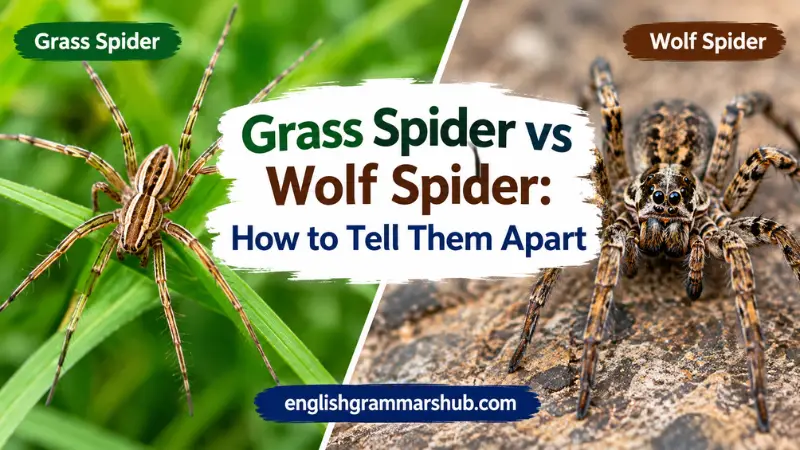
Grass spider vs wolf spider is a common identification question because both spiders can be brown, fast-moving, and found around lawns, gardens, and homes. The easiest way to tell them apart is to look at how they hunt and use silk: grass spiders build distinctive sheet-like funnel webs, while wolf spiders actively hunt prey on the ground.
A grass spider usually builds a distinctive horizontal, sheet-like web with a funnel or tunnel, while a wolf spider is primarily a wandering hunter that does not build a web to catch prey. Grass spiders also have noticeably long spinnerets at the rear of the abdomen, while wolf spiders have a characteristic eye arrangement that is especially useful for identification.
Quick Answer
A grass spider is a web-building funnel weaver; a wolf spider is a ground-hunting spider. If you see a spider sitting on or near a flat sheet web that leads into a funnel, it is likely a grass spider. If the spider is running across the ground without a prey-catching web, especially with a stockier, hairy appearance, it may be a wolf spider.
The most useful clues are:
- Web: Grass spider = funnel-shaped sheet web; wolf spider = no prey-catching web.
- Spinnerets: Grass spider = long, obvious spinnerets.
- Body: Grass spider = generally slimmer and more elongated; wolf spider = often stockier and hairier.
- Eyes: Wolf spider = four small eyes in the bottom row, with two larger rows above; grass spiders have a different arrangement.
- Hunting: Grass spider waits in its funnel; wolf spider actively searches for prey.
- Mother and young: Female wolf spiders carry their egg sacs and later carry spiderlings on their abdomen.
Grass Spider vs Wolf Spider at a Glance
| Feature | Grass Spider | Wolf Spider |
|---|---|---|
| Family | Agelenidae | Lycosidae |
| Hunting method | Uses a sheet-and-funnel web | Hunts actively on the ground |
| Prey-catching web | Yes | No |
| Typical web | Horizontal sheet with a funnel | None for catching prey |
| Spinnerets | Long and prominent | Not typically the obvious long feature |
| Body appearance | Often slender with longitudinal stripes | Usually stockier and somewhat hairy |
| Eyes | Eight eyes in two rows in Agelenopsis | Eight eyes in a distinctive 4-2-2 arrangement |
| Common habitat | Grass, shrubs, ground cover, yards | Ground, fields, forests, gardens, under stones |
| Speed | Very fast | Fast |
| Female carries spiderlings on back | No | Yes |
| Main identification clue | Funnel web and long spinnerets | Eye arrangement and active hunting |
The exact appearance varies among species, so these characteristics are best used together rather than relying on color alone.
What Does a Grass Spider Look Like?
Grass spiders are funnel weavers in the family Agelenidae. In North America, many spiders commonly called grass spiders belong to the genus Agelenopsis.
They commonly have:
- Brown or yellow-brown coloration
- Dark longitudinal markings on the carapace
- A lighter central band on the abdomen
- Long legs that may have darker bands
- A relatively elongated body
- Two conspicuous, elongated spinnerets at the rear
Penn State Extension describes adult Agelenopsis grass spiders as roughly 9–20 mm in body length, depending on sex.
The Grass Spider’s Web Is the Biggest Clue
The web is often easier to recognize than the spider.
A typical grass spider web is:
- Broad and horizontal
- Sheet-like
- Slightly concave
- Connected to a funnel or tunnel
- Often built in grass, shrubs, weeds, or ground cover
The web is not sticky. Instead, a network of threads above the sheet can interfere with flying insects, causing them to fall onto the sheet. The spider then rushes from its funnel to capture the prey.
After morning dew collects on the silk, these webs can become particularly noticeable in lawns and vegetation.
What Does a Wolf Spider Look Like?
Wolf spiders belong to the family Lycosidae. Unlike grass spiders, they generally do not build webs to capture prey. Instead, they actively search for prey on the ground.
Typical wolf spiders have:
- Brown, gray, or darker coloration
- A somewhat robust or stocky body
- Noticeable hairs
- Long legs
- Strong eyesight compared with many web-building spiders
- A distinctive eye arrangement
Wolf spiders occur in many environments, including grasslands, forests, fields, gardens, shorelines, and other areas where they can hunt on or near the ground.
The Eyes: One of the Best Wolf Spider Clues
If you can safely get a close enough view, the eyes can help separate a wolf spider from a grass spider.
Wolf spiders have eight eyes arranged in three rows:
- Four small eyes in the bottom row
- Two larger eyes in the middle row
- Two eyes in the upper row
This 4-2-2 arrangement is a useful characteristic of wolf spiders.
You normally do not need to inspect the eyes, however. For a quick backyard identification, the presence or absence of a distinctive funnel web is usually much easier to use.
Grass Spider vs Wolf Spider: Web Difference
The hunting strategy provides one of the clearest differences.
Grass Spider
A grass spider builds a web and waits in a funnel-shaped retreat. When prey falls onto the sheet, the spider quickly runs out, captures it, and returns to the funnel.
Wolf Spider
A wolf spider normally hunts without constructing a prey-catching web. It moves across the ground and actively searches for prey.
Easy Memory Rule
Grass spider = grass + web + funnel.
Wolf spider = walk + hunt.
That simple distinction can help when you encounter one outdoors.
Grass Spider vs Wolf Spider: Spinnerets
Spinnerets are silk-producing structures located near the rear of a spider’s abdomen.
Grass spiders are particularly easy to recognize by their long, prominent hind spinnerets. In Agelenopsis, these structures are readily visible without turning the spider over.
Wolf spiders do have spinnerets, but their long, obvious rear spinnerets are not the characteristic feature used to identify them.
If you see a brown spider with two conspicuously elongated structures projecting from the rear of its abdomen, that is a strong clue toward a grass spider.
Grass Spider vs Wolf Spider: Body Shape
Body shape can help, but it should not be your only identification method.
Grass spider
Grass spiders often have a relatively slender, elongated appearance. Their abdomen and carapace commonly show longitudinal patterns, and their long spinnerets make the rear of the body particularly distinctive.
Wolf spider
Wolf spiders are generally more robust and hairy-looking. Their bodies can range from light brown to dark brown or gray, and larger species can appear quite substantial.
Because color and body shape overlap between many spider groups, do not identify a spider as a wolf spider simply because it is large and brown.
Where Do Grass Spiders Live?
Grass spiders commonly live outdoors among:
- Lawn grass
- Weeds
- Shrubs
- Ground covers
- Bushes
- Brush piles
- Other sheltered vegetation
Their webs can also occur around buildings and other exterior structures. In some regions, adults may enter structures as temperatures fall.
Their association with lawns and vegetation is one reason the common name grass spider is so appropriate.
Where Do Wolf Spiders Live?
Wolf spiders are widespread and use many different habitats. They can occur in:
- Grasslands
- Gardens
- Fields
- Forests
- Beaches and shorelines
- Landscaped areas
- Under stones
- Underground burrows or sheltered ground locations
Some species spend considerable time in burrows or other protected places.
Unlike grass spiders, you are more likely to encounter a wolf spider moving across the ground rather than sitting in a web.
Do Grass Spiders and Wolf Spiders Bite?
Both types of spider can bite, but neither is generally considered an important danger to people in the United States.
Grass spiders are described by Penn State Extension as fast and shy, making bites uncommon. Reported bites can cause localized pain, redness, swelling, or itching, but serious consequences are not expected.
Wolf spiders may bite if they are mishandled or trapped against the skin. Typical reported reactions include initial pain and redness, sometimes with localized swelling, and symptoms generally resolve within about a day. Penn State Extension reports no serious medical consequences from wolf spider bites.
As with any bite, an unusual or severe reaction warrants appropriate medical attention.
Are Grass Spiders and Wolf Spiders Dangerous?
For ordinary household encounters, both are generally low-risk spiders.
Spiders are predators that help control insects and other arthropods. University extension guidance notes that spiders generally are not aggressive toward people and that bites are uncommon.
The safest approach is simple: avoid handling an unidentified spider. If one is indoors, it can usually be removed without touching it directly.
Why Do People Confuse Grass Spiders and Wolf Spiders?
The confusion makes sense because the two groups share several visible characteristics.
Both can be:
- Brown or gray
- Fast-moving
- Long-legged
- Found near grass
- Found around homes
- Active around similar seasons
- Similar in overall size
- Marked with darker and lighter patterns
The problem is that color alone is not a reliable identification method.
A grass spider can look surprisingly similar to a wolf spider when you see it away from its web. Even experienced observers may need to examine details such as the eyes, spinnerets, body proportions, and web-building behavior for a confident identification.
How to Tell a Grass Spider From a Wolf Spider
Use this simple identification process.
Step 1: Look for a Web
Flat sheet with a funnel?
Think grass spider.
No prey-catching web?
A wolf spider becomes more likely.
Step 2: Look at the Rear of the Abdomen
Very long, obvious spinnerets?
That strongly suggests a grass spider.
Step 3: Look at the Body
Slender with longitudinal striping?
Grass spider becomes more likely.
Stocky and noticeably hairy?
Wolf spider becomes more likely.
Step 4: Check the Eyes if You Can
Four small eyes in the lowest row, with two rows of two above?
That is the characteristic wolf spider arrangement.
Step 5: Watch the Behavior
Runs into a funnel or waits on a sheet web?
Likely grass spider.
Runs freely across the ground while searching for prey?
Likely wolf spider.
Can a Grass Spider Be Mistaken for a Wolf Spider?
Yes. Grass spiders are frequently mistaken for wolf spiders because their coloration, markings, body shape, and rapid movements can overlap.
In fact, spider identification records show examples of Agelenopsis grass spiders initially suspected to be wolf spiders. Features such as the elongated spinnerets and eye arrangement can resolve the confusion.
This is why “brown and hairy” is not enough to identify a wolf spider.
Grass Spider vs Wolf Spider: Which One Makes a Web?
The grass spider.
Grass spiders construct horizontal sheet webs with a funnel or tunnel where the spider can hide and wait. Their webs are especially noticeable in grass and low vegetation.
Wolf spiders generally do not construct webs for catching prey. They are active hunters that search for food on the ground.
A wolf spider may still use silk for purposes such as reproduction or shelter, so “wolf spiders don’t make silk” would be inaccurate. The important distinction is that they do not use a prey-catching web like a grass spider does.
Grass Spider vs Wolf Spider: Female and Young
Another interesting difference is how females care for their young.
Female wolf spiders carry their egg sacs attached to their spinnerets. After the spiderlings hatch, they can ride on the mother’s abdomen for a period of time.
Grass spiders have a different life cycle. Females deposit egg sacs, and young spiders later emerge and grow through successive molts.
So if you see a large female spider carrying many tiny spiderlings on her back, that is a strong clue that you are looking at a wolf spider.
Common Identification Mistakes
Mistake 1: “It is brown, so it must be a wolf spider.”
Brown coloration occurs in many spider groups.
Better approach: Look at the web, spinnerets, eyes, and hunting behavior.
Mistake 2: “It is in grass, so it must be a grass spider.”
Wolf spiders also commonly live and hunt in grassy areas.
Better approach: Search for the characteristic funnel web.
Mistake 3: “A fast spider must be a wolf spider.”
Grass spiders can also move extremely quickly, especially when disturbed or when rushing from their funnel web.
Mistake 4: “No web means it cannot be a grass spider.”
A grass spider can leave its web to hunt or move. If you encounter the spider away from its web, identification becomes more difficult.
Mistake 5: “A large spider is automatically dangerous.”
Size does not tell you whether a spider is medically important. Most spiders encountered around homes are not considered dangerous to people.
A Simple Grass Spider vs Wolf Spider Decision Guide
Did you find a large, flat web with a funnel?
→ Yes: Grass spider is likely.
→ No: Continue checking.
Does the spider have very long, obvious spinnerets at the rear?
→ Yes: Grass spider is likely.
→ No: Continue checking.
Is it actively running across the ground looking for prey?
→ Yes: Wolf spider becomes more likely.
→ No: Examine the web and body features.
Can you see the characteristic 4-2-2 wolf spider eye arrangement?
→ Yes: Wolf spider.
→ No: More detailed identification may be necessary.
Grass Spider vs Wolf Spider: The Easiest Rule to Remember
The web is usually the quickest clue. If the spider is associated with a broad horizontal sheet that narrows into a funnel, think grass spider. If it is roaming across the ground without a prey-catching web, think wolf spider.
For a closer identification, combine that clue with spinnerets, eye arrangement, body shape, and behavior.
FAQs
Are grass spiders and wolf spiders the same?
No. Grass spiders and wolf spiders belong to different spider families. Grass spiders commonly belong to the funnel-weaver family Agelenidae, while wolf spiders belong to Lycosidae. Their hunting strategies also differ: grass spiders use funnel webs, while wolf spiders actively hunt without prey-catching webs.
How can I tell a grass spider from a wolf spider?
Look for the web first. A grass spider typically builds a horizontal sheet web with a funnel. Grass spiders also have long, visible spinnerets. Wolf spiders generally wander and hunt on the ground and have a distinctive 4-2-2 eye arrangement.
Are wolf spiders bigger than grass spiders?
Wolf spiders can be larger, but size alone is not a reliable way to distinguish them. Wolf spiders range widely in size, and some can reach around an inch or more in body length, while Agelenopsis grass spiders can reach roughly 19–20 mm in body length depending on species and sex. There is enough overlap that other features are more useful.
Do grass spiders build webs?
Yes. Grass spiders build horizontal, sheet-like webs with a funnel or tunnel. The web is not sticky; its structure helps trap or impede insects that fall onto the sheet.
Do wolf spiders build webs?
Wolf spiders generally do not build webs to capture prey. They actively search for prey on the ground. They can still use silk for other purposes, so saying they never produce silk would be incorrect.
Which spider carries its babies on its back?
Female wolf spiders are known for carrying their young spiderlings on their abdomen after they hatch. This is one of the more recognizable behaviors associated with wolf spiders.
Are grass spiders dangerous to people?
Grass spiders are generally considered low-risk to people. They are fast and shy, and bites are uncommon. Reported bites can cause localized symptoms such as pain, redness, swelling, or itching, but serious consequences are not expected.
Are wolf spiders dangerous to people?
Wolf spiders may bite if handled or trapped against the skin, but typical bites cause localized symptoms such as pain, redness, and sometimes swelling. Penn State Extension reports no serious medical consequences from wolf spider bites.
Conclusion
The grass spider vs wolf spider difference becomes much easier once you focus on behavior rather than color. A grass spider is a funnel-weaving spider that typically waits in or near a sheet web and has conspicuous long spinnerets. A wolf spider is an active ground hunter with a characteristic 4-2-2 eye arrangement and no prey-catching web.
For a quick identification, look for the web first. A funnel-shaped sheet web strongly points toward a grass spider; a fast-moving spider hunting freely across the ground is more consistent with a wolf spider. When the identification is uncertain, use several characteristics together rather than relying on size or color alone.


