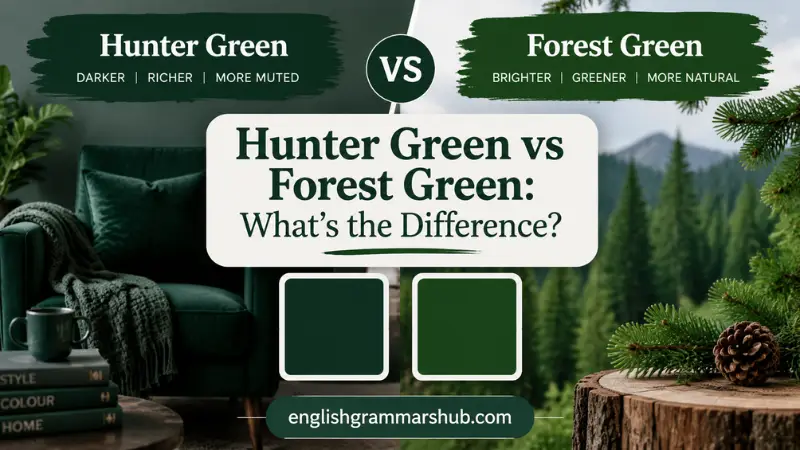
Hunter green and forest green are both deep, dark shades of green, but they are not always identical. Hunter green is typically a darker, more muted green with a subdued, sophisticated appearance, while forest green generally refers to a rich, deep green inspired by the color of dense evergreen forests. The two shades can overlap significantly, and color names are not standardized across every paint, fashion, or design brand.
The main difference is usually tone and visual character. Hunter green often looks slightly more restrained, earthy, or grayish, while forest green can appear somewhat more vivid, natural, or strongly green. However, the exact appearance depends on the color system, manufacturer, lighting, material, and surrounding colors.
Quick Answer
Hunter green vs forest green: Both are deep, dark shades of green, but hunter green is generally more muted, subdued, and traditional, while forest green is often richer, more natural, and woodland-inspired. The two can look very similar, and color names vary by brand. For exact matching, compare the actual color sample or specification rather than relying on the name alone.
Hunter Green vs Forest Green at a Glance
| Feature | Hunter Green | Forest Green |
| General appearance | Deep, dark, muted green | Deep, rich, natural green |
| Visual character | Subdued and sophisticated | Strong, earthy, and nature-inspired |
| Typical impression | Traditional, refined, understated | Natural, lush, grounded |
| Brightness | Usually very dark | Usually very dark |
| Saturation | Often muted | Can be somewhat richer |
| Common association | Outdoors, tradition, classic style | Forests, nature, greenery |
| Interior design | Elegant and dramatic | Organic and immersive |
| Fashion | Refined and versatile | Bold yet natural |
| Best description | Dark, restrained green | Deep woodland green |
| Color-name consistency | Varies by brand | Varies by brand |
The important point is that neither name refers to one universally fixed digital color. A hunter green from one manufacturer may be extremely close to a forest green from another. The names are useful descriptions, but the actual color sample is more reliable than the name alone.
What Is Hunter Green?
Hunter green is a deep green traditionally associated with outdoor clothing, hunting attire, traditional sporting styles, and natural landscapes. It is generally darker and more muted than many ordinary shades of green.
The color tends to have a serious, mature appearance. Rather than looking bright or tropical, hunter green usually feels grounded and restrained. Depending on the particular color formula, it may contain noticeable blue, yellow, gray, or black influences.
One reason hunter green can be difficult to define precisely is that the term has been used in different contexts over time. Fashion companies, paint manufacturers, textile producers, graphic designers, and digital color systems may use the name for somewhat different shades.
Despite these variations, hunter green commonly falls into the category of dark, subdued greens.
Its overall character can be described as:
- Deep
- Muted
- Earthy
- Traditional
- Sophisticated
- Outdoors-inspired
- Calm
- Strong without appearing extremely bright
Hunter green is often chosen when a design needs green that feels mature rather than playful.
The Visual Character of Hunter Green
Hunter green usually has a relatively low-light appearance. It does not compete for attention in the same way that lime green, emerald green, or bright spring green can.
Its darkness gives it visual weight.
This makes hunter green particularly useful when the goal is to create a color palette that feels:
- Classic
- Comfortable
- Elegant
- Natural
- Historic
- Rustic
- Masculine or tailored, depending on the surrounding colors
However, hunter green does not have to look old-fashioned. Modern combinations with cream, white, warm beige, brass, natural wood, charcoal, or soft gray can make it look contemporary.
What Is Forest Green?
Forest green is a deep green associated with the color of dense forests, evergreen trees, mossy vegetation, and shaded natural environments.
Like hunter green, forest green is usually dark. However, the name emphasizes its natural and woodland character more strongly.
Forest green can range from a muted dark green to a richer, more saturated green. Because color naming is not completely standardized, two colors labeled forest green may look noticeably different.
The shade is often perceived as:
- Deep
- Rich
- Natural
- Earthy
- Botanical
- Lush
- Grounded
- Strong
Forest green can sometimes appear more distinctly green than hunter green. In other cases, the two shades can be almost indistinguishable.
The Visual Character of Forest Green
Forest green often creates a stronger connection to nature. Its name immediately suggests trees, woodland, leaves, and dense vegetation.
This makes it popular in:
- Interior design
- Fashion
- Home décor
- Branding
- Graphic design
- Outdoor-inspired styles
- Botanical themes
- Seasonal color palettes
Its depth also allows it to function almost like a neutral in certain designs. A dark forest green can provide the visual weight that might otherwise come from navy, charcoal, or dark brown.
The Main Difference Between Hunter Green and Forest Green
The easiest way to distinguish hunter green from forest green is to think about their visual emphasis.
Hunter green tends to emphasize a dark, muted, traditional green appearance. Forest green tends to emphasize a deep, natural, woodland green appearance.
That distinction is more useful than trying to assign one exact numerical color value to each name.
Hunter green often feels slightly more subdued. Forest green may feel slightly richer or more naturally green. But this is not an absolute rule.
A particular forest green can be darker and duller than a particular hunter green. Likewise, a particular hunter green can look more saturated than a particular forest green.
This happens because color names are often used as descriptive labels rather than universal technical standards.
Tone
Tone is one of the most noticeable differences.
Hunter green often has a muted quality that gives it a refined appearance. Forest green can have a more pronounced green presence.
Saturation
Saturation describes how intense or pure a color appears.
Many hunter greens are relatively muted. Forest greens can range from muted to fairly rich.
Therefore, saturation alone cannot always separate the two.
Undertones
Undertones can also vary.
A hunter green may lean toward blue-green, yellow-green, gray-green, or nearly neutral dark green depending on the formulation.
Forest green may also show blue, yellow, gray, or black influences.
This means that undertones are helpful when comparing actual samples, but the names alone cannot guarantee a specific undertone.
Overall Mood
Hunter green often creates a more traditional or sophisticated mood.
Forest green often creates a more natural or woodland-inspired mood.
The difference is subtle, which is why the terms are sometimes used interchangeably.
Why Hunter Green and Forest Green Are Often Confused
Hunter green and forest green are frequently confused because they belong to the same broad family of dark greens.
Both are:
- Darker than ordinary medium green
- Associated with nature
- Common in clothing
- Popular in interiors
- Suitable for traditional and modern design
- Strong enough to create visual contrast
- Often used in autumn and winter palettes
- Associated with outdoor environments
The names also encourage overlap.
A hunter’s traditional outdoor clothing can naturally suggest a forest. A forest environment can naturally suggest hunting and outdoor activities. As a result, the two color names have developed overlapping associations.
Another factor is that color naming is often commercial rather than scientific.
A company may call a shade hunter green because the name communicates a particular style. Another company may use forest green for a very similar color. A third company might use one of these names for a noticeably different shade.
For this reason, visual comparison is more dependable than the label.
Are Hunter Green and Forest Green the Same Color?
Hunter green and forest green are not necessarily the same color, but they can be extremely similar.
In casual conversation, people may use the names interchangeably. In professional color matching, however, the actual color specification matters more than the name.
There is no single universal rule saying that every hunter green must have one exact RGB, HEX, CMYK, or paint formula and every forest green must have another.
Different systems and industries may define or use these names differently.
This is especially important when buying:
- Paint
- Fabric
- Clothing
- Furniture
- Curtains
- Wallpaper
- Shoes
- Accessories
- Printing materials
- Digital design assets
If two products need to match, do not rely only on the names “hunter green” and “forest green.” Compare physical samples or the exact color specifications provided by the manufacturer.
Hunter Green vs Forest Green in Clothing
Both hunter green and forest green work well in clothing because dark greens are generally versatile.
Hunter green often creates a more polished and understated appearance. It can work particularly well with classic garments and structured pieces.
Forest green can create a slightly richer and more nature-focused appearance. It is useful when green needs to be noticeable without becoming bright.
Both shades can work with:
- Black
- White
- Cream
- Beige
- Tan
- Brown
- Gray
- Navy
- Denim
- Burgundy
- Gold
- Camel
The final effect depends heavily on the exact shade.
Hunter Green Clothing
Hunter green is often effective when the goal is a classic, mature appearance.
Its darker and muted quality can make it suitable for:
- Jackets
- Sweaters
- Pants
- Coats
- Dresses
- Shirts
- Hats
- Bags
- Shoes
- Accessories
It can also serve as a substitute for black, navy, or dark brown when a softer natural color is preferred.
Forest Green Clothing
Forest green can provide similar versatility while creating a stronger connection to natural colors.
It works well in:
- Outerwear
- Knitwear
- Dresses
- Trousers
- Skirts
- Shirts
- Accessories
- Casual clothing
- Formal clothing
The richness of forest green can make it especially useful when someone wants a dark color that is more distinctive than standard neutrals.
Hunter Green vs Forest Green for Home Interiors
Both colors can dramatically change the character of a room.
Because they are dark shades, they can add depth and visual weight. They can also make a space feel more enclosed when used extensively in a room with limited natural light.
Hunter green often produces an elegant, traditional, or sophisticated effect.
Forest green can produce a more botanical, natural, or immersive effect.
Neither is automatically better. The choice depends on the atmosphere you want.
Hunter Green in Interior Design
Hunter green can work well for:
- Accent walls
- Cabinets
- Dining rooms
- Studies
- Libraries
- Upholstery
- Furniture
- Doors
- Trim
- Decorative accessories
It pairs naturally with warm materials such as wood, leather, brass, and cream-colored textiles.
Because the shade is dark, smaller applications can sometimes create impact without making the entire room feel heavy.
Forest Green in Interior Design
Forest green is especially effective when the design aims to emphasize nature.
It can work well with:
- Natural wood
- Stone
- Cream
- Beige
- Linen
- Rattan
- Brass
- Terracotta
- Warm white
- Botanical décor
A deep forest green wall can create a dramatic backdrop for lighter furniture and natural textures.
Hunter Green vs Forest Green for Paint
Choosing between hunter green and forest green paint requires more care than choosing between the names alone.
Paint can look dramatically different depending on:
- Natural daylight
- Artificial lighting
- Wall direction
- Room size
- Nearby colors
- Flooring
- Furniture
- Finish
- Surface texture
- Time of day
A color that looks soft and muted in a store may appear much darker on a large wall.
Likewise, a green that looks strongly forest-like under cool lighting may appear warmer under yellow-toned lighting.
Why Paint Samples Matter
When selecting either shade, a physical sample is more reliable than the color name.
This is particularly important because manufacturers may use “hunter green” and “forest green” differently.
If the goal is a very specific appearance, compare several samples under the lighting conditions of the room where the color will be used.
Hunter Green vs Forest Green in Graphic Design
In digital design, the distinction becomes even more dependent on the exact color values.
A designer cannot assume that the words “hunter green” and “forest green” identify a single universally recognized digital color.
For consistent results, a project should use a defined color value rather than relying only on a descriptive name.
Depending on the project, designers may work with:
- HEX
- RGB
- HSL
- CMYK
- Pantone references
- Brand-specific color systems
This matters when the same color needs to appear consistently across websites, printed materials, packaging, advertising, and other media.
A dark green that looks correct on one monitor may also appear different on another display.
Therefore, the practical rule is simple: use the exact color specification when accuracy matters.
Which Color Is Darker: Hunter Green or Forest Green?
There is no universal answer.
Hunter green is commonly perceived as very dark, and many versions are strongly muted. Forest green is also commonly very dark.
Depending on the specific shades being compared, either one may appear darker.
If you’re comparing two named colors from the same manufacturer, the manufacturer’s actual color sample or specification should determine the answer.
The names alone are not reliable enough to establish a universal brightness ranking.
Which Color Is More Muted?
Hunter green is often more muted than forest green.
This is one of the more useful general distinctions between the two names.
A muted green has reduced visual intensity and often contains a gray, brown, or dark influence. Hunter green commonly has this restrained quality.
Forest green can also be muted, but the name is frequently associated with a richer and more visibly green woodland shade.
Still, this is a tendency rather than a strict rule.
Which Color Looks More Natural?
Both colors are natural-looking, but forest green usually has the stronger direct association with nature.
The word “forest” immediately connects the shade with trees, leaves, woodland, and vegetation.
Hunter green also has a strong outdoor association, but its identity is more closely tied to traditional outdoor clothing and sporting imagery in addition to nature.
If the desired visual message is specifically:
- Woodland
- Botanical
- Organic
- Lush
- Environmental
forest green may communicate that idea more directly.
If the desired message is:
- Traditional
- Refined
- Outdoor-inspired
- Classic
- Understated
hunter green may be a more natural fit.
Which Green Is More Versatile?
Both can be highly versatile.
Hunter green often works well when a darker, more restrained green is needed. Forest green works well when a richer natural green is preferred.
Versatility depends less on the name and more on the exact shade and what surrounds it.
A very dark green may function almost like a neutral. A more saturated green will attract more attention.
The same shade can also feel completely different depending on whether it is paired with:
- Bright white
- Warm cream
- Black
- Gray
- Brown
- Navy
- Gold
- Red
- Orange
- Natural wood
Therefore, the surrounding palette should be considered before choosing between the two.
Hunter Green vs Forest Green for Different Styles
Color choice often becomes easier when you start with the style you want rather than the color name.
Traditional Style
Hunter green often fits naturally into traditional settings because its subdued character works well with classic materials and darker neutrals.
Rustic Style
Both shades can work well in rustic settings. Their natural associations make them suitable for wood, leather, stone, and warm neutrals.
Modern Style
Either color can work in modern design when used with clean shapes and controlled contrast.
Hunter green may create a quieter modern appearance, while a richer forest green can become a stronger focal color.
Botanical Style
Forest green is particularly natural for botanical themes because of its direct association with vegetation.
Outdoor Style
Both colors work well for outdoor-inspired palettes.
Hunter green has especially strong traditional outdoor associations, while forest green emphasizes the natural environment itself.
Luxury Style
Deep green can look luxurious when combined with materials such as velvet, brass, polished wood, marble, or rich neutral fabrics.
Hunter green’s muted quality can create a refined effect, while a richer forest green can provide greater visual intensity.
Hunter Green vs Forest Green and Color Undertones
Undertones are one of the most important factors when selecting a dark green.
A green may lean:
- Blue
- Yellow
- Gray
- Brown
- Black
These undertones influence how the color interacts with nearby shades.
A blue-leaning dark green can appear cooler and more formal.
A yellow-leaning dark green can appear warmer and more organic.
A gray-influenced green can look softer and more muted.
A brown-influenced green can feel earthy and rustic.
This is why two colors with the same basic description can create very different impressions.
Why Undertones Matter in Rooms
Suppose a green is placed next to warm beige. A yellow or brown undertone may blend smoothly with the beige.
A cooler green may create more contrast.
Similarly, a green placed next to cool gray may appear different from the same green placed next to warm cream.
The surrounding palette can change how the eye perceives the green.
How Lighting Changes Hunter Green and Forest Green
Lighting can significantly affect both colors.
Natural daylight usually reveals more of a color’s underlying character.
Warm artificial light can make dark greens appear warmer, browner, or more subdued.
Cool artificial light can emphasize blue or gray qualities.
The direction and amount of natural light also matter.
A green used in a bright, sun-filled room may appear more energetic than the same color in a dim room.
Dark colors also tend to absorb more visual light, which can make them appear deeper on large surfaces.
For this reason, color decisions should be evaluated in the actual environment where the color will be used.
Can Hunter Green and Forest Green Be Used Together?
Yes. The two shades can be used together when their differences are intentional.
Because both belong to the dark green family, they can create a layered monochromatic palette.
The challenge is contrast.
If two shades are extremely similar, they may look accidental rather than deliberately coordinated. A clear difference in tone, brightness, saturation, or texture can help separate them.
For example, one shade can serve as the dominant color while the other functions as an accent.
The combination can work particularly well when supported by neutral colors such as cream, beige, white, gray, brown, or black.
Colors That Pair Well With Hunter Green
Hunter green works with many neutral and earthy colors.
Common complementary palette directions include:
- Cream
- Ivory
- Warm white
- Beige
- Tan
- Camel
- Brown
- Charcoal
- Gray
- Black
- Navy
- Burgundy
- Brass
- Gold
Warm neutrals can soften the darkness of hunter green.
White can create sharper contrast.
Black can produce a dramatic palette.
Brown can reinforce its outdoor and earthy character.
Gold or brass can add warmth and visual richness.
The best combination depends on whether the desired result is traditional, modern, rustic, elegant, or casual.
Colors That Pair Well With Forest Green
Forest green also works with a broad range of colors.
Common pairings include:
- White
- Cream
- Beige
- Taupe
- Tan
- Brown
- Camel
- Gray
- Black
- Gold
- Brass
- Burgundy
- Rust
- Terracotta
- Soft pink
Because forest green has a strong natural identity, earthy colors can create especially cohesive palettes.
Warm terracotta and rust can make the green feel more autumnal.
Cream and beige can make it feel softer.
Black can make it more dramatic.
Metallic gold and brass can create a richer appearance.
Hunter Green vs Forest Green for Branding
Dark greens are frequently associated with qualities such as nature, stability, tradition, quality, growth, and environmental themes.
However, color psychology should not be treated as a universal formula. The meaning of a color changes depending on context, culture, industry, typography, imagery, and the rest of the visual identity.
Hunter green can communicate a more traditional or established visual style.
Forest green can communicate a more natural or environmentally oriented visual style.
For a brand, the exact shade matters more than the name.
A company should define its chosen color using an exact specification so that the brand looks consistent across different platforms.
Hunter Green vs Forest Green in Seasonal Design
Both colors are popular in seasonal palettes because they are deep and natural.
Hunter green often works particularly well with traditional autumn and winter combinations.
Forest green can work across autumn, winter, and year-round nature-inspired designs.
Neither shade is limited to a particular season.
The surrounding colors determine much of the seasonal feeling.
For instance, a dark green combined with warm reds and golds may feel festive or autumnal, while the same green paired with white and pale neutrals can feel clean and contemporary.
Does Hunter Green Have More Blue Than Forest Green?
Not necessarily.
This is a common assumption because some hunter greens have a cool, blue-influenced appearance.
However, the name “hunter green” does not guarantee a particular blue-to-yellow balance.
Some versions can be cooler, while others can be warmer.
The same is true for forest green.
If undertone matters for a design, evaluate the actual color rather than assuming it from the name.
Does Forest Green Have More Yellow Than Hunter Green?
Not necessarily.
Some forest greens may have a warmer appearance, which can make them seem slightly yellow-influenced.
But other forest greens can be distinctly cool.
Color names do not provide enough information to determine the precise undertone.
The safest approach is to inspect the actual color value or physical sample.
Are Hunter Green and Forest Green Good Neutral Colors?
They can function as near-neutrals in some color schemes, but they are not true neutrals in the strict sense.
True neutrals generally lack a strong hue identity, while hunter green and forest green clearly belong to the green family.
However, their darkness and muted qualities can allow them to play a similar supporting role to navy, charcoal, or dark brown.
This is particularly useful in fashion and interior design.
A deep green can provide variety without being as visually demanding as a bright color.
How to Choose Between Hunter Green and Forest Green
The easiest way to choose is to focus on the desired visual effect.
Choose hunter green when you want a dark green that generally feels:
- Muted
- Traditional
- Refined
- Understated
- Classic
- Outdoor-inspired
Choose forest green when you want a dark green that generally feels:
- Natural
- Rich
- Woodland-inspired
- Botanical
- Lush
- Earthy
But if exact color matching matters, ignore the name and compare the actual color specifications or samples.
This is especially important for projects involving multiple products from different manufacturers.
When Hunter Green Is the Better Fit
Hunter green may be a better fit when the design needs a restrained dark green.
Its subdued appearance can work particularly well when other elements already provide strong visual interest.
It can also be useful when you want green without making the overall design feel bright.
Hunter green’s traditional associations make it particularly suitable for classic, heritage-inspired, outdoor, rustic, and sophisticated settings.
When Forest Green Is the Better Fit
Forest green may be a better fit when the goal is to emphasize nature.
Its woodland association can make it especially appropriate for botanical, organic, environmental, rustic, and nature-inspired designs.
It can also work when a dark color needs to retain a stronger sense of green rather than appearing almost neutral.
Again, the exact shade determines the final result.
Common Mistakes When Comparing Hunter Green and Forest Green
Mistake 1: Assuming the Names Are Universal
There is no guarantee that every manufacturer uses these names for identical color values.
Mistake 2: Assuming One Is Always Darker
Both are generally dark greens, but either can be darker depending on the specific shades being compared.
Mistake 3: Ignoring Undertones
A green’s blue, yellow, gray, or brown influence can dramatically affect its appearance.
Mistake 4: Choosing Paint From a Screen Alone
Digital representations do not always reproduce physical paint accurately.
Mistake 5: Treating Color Names as Technical Specifications
Names are useful for communication, but exact specifications are better for precision.
Mistake 6: Ignoring Surrounding Colors
The colors around a green can change how the green appears.
Mistake 7: Assuming Color Psychology Is Absolute
Color associations are influenced by context and culture. A color does not automatically communicate one fixed message.
Hunter Green vs Forest Green: Which One Should You Choose?
There is no universal winner because the two shades serve slightly different visual purposes and can overlap considerably.
If you want a darker, quieter, more traditional green, hunter green is often the better description.
If you want a rich, natural, woodland-inspired green, forest green is often the better description.
If you need an exact match, however, the most important factor is not whether the label says hunter green or forest green. The actual color value, sample, finish, lighting, and surrounding colors should determine the decision.
For clothing, interiors, branding, and décor, both shades can be highly effective. The best choice depends on the mood and level of contrast you want to create.
Hunter Green vs Forest Green: Key Differences by Category
| Category | Hunter Green | Forest Green |
| Basic identity | Deep, muted green | Deep, natural green |
| Typical mood | Refined and traditional | Natural and rich |
| Nature association | Strong | Very strong |
| Woodland association | Moderate to strong | Very strong |
| Traditional feel | Strong | Moderate to strong |
| Muted appearance | Often prominent | Variable |
| Richness | Moderate to high | Often high |
| Versatility | High | High |
| Fashion use | Excellent | Excellent |
| Interior use | Excellent | Excellent |
| Outdoor style | Excellent | Excellent |
| Botanical style | Good | Excellent |
| Exact color consistency | Depends on manufacturer | Depends on manufacturer |
The Role of Color Naming in Design
Color names are useful because they give people a shared starting point for discussing visual appearance.
However, color names are not always precise enough for technical work.
Words such as:
- Hunter green
- Forest green
- Olive
- Sage
- Emerald
- Teal
- Moss
- Pine
can represent ranges of colors depending on the context.
This is especially common in commercial industries.
A fashion company may choose a name that fits its seasonal collection. A paint company may use a name to evoke a particular atmosphere. A designer may use a familiar name informally to describe a custom shade.
Therefore, names should be treated as descriptive identifiers rather than universal mathematical definitions.
Why the Same Green Can Look Different
Even when two products use the same nominal color, the final appearance may differ.
Material affects perception.
Fabric reflects light differently from painted walls.
Glossy surfaces reflect highlights differently from matte surfaces.
Printed ink behaves differently from light emitted by a screen.
Wood and surrounding textures can also influence how a color is perceived.
This means a hunter green shirt and a hunter green wall may not look identical even if both products use a similar color reference.
The same applies to forest green.
When coordinating multiple objects, compare them under the conditions in which they will actually be viewed.
Hunter Green vs Forest Green: A Practical Decision Guide
Use this simple decision process:
Choose hunter green if your priority is a muted, classic, restrained, and sophisticated dark green.
Choose forest green if your priority is a rich, natural, woodland-inspired dark green.
Compare actual samples if you need precise color matching.
Check lighting if the color will be used on a large surface.
Check undertones if the shade must coordinate closely with other colors.
Check the manufacturer specification if the color needs to remain consistent across products.
This approach is more reliable than assuming that one color name always represents one exact shade.
FAQs
Is hunter green darker than forest green?
Not universally. Both are generally considered deep, dark greens, but their exact brightness depends on the specific color definition. One manufacturer’s hunter green may be darker than its forest green, while another brand may use the names differently.
Is hunter green the same as forest green?
No, not necessarily. They are distinct color names, but their actual shades can overlap significantly. Both usually describe deep greens, and some versions may look nearly identical.
Which is more muted, hunter green or forest green?
Hunter green is often more muted, while forest green can appear somewhat richer or more strongly green. This is a general tendency rather than a universal technical rule.
Which color is more natural, hunter green or forest green?
Both are strongly associated with nature. Forest green usually has the more direct nature association because its name specifically refers to forests and woodland environments. Hunter green also has strong outdoor and natural associations.
Can hunter green and forest green be used together?
Yes. They can create a layered dark-green palette when their shades are sufficiently different. Using neutral colors alongside them can help provide contrast and prevent the palette from becoming visually heavy.
Is hunter green good for clothing?
Yes. Hunter green is a versatile dark color that can work well in casual, traditional, outdoor, and polished clothing. Its muted character allows it to coordinate with many neutrals and earthy colors.
Is forest green good for interior design?
Yes. Forest green can create a rich, natural, and dramatic interior when used appropriately. It can work on walls, cabinetry, furniture, upholstery, and decorative elements.
Which green is better for a room?
Neither is universally better. Hunter green may suit a more traditional or subdued room, while forest green may suit a natural or botanical atmosphere. Lighting and surrounding colors should also be considered.
Can hunter green look blue?
Yes. Some hunter greens have cool or blue-influenced undertones, which can make them appear slightly blue-green under certain lighting conditions. However, not every hunter green has a blue undertone.
Can forest green look yellow?
Yes. Some forest greens can have warmer undertones that make them appear slightly yellow- or olive-influenced. The exact appearance depends on the specific color formulation.
Are hunter green and forest green warm or cool colors?
Either can be warm or cool depending on their undertones. A green with more blue influence tends to feel cooler, while one with more yellow or brown influence tends to feel warmer.
Which green looks more sophisticated?
Hunter green is often associated with a more restrained and traditional appearance, which can make it feel sophisticated. However, forest green can also look highly refined when used with appropriate materials and surrounding colors.
Which green is better for a natural look?
Forest green is often the more direct choice for a natural look because of its strong woodland association. Hunter green can also create a natural appearance, particularly in outdoor and earthy palettes.
Does the color name matter when buying paint?
The name can help you understand the intended character of the shade, but it should not be your only consideration. A physical sample and the manufacturer’s actual color reference are more reliable for precise selection.
Why do different brands have different hunter greens?
Color naming is not completely standardized across commercial products. Manufacturers may use familiar names to describe their own particular shades, so colors with the same name can differ.
Why do different brands have different forest greens?
The same reason applies to forest green. The name communicates a general visual idea, but the manufacturer determines the actual formulation or color specification.
Which color is more versatile, hunter green or forest green?
Both can be highly versatile. Hunter green tends to work especially well when a muted, classic dark green is desired, while forest green is useful when a richer, more natural green is preferred.
Conclusion
Hunter green and forest green are closely related dark green shades, but they usually communicate slightly different visual qualities. Hunter green tends to be more muted, restrained, and traditional, while forest green tends to feel richer, more natural, and more strongly connected with woodland environments.
The distinction is not absolute because color names vary among manufacturers and industries. A hunter green from one source can look very similar to a forest green from another.
For everyday use, think of hunter green as a sophisticated, subdued dark green and forest green as a rich, nature-inspired dark green. For exact matching, always evaluate the actual color specification or physical sample rather than relying on the name alone.


