
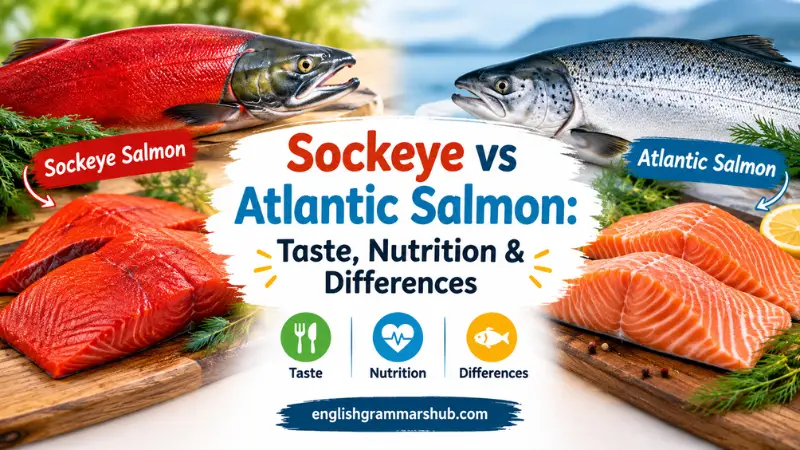
Sockeye vs Atlantic salmon is a useful comparison because these two fish differ in species, origin, appearance, life cycle, flavor, texture, and typical production methods. Sockeye salmon is a Pacific salmon species known for its deep red flesh and rich flavor. Atlantic salmon is a different species and is the salmon most commonly sold as farm-raised Atlantic salmon in U.S. seafood markets.
The biggest practical difference is simple: sockeye is typically leaner, darker in color, and more intensely flavored, while farmed Atlantic salmon is generally milder, richer, and fattier. The better choice depends on the flavor, texture, price, and cooking result you want.
Quick Answer
Sockeye salmon and Atlantic salmon are different species, not two varieties of the same fish. Sockeye (Oncorhynchus nerka) is a Pacific salmon, while Atlantic salmon (Salmo salar) belongs to a different genus. Sockeye usually has deep red flesh and a firm, distinctive flavor. Farmed Atlantic salmon generally has a milder, buttery taste, a softer texture, and higher fat content.
For a stronger salmon flavor and firmer texture, sockeye is often the more suitable option. For a milder, richer, fattier fillet, Atlantic salmon is commonly preferred.
Sockeye vs Atlantic Salmon at a Glance
| Feature | Sockeye Salmon | Atlantic Salmon |
|---|---|---|
| Scientific name | Oncorhynchus nerka | Salmo salar |
| Salmon group | Pacific salmon | Atlantic salmon |
| Typical U.S. market source | Often wild-caught | Farm-raised |
| Flesh color | Deep red to orange-red | Pink to reddish-orange |
| Flavor | Rich, distinctive, more intense | Mild, rich, buttery |
| Texture | Firm and relatively lean | Firm but generally fattier |
| Fat level | Generally lower than farmed Atlantic salmon | Generally higher in farmed fish |
| Common availability | Fresh in season; frozen, canned, and smoked year-round | Available year-round |
| Typical habitat | North Pacific and associated freshwater systems | North Atlantic and associated freshwater systems |
| Scientific genus | Oncorhynchus | Salmo |
| Cooking character | Strong flavor and firm flakes | Rich texture and mild flavor |
The two species also have different life histories. Sockeye commonly spend part of their freshwater life in lakes before migrating to the ocean, while Atlantic salmon typically develop in rivers before moving to the sea.
What Is Sockeye Salmon?
Sockeye salmon is a Pacific salmon species scientifically known as Oncorhynchus nerka. It is also called red salmon or blueback salmon.
Sockeye is found along the Pacific coast, including Alaska and parts of the Pacific Northwest. Most sockeye are anadromous, meaning they hatch and develop in freshwater, migrate to the ocean to grow, and later return to freshwater to reproduce.
One unusual feature of sockeye is its close association with freshwater lakes. Juvenile sockeye commonly spend one to three years in freshwater lakes before migrating to the ocean.
Why Is Sockeye Flesh So Red?
Sockeye has some of the reddest flesh among wild salmon species. Its deep color is related largely to its diet, which includes zooplankton and other marine food sources containing carotenoid pigments.
The flesh remains noticeably red or orange-red after cooking, which makes sockeye particularly recognizable.
What Is Atlantic Salmon?
Atlantic salmon is scientifically known as Salmo salar. It is not a Pacific salmon species and belongs to a different genus from sockeye.
Atlantic salmon are native to the North Atlantic region. Their natural life cycle includes freshwater rivers and the ocean. They hatch and grow in rivers, migrate to saltwater to mature, and return to freshwater to spawn.
For U.S. shoppers, there is an important distinction: Atlantic salmon sold in U.S. seafood markets is farm-raised. Commercial and recreational fishing for Atlantic salmon is prohibited in the United States.
That means a comparison between supermarket sockeye and Atlantic salmon is often also a comparison between wild-caught Pacific salmon and farmed Atlantic salmon.
Sockeye vs Atlantic Salmon: Species Difference
The most basic difference is their scientific classification.
- Sockeye salmon: Oncorhynchus nerka
- Atlantic salmon: Salmo salar
Both belong to the salmon family, Salmonidae, but they are separate species in different genera.
This distinction matters because their genetics, natural ranges, life cycles, appearance, diet, and commercial production can differ substantially.
Calling sockeye and Atlantic salmon simply two types of the same salmon would therefore be misleading.
Taste: Does Sockeye or Atlantic Salmon Taste Better?
There is no universal answer because taste preference is subjective, but the flavor profiles are noticeably different.
Sockeye tends to have a stronger, more distinctive salmon flavor. NOAA describes sockeye as having a rich flavor and a firm, fatty texture.
Atlantic salmon tends to have a milder, buttery flavor. Farmed Atlantic salmon is generally known for its rich taste and fatty texture.
Choose Sockeye If You Want
- A pronounced salmon flavor
- Deeply colored flesh
- A firm bite
- A less mild seafood profile
- A fish that works well with simple seasonings
Choose Atlantic Salmon If You Want
- A milder salmon flavor
- A buttery mouthfeel
- A richer, fattier texture
- A versatile fillet for sauces and marinades
- A widely available year-round option
Neither flavor profile is inherently better. The choice depends on what you want from the dish.
Texture: Sockeye vs Atlantic Salmon
Sockeye generally has a firm texture and relatively tight flakes. Its texture works particularly well when you want the fish to remain substantial after cooking.
Farmed Atlantic salmon is also firm but generally has a richer, softer, fattier mouthfeel.
This difference becomes noticeable when the fish is cooked simply with salt, pepper, and a little oil.
Sockeye: firmer and more pronounced.
Atlantic salmon: richer and more buttery.
Cooking method also matters. Overcooking either fish can make it dry, so temperature and cooking time can have as much impact on texture as the species itself.
Color Difference
Color is one of the easiest ways to distinguish these salmon types.
Sockeye usually has deep red or orange-red flesh. NOAA identifies sockeye as having the reddest flesh among wild salmon species.
Atlantic salmon sold commercially is usually pink to reddish-orange.
The color difference is especially obvious when the two fillets are placed next to each other.
However, flesh color should not be treated as a simple quality score. Different salmon species, diets, production systems, and individual fish can produce variation.
Nutrition: Sockeye vs Atlantic Salmon
Both sockeye and Atlantic salmon can provide high-quality protein and omega-3 fatty acids.
However, the nutritional comparison needs context because the type of Atlantic salmon matters. In U.S. seafood markets, Atlantic salmon is generally farm-raised, while sockeye is commonly wild-caught.
NOAA’s current seafood data lists the following values per 100 grams of raw fish:
| Nutrient | Sockeye Salmon | Farmed Atlantic Salmon |
|---|---|---|
| Calories | 168 | 142 |
| Protein | 21.3 g | 19.84 g |
| Total fat | 8.56 g | 6.34 g |
| Saturated fat | 1.495 g | 0.981 g |
| Sodium | 47 mg | 44 mg |
| Cholesterol | 62 mg | 55 mg |
| Selenium | 33.7 mcg | 36.5 mcg |
These figures come from NOAA’s seafood profiles and are useful for comparison, but they should not be interpreted as universal values for every sockeye or Atlantic salmon fillet. Fish size, feed, farming conditions, season, and preparation can affect nutrition.
Which Has More Omega-3?
Both contain substantial omega-3 fatty acids.
Atlantic salmon is often associated with a higher-fat profile, while sockeye is also a rich source of omega-3s. The exact amount varies by fish and production method, so a blanket statement that one always contains more omega-3 than the other is too broad.
If omega-3 intake is your main concern, compare the nutrition label or species-specific nutrition data for the fish you are actually buying.
Wild Sockeye vs Farmed Atlantic Salmon
This is one of the most important parts of the comparison.
In the United States, sockeye is commercially harvested from wild populations, including major fisheries in Alaska. Farmed Atlantic salmon is available year-round, and NOAA states that Atlantic salmon in U.S. seafood markets is farm-raised.
This difference affects several characteristics.
Source
Sockeye commonly comes from wild fisheries.
Atlantic salmon sold in U.S. markets comes from aquaculture.
Availability
Sockeye has a strong seasonal fresh market, although frozen, canned, and smoked versions can be available year-round.
Farmed Atlantic salmon is generally available year-round.
Consistency
Farmed Atlantic salmon can offer relatively consistent size, fat content, and availability.
Wild sockeye can vary more with season, fishery, location, and individual fish.
Where Do Sockeye and Atlantic Salmon Live?
The species have different natural geographic ranges.
Sockeye Salmon Range
Sockeye is a Pacific salmon. NOAA lists its U.S. range from northwest Alaska to the Deschutes River in Oregon.
Some sockeye populations spend their entire lives in freshwater. These non-anadromous fish are commonly known as kokanee in the Pacific Northwest.
Atlantic Salmon Range
Atlantic salmon naturally occur in the North Atlantic region, including parts of North America, Europe, Iceland, Greenland, and nearby waters.
In the United States, native Atlantic salmon populations are now restricted to Maine. NOAA notes that U.S. commercial and recreational fishing for Atlantic salmon is prohibited.
Life Cycle Differences
Both species are anadromous, but their life cycles are not identical.
Sockeye commonly hatch in freshwater and spend significant juvenile time in lakes or streams before migrating to the ocean. They generally return to freshwater after spending time at sea and die within weeks after spawning.
Atlantic salmon also begin life in freshwater and migrate to the ocean. Unlike Pacific salmon species such as sockeye, Atlantic salmon can survive spawning and potentially return to spawn again, although repeat spawning is now relatively uncommon.
This is a major biological difference between the two species.
Which Salmon Is Better for Grilling?
Both work well on a grill.
Sockeye is a strong choice when you want a firm fillet with pronounced salmon flavor. Because sockeye can be relatively lean, careful cooking helps prevent it from drying out.
Atlantic salmon is useful when you want a richer, fattier fillet that works well with marinades, sauces, herbs, and glazes.
For either fish, avoid excessive cooking. A hot grill and attentive timing can help preserve moisture.
Which Salmon Is Better for Baking?
Both are suitable for baking.
Sockeye works especially well with simple combinations such as:
- Lemon and herbs
- Garlic and olive oil
- Black pepper
- Dijon mustard
- Fresh dill
Atlantic salmon’s richer texture works particularly well with:
- Honey-based glazes
- Mustard sauces
- Garlic butter
- Teriyaki-style sauces
- Creamy herb preparations
The best choice depends more on the desired flavor and texture than on the cooking method itself.
Which Salmon Is Better for Smoking?
Both sockeye and Atlantic salmon can be smoked, but they produce different results.
Sockeye’s firm texture and strong flavor make it particularly distinctive when smoked.
Atlantic salmon’s higher-fat, buttery character can produce a rich smoked product.
If you want a stronger, more concentrated salmon flavor, sockeye is a natural choice.
If you prefer a milder and richer smoked fish, Atlantic salmon may suit you better.
Which Salmon Is Better for Salads?
Either can work well.
Sockeye is especially useful in salads when you want the fish to remain the main flavor.
Atlantic salmon works well when you want the fish to blend with creamy dressings, grains, vegetables, or other mild ingredients.
For cold salads, cooked and chilled salmon can be flaked into:
- Green salads
- Pasta salads
- Grain bowls
- Potato salads
- Salmon wraps
Sockeye vs Atlantic Salmon for Meal Preparation
For regular home cooking, Atlantic salmon’s year-round availability can make it convenient.
Sockeye is attractive when you want a more pronounced flavor and firm texture.
A simple decision rule is:
Strong flavor + firm texture → sockeye.
Mild flavor + rich, buttery texture → Atlantic salmon.
That rule will not cover every preference, but it is a useful starting point when choosing between the two.
Common Misconceptions About Sockeye and Atlantic Salmon
“Atlantic salmon is just another Pacific salmon.”
No. Atlantic salmon is Salmo salar, while sockeye is Oncorhynchus nerka. They belong to different genera.
“Sockeye is always healthier.”
That is too broad. Both can be nutritious sources of protein and omega-3 fatty acids. Nutrition varies according to the particular fish and whether it is wild or farmed.
“Redder salmon automatically means better salmon.”
Not necessarily. Flesh color is a characteristic of the fish and its diet, not a universal quality ranking.
“All Atlantic salmon is wild.”
Not in the U.S. seafood market. NOAA states that Atlantic salmon sold in U.S. markets is farm-raised.
“Sockeye and Atlantic salmon cook exactly the same.”
They can be prepared using many of the same methods, but their different fat levels, texture, and flavor can change the final result.
Which Salmon Should You Choose?
Use your preference as the deciding factor.
| If you want… | Consider… |
|---|---|
| Strong salmon flavor | Sockeye |
| Deep red flesh | Sockeye |
| Firm texture | Sockeye |
| Mild flavor | Atlantic salmon |
| Buttery texture | Atlantic salmon |
| Year-round availability | Atlantic salmon |
| A simple, strongly flavored fillet | Sockeye |
| A rich base for sauces | Atlantic salmon |
This is a preference-based guide rather than a universal ranking. Both species can produce excellent meals.
FAQs
Is sockeye salmon healthier than Atlantic salmon?
Neither can be declared universally healthier. Both provide protein and omega-3 fatty acids, but their nutritional profiles differ. The comparison also depends on whether you are comparing wild sockeye with farmed Atlantic salmon and on the specific product you purchase.
Does sockeye salmon taste different from Atlantic salmon?
Yes. Sockeye generally has a stronger, more distinctive salmon flavor and firm texture. Farmed Atlantic salmon is typically milder, richer, and more buttery.
Why is sockeye salmon so red?
Sockeye naturally develops deeply colored flesh, partly because of pigments in its diet. NOAA describes sockeye as having the reddest flesh among wild salmon species.
Is Atlantic salmon wild or farmed?
In U.S. seafood markets, Atlantic salmon is farm-raised. Commercial and recreational fishing for Atlantic salmon is prohibited in the United States.
Can you substitute sockeye for Atlantic salmon?
Yes, in many recipes. However, expect a firmer texture and stronger flavor from sockeye. Cooking time may also need slight adjustment depending on the thickness and fat content of the fillet.
Which salmon is better for grilling?
Both can be grilled successfully. Sockeye is a good choice for a firmer, more strongly flavored result, while Atlantic salmon works well when you want a richer and milder fillet.
Which salmon is more buttery?
Farmed Atlantic salmon is generally described as having a buttery, rich taste and a firm, fatty texture.
Conclusion
The main difference between sockeye vs Atlantic salmon is that they are separate salmon species with different origins, biology, appearance, flavor, and typical market sources. Sockeye is a Pacific salmon known for deep red flesh, firm texture, and a rich, pronounced flavor. Atlantic salmon is a different species and, in U.S. seafood markets, is farm-raised and generally milder, richer, and more buttery.
For stronger flavor and firmer texture, sockeye is a natural choice. For milder flavor, richer texture, and consistent year-round availability, Atlantic salmon may fit better. The best option ultimately depends on the specific dish and the eating experience you prefer.


