
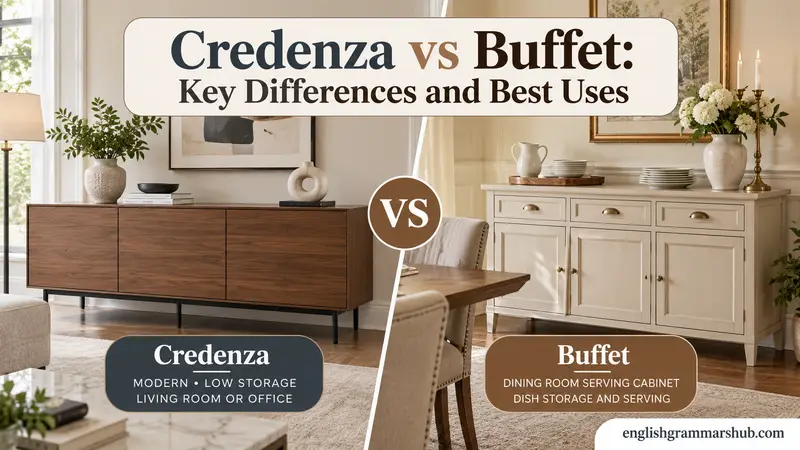
A credenza vs buffet comparison can be confusing because both furniture pieces look similar. They usually have a long, flat top, cabinets or drawers, and plenty of storage space. However, their traditional purposes and common designs are slightly different.
A credenza is generally a lower, streamlined storage cabinet used in living rooms, offices, and sometimes dining rooms. A buffet is usually designed for dining spaces, where it holds dishes, stores table linens, and provides a surface for serving food.
Modern furniture stores often use these names interchangeably. Understanding their differences in height, design, and function can help you choose the right piece for your home.
Quick Answer
The main difference between a credenza and a buffet is their traditional use. A credenza is typically a long, low cabinet designed for general storage and display. A buffet is usually a taller dining room cabinet that provides storage and a convenient surface for serving meals. Both can perform similar jobs, and modern designs often overlap.
Credenza vs Buffet: Key Differences at a Glance
| Feature | Credenza | Buffet |
| Main purpose | General storage and display | Dining storage and food service |
| Common location | Living room, office, dining room | Dining room |
| Typical height | Usually lower | Often taller |
| Overall shape | Long, low, streamlined | Long, with a practical serving surface |
| Storage | Cabinets, shelves, or drawers | Cabinets and drawers for dining essentials |
| Doors | Often sliding or flush, but varies | Often hinged, but varies |
| Leg design | Short legs or a solid base are common | May have more visible legs |
| Design | Often sleek or modern | Traditional or modern |
| Best for | Office supplies, décor, media accessories | Dinnerware, linens, and serving dishes |
| Food serving | Possible if the top is suitable | A traditional primary use |
Key takeaway: Choose a credenza when you want flexible, low-profile storage. Choose a buffet when your main goal is organizing dining items and serving food comfortably.
These are common design patterns, not strict rules. The actual dimensions and features matter more than the product label.
What Is a Credenza?
A credenza is a long, relatively low storage cabinet with a flat top. It usually contains enclosed shelves, drawers, or compartments for keeping household and office items organized.
Credenzas are popular because they offer useful storage without taking up much vertical space. Their horizontal shape also makes them suitable for displaying lamps, artwork, books, and decorative objects.
Common Features of a Credenza
Most credenzas share several design features:
- A wide, flat top for display or everyday use
- Cabinets, drawers, or adjustable interior shelves
- A relatively low profile
- Short legs, a solid base, or another support design
- Wood, metal, glass, or mixed materials
- A simple, decorative, or modern appearance
Some credenzas have sliding doors, while others use traditional hinged cabinet doors.
Where Is a Credenza Used?
A credenza can fit into several rooms.
Living room: Store games, books, electronics, and other items while displaying photographs or decorations on top.
Home office: Keep paperwork, files, office supplies, and small equipment organized.
Dining room: Store dishes, table accessories, and serving items without needing a traditional buffet.
Entryway: Use a credenza to hold household essentials and create a decorative focal point.
For example, a walnut credenza with sliding doors can provide hidden storage in a modern living room while leaving plenty of space above it for wall art.
What Is a Buffet?
A buffet is a dining room storage cabinet traditionally used for holding dinnerware and serving food. It normally features a wide top surface with drawers, cupboards, or shelves underneath.
Buffets are especially useful for families that entertain guests or need extra storage near their dining tables.
Their tops can hold serving platters, beverage pitchers, dishes, and table decorations.
Common Features of a Buffet
A typical buffet may include:
- A broad surface for serving meals
- Cabinets for plates, bowls, and serving dishes
- Drawers for silverware and table linens
- A height suited to standing food service
- Wooden, painted, or mixed-material finishes
- Decorative legs, handles, or cabinet details
Buffets are available in both traditional and contemporary styles.
Where Is a Buffet Used?
The dining room is the most common location for a buffet.
During a family gathering, you can arrange serving dishes on its top while keeping extra plates and utensils inside.
A buffet may also work in a breakfast area or a spacious kitchen.
For example, a buffet placed beside a dining table can hold dinner plates, serving bowls, napkins, and other items needed for family meals.
Credenza vs Buffet: Main Differences Explained
Although both furniture pieces provide storage, their common uses and design priorities differ.
Height and Overall Size
A credenza is often lower than a buffet.
Its shorter design can make a room feel more open, especially when placed beneath artwork or along a large wall.
A buffet generally has a height that makes serving food while standing more convenient.
However, there are no universal height standards for either type. Some credenzas are taller than certain buffets.
When choosing between them, compare the actual measurements rather than relying only on the name.
Storage Design
Credenzas often emphasize flexible storage.
Depending on the model, they may accommodate office supplies, electronics, books, or household items.
Buffets usually focus on dining needs. Their interior spaces may be designed to hold plates, glassware, serving bowls, and table accessories.
A buffet with drawers can be especially convenient for keeping napkins and silverware close to the dining table.
Appearance and Style
Credenzas are often associated with streamlined designs and clean horizontal lines.
Midcentury modern credenzas, for example, may feature wood finishes, simple handles, and tapered legs.
Buffets can also have modern designs, but traditional versions often feature decorative cabinet doors, visible legs, and detailed hardware.
Neither piece belongs to only one decorating style.
Primary Function
The clearest practical difference is how each piece is normally used.
A credenza provides flexible storage and display space across different rooms.
A buffet focuses on dining storage and serving.
That doesn’t mean a credenza cannot hold dinnerware or a buffet cannot display artwork. Their functions frequently overlap.
Credenza vs Buffet Height and Dimensions
Size is one of the most useful things to compare when shopping for these furniture pieces.
The measurements below are approximate shopping guidelines, not fixed furniture standards.
| Measurement | Credenza | Buffet |
| Height | Often 24–32 inches | Often 32–38 inches |
| Width | Varies widely | Varies widely |
| Depth | Often 15–20 inches | Often 16–22 inches |
| Overall profile | Frequently lower | Usually suited to standing use |
Manufacturers offer designs outside these ranges, so always check the listed dimensions.
A particularly important measurement is depth. A cabinet that extends too far into a narrow dining room may leave little space for chairs and foot traffic.
Before buying, measure the available wall space and the floor area needed to open cabinet doors.
Credenza vs Buffet vs Sideboard: Are They the Same?
A sideboard is another storage cabinet that closely resembles both a credenza and a buffet.
In fact, sideboard and buffet are often used as interchangeable names in American furniture stores.
Traditionally, a sideboard provides storage and serving space along a dining room wall. A buffet has a similar purpose, with greater emphasis on food service.
A credenza is also related to these pieces, but the word is often associated with lower cabinets used in offices and living rooms.
| Furniture Type | Traditional Association | Modern Use |
| Credenza | Storage and display cabinet | Offices, living rooms, dining rooms |
| Buffet | Dining room serving cabinet | Meal service and dining storage |
| Sideboard | Dining room storage cabinet | Storage and display in various rooms |
The boundaries between these categories have become less strict.
For example, one furniture company might advertise a cabinet as a modern credenza, while another describes a nearly identical design as a dining room sideboard.
Neither description is necessarily wrong.
Why Are Credenzas and Buffets Often Confused?
Credenzas and buffets are frequently confused because they share several visible features.
Both usually have horizontal shapes, enclosed storage, and flat top surfaces. They may also use similar materials, including oak, walnut, painted wood, and metal.
Modern furniture design has made the difference even less obvious.
A minimalist buffet can look almost identical to a contemporary credenza.
Furniture retailers also use different naming systems. Some classify products by appearance, while others use the room where the cabinet will likely be placed.
As a result, the product name alone cannot reliably tell you its size, construction, or intended function.
The most helpful approach is to examine what the cabinet actually offers.
The History and Origin of Credenzas and Buffets
The words credenza and buffet come from different European language traditions.
Their histories help explain why the furniture pieces have similar purposes today.
Origin of the Word Credenza
Credenza comes from Italian and is connected with the ideas of belief, confidence, and trust.
Historically, the word became associated with the practice of tasting food or drink before serving it to an important person.
Over time, the name was applied to furniture connected with serving and storing dining items.
As furniture styles changed, credenzas developed into practical storage cabinets used in different settings.
Modern American English also uses the term for storage furniture found behind or beside an office desk.
Origin of the Word Buffet
The furniture-related meaning of buffet comes from French.
Historically, buffets were associated with displaying and storing dishes, tableware, and serving items.
The word later became closely connected with food service.
This explains why buffet can refer to both a piece of dining furniture and a meal where people serve themselves.
In American English, the furniture and meal meanings are pronounced approximately buh-FAY.
A separate word, buffet, meaning to strike repeatedly, is pronounced BUFF-it.
Credenza vs Buffet: Which Is Better for a Dining Room?
A buffet is often the more practical choice for a dining room when you regularly serve meals or entertain guests.
Its traditional design focuses on accessible storage and a convenient serving surface.
A credenza may be better when you prefer a lower cabinet or want your dining room furniture to have a streamlined appearance.
Choose a Buffet When:
- You frequently host family dinners.
- You need convenient storage for plates and serving dishes.
- You want a comfortable surface for arranging food.
- You prefer a traditional dining room setup.
- You need drawers for table linens and utensils.
Choose a Credenza When:
- You prefer lower furniture with a sleek appearance.
- Your dining room has a modern or minimalist design.
- You need general-purpose storage.
- You want to display artwork or decorative items above the cabinet.
- You plan to use the furniture in another room later.
Best choice: A buffet is generally better for dedicated dining room service. A credenza works well when flexible storage and a lower profile matter more.
Can You Use a Credenza as a Buffet?
Yes, you can use a credenza as a buffet if it has enough storage and a suitable top surface.
This is a practical option for smaller homes where furniture needs to serve more than one purpose.
For example, a credenza can store dinnerware throughout the week and become a serving station during a weekend gathering.
Before using one this way, consider three important factors.
Surface protection: Use trivets or protective mats beneath hot dishes. Not every furniture finish can handle heat or moisture.
Comfortable height: A low credenza may require guests to bend when serving food.
Storage access: Make sure cabinet doors and drawers can open without interfering with nearby chairs or walking space.
A properly sized credenza can work well in a dining area, even if the manufacturer markets it for living rooms.
Can You Use a Buffet in a Living Room?
Yes, a buffet can work as an attractive storage cabinet in a living room.
Its enclosed compartments can hold board games, books, household accessories, and other items that might otherwise create clutter.
A buffet can also provide a display surface for decorative objects, lamps, or framed photographs.
However, height matters.
A tall buffet may not be suitable for supporting a television because it could place the screen above a comfortable viewing level.
For electronics, check ventilation, cable access, load capacity, and the manufacturer’s installation instructions.
If these requirements are important, a purpose-built media cabinet may be more practical.
How to Choose Between a Credenza and a Buffet
The best choice depends on your room, storage needs, and preferred furniture style.
Consider these practical steps before making a decision.
Measure Your Available Space
Start by measuring the wall where the furniture will stand.
Record the available width, height, and depth.
Check nearby doorways, furniture, and walking paths.
In a dining room, leave enough clearance for people to move comfortably when chairs are pulled away from the table.
Decide What You Need to Store
Think about the items you will keep inside.
For dining essentials, a buffet with roomy cabinets and smaller drawers may be useful.
For office supplies or electronics, a credenza with adjustable shelves or specialized compartments may work better.
Measure any large objects before choosing the cabinet.
Consider Your Furniture Style
Look at the materials, colors, and shapes already present in your room.
A walnut credenza may complement midcentury modern furniture, while a painted buffet with detailed doors may suit a more traditional dining space.
These are style suggestions rather than strict design rules.
Check Construction and Function
Look beyond the cabinet’s appearance.
Check the stability of its base, the quality of its hinges, the smoothness of its drawers, and the strength of its shelves.
Confirm whether the furniture requires wall anchoring or other safety measures.
Also consider how easily you can clean the surfaces and reach stored items.
Compare Features Rather Than Labels
A product called a credenza might offer everything you need for dining storage.
Likewise, a buffet could be the right choice for your hallway or living room.
Compare the dimensions, interior layout, materials, and intended use before deciding.
Common Mistakes When Comparing Credenzas and Buffets
Some furniture shopping mistakes happen because people focus too much on the names.
Assuming every buffet is taller: Buffets often have taller designs, but individual models vary. Always confirm the exact height.
Believing credenzas are only for offices: Credenzas can work in living rooms, dining rooms, entryways, and offices.
Choosing a cabinet based only on appearance: Attractive furniture may still be too deep, too short, or unsuitable for the items you need to store.
Ignoring how doors open: Cabinet doors and drawers need enough room to operate comfortably.
Using any cabinet as a TV stand: Some furniture lacks the required ventilation, cable access, or safe equipment support.
Assuming expensive materials guarantee durability: Construction quality, hardware, maintenance, and everyday use all influence how well a cabinet performs.
Avoiding these mistakes can help you select storage furniture that looks attractive and works well in your space.
Credenza vs Buffet: Examples in Everyday English
Both words are nouns that refer to furniture. Their natural use often reflects the room or purpose being discussed.
Here are some examples.
Credenza Example Sentences
- We placed a walnut credenza beneath the living room window.
- The office credenza holds extra paper, folders, and supplies.
- A modern credenza can provide storage without making the room feel crowded.
- She decorated the top of the credenza with a lamp and framed photographs.
- Our new dining room credenza has adjustable shelves behind its doors.
Buffet Example Sentences
- The buffet holds our plates, serving bowls, and table linens.
- We arranged the dinner dishes on the buffet before the guests arrived.
- A wooden buffet adds extra storage to the dining room.
- They purchased a buffet with drawers for silverware and napkins.
- The dining room buffet has plenty of space for serving holiday meals.
Both terms sound natural in American English. The main difference is what the speaker wants to emphasize.
For example:
- The credenza behind my desk holds important files.
- The buffet beside our dining table stores extra dishes.
The first sentence highlights office storage. The second describes a dining room function.
FAQs
Is a credenza the same as a buffet?
A credenza and a buffet are similar types of storage furniture, but their traditional uses differ. A credenza is generally a lower cabinet for storage and display in various rooms. A buffet is associated with dining room storage and serving food. Modern furniture manufacturers often use the terms interchangeably.
What is the main purpose of a credenza?
A credenza provides enclosed storage and a flat surface for displaying or holding items. People commonly use credenzas in living rooms, dining rooms, and offices. Depending on the design, they may store paperwork, electronics, books, dinnerware, or household accessories.
Is a buffet taller than a credenza?
A buffet is often taller than a credenza, but this is not a fixed rule. Buffets are commonly designed for standing food service, while credenzas tend to have lower profiles. Some modern furniture designs do not follow these traditional differences, so comparing actual dimensions is the most reliable approach.
Can you put a TV on a credenza?
Yes, some credenzas can support a television if their dimensions, construction, and weight capacity are suitable. The cabinet should provide stable support and a comfortable viewing height. For electronics stored inside, adequate ventilation and cable access are also important. Follow the manufacturer’s safety instructions.
Is a buffet the same as a sideboard?
A buffet and a sideboard are closely related dining room storage cabinets. In modern American English, the names are often interchangeable. A buffet usually emphasizes food service, while sideboard is a broader term for storage and display furniture placed against a wall.
Can a credenza be used in a dining room?
Yes, a credenza can work well in a dining room. It can store dishes, glasses, table linens, and serving accessories. Its flat top may also serve as an extra surface during meals. Make sure its height and surface material are appropriate for your intended use.
Which is better for a small room, a credenza or a buffet?
A low-profile credenza may suit a small room because it can create a more open visual appearance. However, a compact buffet could work just as well. The most important factors are the furniture’s actual width, depth, height, storage capacity, and the available space around it.
Conclusion
Understanding credenza vs buffet comes down to purpose, design, and placement.
A credenza is generally a lower, versatile storage cabinet suitable for living rooms, offices, and dining spaces. A buffet is traditionally designed for dining rooms, offering convenient storage and a practical surface for serving meals.
Both pieces can provide attractive and useful storage. Their modern designs also overlap, so neither name guarantees a particular height or style.
For the best choice, measure your room, consider what you need to store, and compare the furniture’s actual features. A cabinet that fits your space and daily routine matters more than its label.


